How Do You Design Companion Planting Beds for Natural Pest Deterrence? (The Science of Companion Planting)

How Do You Design Companion Planting Beds for Natural Pest Deterrence? (The Science of Companion Planting)
The Ecological Vulnerability of Monoculture Beds
When a gardener plants a uniform twenty-foot bed containing nothing but broccoli or cabbage, they believe they are creating an organized, efficient growing space. In the eyes of the natural world, however, that dense row of uniform foliage looks like an open invitation. Nature operates on biodiversity, continuous succession, and biological checks and balances. When you strip away plant diversity to establish an artificial monoculture, you construct an ecological magnet for specialized insect pests.
Pest insects—such as cabbage loopers, flea beetles, and diamondback moths—have evolved over millions of years to track specific plant species across vast landscapes. When they encounter hundreds of square feet of their preferred food source packed together without physical barriers or confusing scent trails, their populations explode exponentially.
In conventional agriculture, growers respond to these predictable outbreaks by reaching for broad-spectrum synthetic chemical pesticides. That response triggers a vicious ecological treadmill. While a chemical spray might knock down 90% of the active caterpillars today, it simultaneously wipes out every ladybug, lacewing, hoverfly, and parasitic wasp hunting in that bed.
Predatory insects reproduce much more slowly than their prey. Within ten to fourteen days, the surviving pests—now free from natural predation—rebound with devastating speed. The grower finds themselves trapped in a costly cycle of chemical dependency, spraying heavier doses while degrading the soil microbiome and washing toxic residues into local waterways.
Companion planting breaks this cycle entirely. Far from being quaint folklore or superstitious gardening lore, genuine companion planting is an applied science rooted in chemical ecology, entomology, and spatial biology. By interplanting diverse botanical families, home gardeners and market growers can scramble pest navigation, lure destructive insects onto sacrificial trap crops, deploy biological nematicides in the rhizosphere, and recruit an army of predatory insects to defend their crops around the clock.
1. Olfactory Masking and Volatile Organic Compounds
To outsmart garden pests, you must understand how they perceive their environment. Insect pests do not locate host plants through acute eyesight; their visual acuity is remarkably crude. Instead, they navigate by detecting microscopic concentrations of airborne Volatile Organic Compounds (VOCs) through sensitive chemoreceptors located on their antennae.
The Chemical Scent Trail
Every plant family emits a distinct chemical signature into the air. A carrot emits specific terpenes and aromatic esters; a brassica releases volatile glucosinolates; an heirloom tomato exudes heavy concentrations of solanine and beta-phellandrene from its glandular trichomes. A carrot rust fly (Psila rosae) can detect the faint airborne scent of a carrot bed from hundreds of yards downwind, locking onto the plume and following it directly to your rows.
When you plant a single block of carrots, that chemical plume rises into the atmosphere like a bold signal flare. But when you interplant those carrots tightly alongside heavily scented alliums—such as yellow storage onions, leeks, garlic, or scallions—the chemical physics change completely.
Scrambling Pest Navigation
Alliums produce intense, sulfurous volatile compounds, primarily diallyl disulfide and allicin. When these sharp sulfur vapors mix with the sweet terpenes emitted by the carrots, they create an olfactory smoke screen.
The carrot rust fly flies straight through the garden without stopping because its antennal receptors are overwhelmed by sulfur molecules. It cannot isolate the delicate signal of the carrot beneath the pungent background noise of the onions.
This passive, chemical deterrence costs nothing in synthetic sprays, leaves zero toxic residues on your food, and operates 24 hours a day in all weather conditions.
Architectural Stacking in the Soil Profile
Beyond scent masking, the carrot-and-onion partnership provides a masterclass in spatial efficiency. Carrots send a thick, tapering taproot deep into the lower soil strata, mining moisture and minerals eight to twelve inches below the surface. Onions, by contrast, possess a fibrous, shallow root system that spreads horizontally within the top three to four inches of topsoil.
Because their root systems occupy entirely different depths, these two crops do not compete for the same moisture reserves or fertilizer fractions. You can plant them in alternating rows spaced barely four inches apart, effectively doubling your harvest yield per square foot while maintaining continuous pest protection.
2. Sacrificial Trap Cropping Mechanics
Sometimes a pest is so aggressive, or a cash crop is so fragrant, that scent masking alone cannot offer complete protection. In these scenarios, experienced growers deploy trap cropping—the strategic planting of sacrificial plants that pests find far more irresistible than the main crop.
Nasturtiums for Aphid Protection
Garden nasturtiums (Tropaeolum majus) are beloved by gardeners for their edible flowers and trailing habit, but their greatest utility is as an elite trap crop for aphid infestations.
Aphids—particularly black bean aphids and green peach aphids—possess an overwhelming preference for the succulent stems and leaves of nasturtiums. When cultivating valuable slicing tomatoes, bell peppers, or English cucumbers, plant a perimeter border of nasturtiums two to three feet away from your primary production beds.
The incoming winged aphids will settle directly onto the tender nasturtium foliage, completely ignoring your fruiting cash crops. The nasturtiums act as a biological sponge, concentrating the infestation into a small, contained area.
When managing a trap crop, human intervention is critical. Do not spray the infested nasturtiums with synthetic pesticides. Instead, allow beneficial ladybugs and hoverfly larvae to colonize the colony. If pest pressure becomes overwhelming, pull the heavily infested nasturtium vines by the roots, seal them in a dark contractor bag to solarize in the sun, and sow fresh nasturtium seeds in their place.
Blue Hubbard Squash: Defending Cucurbits
Growers of summer squash, zucchini, and pumpkins face two devastating adversaries: the squash bug (Anasa tristis) and the squash vine borer (Melittia cucurbitae). A single vine borer larva can tunnel into the crown of a productive zucchini plant, severing its vascular bundles and causing the entire plant to collapse overnight.
Entomological field trials have demonstrated that both squash bugs and vine borers exhibit an intense behavioral preference for Cucurbita maxima varieties—specifically the heritage 'Blue Hubbard' squash—over common Cucurbita pepo varieties like black beauty zucchini or yellow crookneck.
Trap Crop Perimeter Strategy:
[Row of Blue Hubbard Squash] ➔ (Attracts 90% of Borers & Squash Bugs)
   ↕ (10-15 Foot Buffer Zone)
[Main Production Bed: Zucchinis, Cucumbers, Melons] ➔ (Protected & Pristine)
To execute this trap crop protocol:
- Direct-sow Blue Hubbard seeds around the outer margins of your garden two weeks before transplanting your main zucchini and melon crops.
- The large, vigorous Blue Hubbard vines will emerge first, capturing the initial spring flight of overwintered adult vine borer moths and squash bugs.
- Scout the Blue Hubbard leaves every morning to crush bronze squash bug egg masses deposited on the undersides of the foliage.
- Because the pest population remains concentrated on the sacrificial perimeter, your interior summer squash and cucumber rows thrive without chemical treatments.
3. Below-Ground Chemical Defense: Rhizosphere Exudates
Companion planting is not merely an above-ground phenomenon. In the dark, crowded matrix of the rhizosphere—the narrow zone of soil surrounding plant roots—intense biochemical warfare occurs continuously. Roots do not simply absorb water and minerals; they actively exude complex chemical cocktails composed of carbohydrates, amino acids, enzymes, and specialized secondary metabolites.
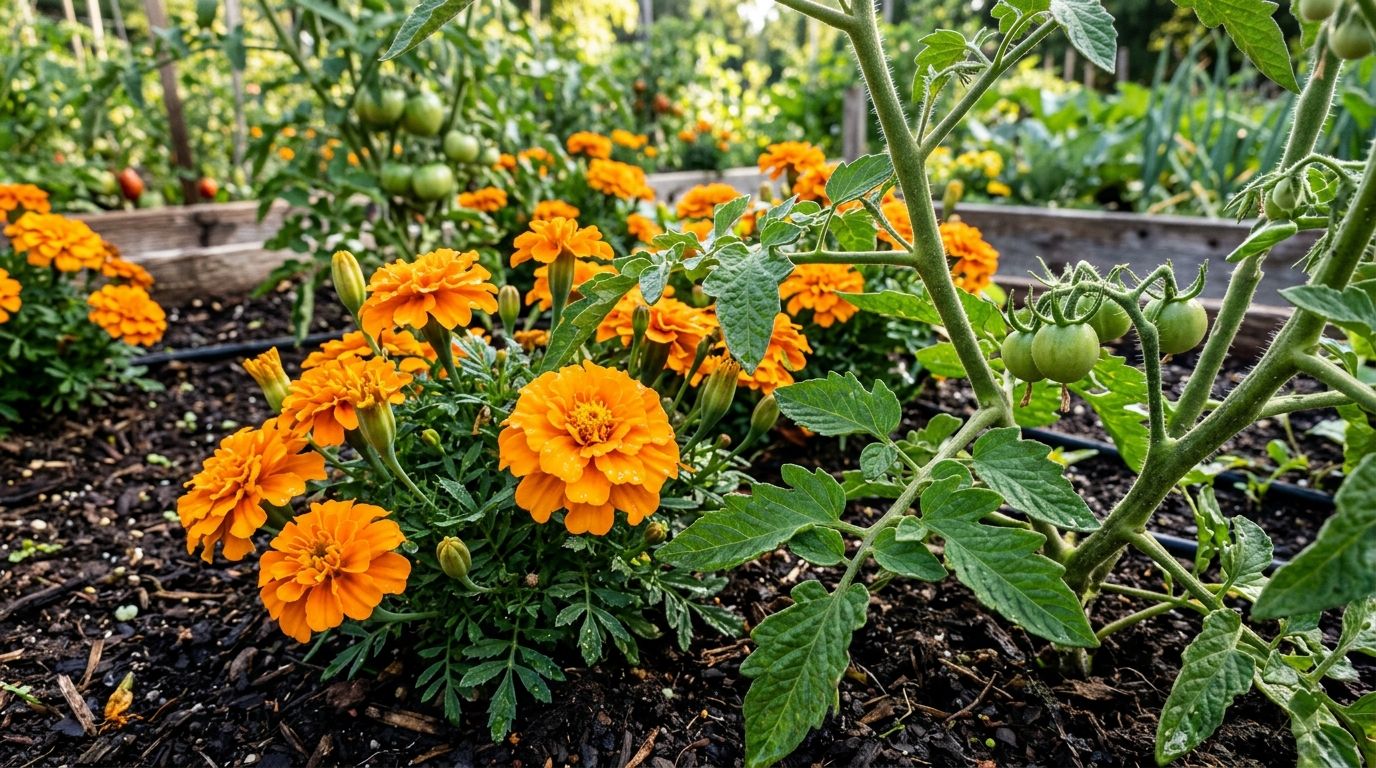
French Marigolds and Root-Knot Nematodes
The most celebrated and scientifically substantiated example of subterranean companion defense involves the French Marigold (Tagetes patula).
Root-knot nematodes (Meloidogyne incognita) are microscopic, parasitic roundworms that inhabit warm, sandy soils, particularly throughout the Southern United States. These microscopic worms burrow into the root systems of nightshades (tomatoes, peppers, eggplants) and cucurbits, injecting hormones that trigger massive, disfigured root galls. These galls strangle the plant's vascular tissue, preventing water and nutrient transport and causing severe midday wilting, stunted growth, and premature plant death.
When French Marigolds grow in the soil, their roots synthesize and release a potent polyacetylene compound called alpha-terthienyl.
When a root-knot nematode encounters alpha-terthienyl in the presence of natural enzymes, the compound generates reactive oxygen species that disrupt the nematode's cellular membranes, killing the pest upon contact.
To maximize this biological nematicidal effect:
- Plant French Marigolds as dense, living borders directly between tomato plants rather than scattering a few lonely blossoms at the corners of the bed.
- For severely infested beds, dedicate an entire midsummer rotation to a dense cover crop of French Marigolds.
- At the end of the season, chop the marigold foliage and incorporate the roots directly into the topsoil. As the marigold biomass decomposes, it releases additional biofumigant compounds that suppress soil-borne pathogens before you establish long-term perennial crops like growing fruit trees.
Allelopathy: When Companion Planting Goes Wrong
Not all root exudates are mutually beneficial. Some plant species produce biochemicals specifically designed to inhibit seed germination and stunt competing vegetation—a biological phenomenon termed allelopathy.
The most notorious allelopathic agent is the Black Walnut tree (Juglans nigra). Black walnut roots, leaves, and nut hulls contain a glucoside called hydrojuglone. When exposed to air or soil microbes, hydrojuglone oxidizes into juglone, a toxic respiratory inhibitor.
Nightshade crops—especially heirloom tomatoes, potatoes, and bell peppers—are acutely sensitive to juglone. If you plant a tomato bed within sixty to eighty feet of a mature black walnut drip line, the tomato roots absorb juglone, triggering irreversible vascular collapse known as "walnut wilt." The plants will wilt, turn yellow, and die within days, regardless of soil moisture levels.
Understanding companion ecology requires knowing which plants are antagonistic just as deeply as knowing which plants form cooperative alliances.
4. Recruiting the Biological Cavalry: Flowering Insectaries
A balanced garden ecosystem does not rely on human intervention to eliminate every single aphid or caterpillar. Instead, it establishes an environment where beneficial predatory insects do the heavy lifting for you.
Predatory insects—including minute pirate bugs, green lacewings, syrphid (hover) flies, and hundreds of species of solitary parasitic wasps—are ruthless carnivores during their larval stages. A single syrphid fly maggot can consume up to 400 aphids before pupating, while a lacewing larva (aptly nicknamed the "aphid lion") devours thrips, spider mites, and small caterpillars with ravenous speed.
The Floral Nectar Fuel Station
There is a biological catch: while their larvae are fierce carnivores, the adult forms of hoverflies, lacewings, and parasitic wasps feed almost exclusively on floral nectar and pollen. They require high-energy carbohydrates to fuel their flight muscles while mating and hunting for egg-laying sites.
Most tiny beneficial insects possess extremely short, delicate mouthparts. They cannot reach inside deep, tubular blossoms like petunias, foxgloves, or morning glories. To support them, a garden must provide shallow, open, nectar-rich flowers.
The Power of Apiaceae (Umbellifers)
The absolute premier companion flowers for predatory insect conservation belong to the Apiaceae (umbellifer) family:
- Dill
- Fennel
- Cilantro (Coriander)
- Parsley
- Queen Anne's Lace
When dill or cilantro bolts in early summer, it sends up large, umbrella-shaped floral clusters composed of hundreds of tiny, exposed florets. These flat platforms allow parasitic micro-wasps (Braconidae and Trichogramma) to land easily and drink nectar.
Once nourished, female parasitic wasps search adjacent brassica beds for cabbage looper caterpillars. Upon finding a caterpillar, the wasp uses its ovipositor to inject microscopic eggs directly inside the pest. The larvae hatch internally, consuming the pest from within and killing it before it can destroy your heading cabbages.
Biological Control Chain:
[Bolting Dill & Cilantro Flowers] ➔ [Supplies Nectar to Adult Parasitic Wasps]
   ➔ [Wasps Lay Eggs in Cabbage Loopers] ➔ [Pest Population Drops to Zero]
Sweet Alyssum: The Living Aphid Shield
Another essential companion flower is Sweet Alyssum (Lobularia maritima). This low-growing, sweet-smelling annual produces carpets of tiny white blossoms that produce nectar continuously from early spring until the first hard autumn freeze.
Commercial organic lettuce growers in California and the Pacific Northwest interplant strips of sweet alyssum every ten rows of salad greens. Academic field research demonstrates that hoverflies flock to these alyssum strips, laying their predatory eggs directly inside the surrounding lettuce heads. When aphids land on the crop, hoverfly larvae consume them immediately, keeping the produce commercially spotless without a single drop of chemical spray. For detailed agronomic databases on pairing specific floral insectaries with regional pests, explore the University of California Statewide Integrated Pest Management Program (UC IPM).
5. Architectural Harmony: The Indigenous Three Sisters
Centuries before Western agricultural science began publishing papers on polycultures, indigenous North American farming communities—most notably the Haudenosaunee (Iroquois) Confederacy—perfected the ultimate companion planting matrix: The Three Sisters.
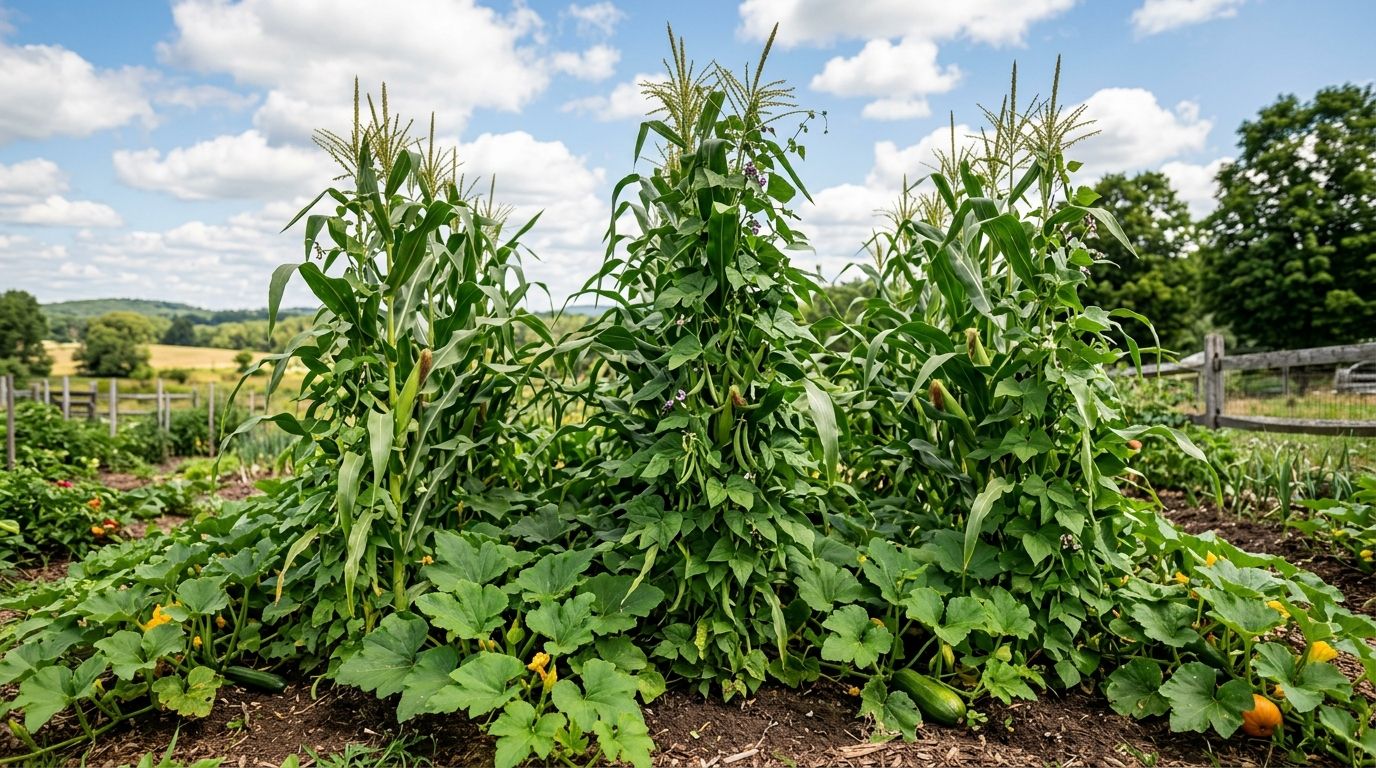
This ancient polyculture combines three core crops—sweet corn, climbing pole beans, and winter squash—into a single, self-sustaining mound. It represents agronomic, mechanical, and biological perfection.
The Structural Roles:
- The Corn (The Living Trellis): Corn is planted first in the center of the mound. It surges upward with a thick, fibrous stalk, creating a natural vertical trellis. This structural element eliminates the need for expensive wooden stakes, metal T-posts, or plastic trellising twine.
- The Pole Beans (The Nitrogen Generator): Two to three weeks after the corn emerges, climbing pole beans are planted at its base. The beans twine up the sturdy corn stalks toward the sunlight. In exchange for structural support, the legume roots form symbiotic partnerships with Rhizobium bacteria in the soil. These specialized bacteria take inert atmospheric nitrogen ($N_2$) and fix it into plant-available ammonium ($NH_4^+$). Because corn is an exceptionally heavy nitrogen feeder, the beans fertilize the corn in real time.
- The Winter Squash (The Living Mulch and Physical Barrier): Squash is planted around the base of the mound. The squash sends out thick vines lined with broad, saucer-like leaves that create a dense canopy over the soil surface. This canopy functions as a living mulch, shading the ground to suppress competing weeds and keeping the soil cool and moist during hot summer droughts. Furthermore, squash leaves and stems are covered in sharp, abrasive trichomes (prickly hairs) that raccoons, deer, and groundhogs dislike walking across, providing a physical barrier around the sweet corn.
Nutritionally, this trio forms a complete human diet. Corn provides complex carbohydrates and dietary energy; beans deliver protein and essential amino acids (methionine and lysine); and winter squash supplies essential vitamin A, minerals, and healthy fats from its seeds.
6. Precision Companion Pairings by Botanical Family
To implement companion planting successfully in your garden, structure your beds around core botanical families and their proven biological companions.
Solanaceae: Tomatoes, Peppers, and Eggplants
- Elite Companions:
- Sweet Basil: Scrambles the scent trail of tomato hornworm moths while concentrating aromatic compounds in adjacent tomato foliage.
- French Marigolds: Releases alpha-terthienyl into the root zone to suppress root-knot nematodes.
- Borage (Borago officinalis): Produces brilliant star-shaped blue flowers rich in potassium that attract bumblebees for buzz-pollination, maximizing fruit set.
- Garlic and Chives: Deter spider mites and aphids through continuous sulfur vapor emission.
- Harmful Antagonists:
- Fennel: Releases chemical exudates that stunt tomato vine vigor and reduce fruit sizing.
- Potatoes: While in the same botanical family, interplanting potatoes directly with tomatoes increases susceptibility to early and late blight (Phytophthora infestans).
- Brassicas: Heavy nutrient competition depletes available nitrogen and calcium, leading to blossom-end rot.
Brassicaceae: Cabbage, Broccoli, Cauliflower, and Kale
- Elite Companions:
- Thyme and Rosemary: Pungent Mediterranean oils disguise the scent of brassicas, preventing cabbage white butterflies from laying eggs.
- Sage: Confuses flying flea beetles and attracts predatory braconid wasps when allowed to flower.
- Dill and Cilantro: Essential umbellifer nectar stations for parasitic micro-wasps.
- Bush Beans: Fixes nitrogen in the soil to feed heavy-feeding brassicas without excessive foliage crowding.
- Harmful Antagonists:
- Tomatoes and Peppers: Severe competition for soil calcium and nitrogen leads to poor head formation.
- Strawberries: Can harbor fungal pathogens that transfer readily to brassica root systems.
Cucurbitaceae: Cucumbers, Melons, and Squashes
- Elite Companions:
- Radishes: Planted liberally around the base of cucumbers and squashes, pungent radish foliage deters striped and spotted cucumber beetles (Acalymma vittatum).
- Oregano: A spreading ground cover that repels squash bugs with strong carvacrol and thymol oils.
- Sunflowers: Serves as a sturdy living windbreak and vertical trellis for climbing cucumber varieties.
- Harmful Antagonists:
- Aromatic Potatoes: Release moisture-retaining compounds that promote powdery and downy mildew outbreaks across dense cucurbit vines.
Fabaceae: Snap Peas and Green Beans
- Elite Companions:
- Summer Savory: Repels the destructive Mexican bean beetle (Epilachna varivestis) while imparting subtle aromatic flavor to pole bean beds.
- Sweet Corn: Acts as a living structural trellis.
- Carrots and Radishes: Deep taproots loosen the subsoil, allowing legume root nodules to expand freely.
- Harmful Antagonists:
- Alliums (Onions, Garlic, Leeks, Scallions): Allium root exudates produce sulfur compounds that inhibit the nitrogen-fixing Rhizobium bacteria on legume roots, stunting bean growth and lowering yields.
7. Dynamic Accumulators and Subsoil Mineral Mining
Companion planting extends beyond insect management into long-term nutrient cycling. Specialized plants known as "dynamic accumulators" use deep taproots to mine essential minerals from deep subsoil layers that shallow-rooted garden crops cannot reach.
Comfrey: The Potassium Mine
Russian Comfrey (specifically the sterile Bocking 14 cultivar, Symphytum x uplandicum) develops a thick taproot capable of driving ten to fifteen feet straight down into dense subsoil clays.
Along this vertical journey, comfrey absorbs high concentrations of potassium, calcium, magnesium, and trace micronutrients, storing them inside its broad, succulent leaves.
Growers do not plant comfrey directly inside raised beds, where its vigorous crown could crowd out delicate lettuces. Instead, comfrey is planted as a permanent buffer along garden margins or beneath fruit tree drip lines.
Throughout the growing season, gardeners perform "chop-and-drop" management:
- Cut the comfrey foliage down to two inches above soil level three to four times per season using a sickle or hedge shears.
- Lay the fresh comfrey leaves directly across the soil surface around heavy fruiting crops like heirloom tomatoes, peppers, and eggplants.
- As the comfrey leaves break down, they release bio-available potassium directly into the topsoil, fueling blossom formation and sweet fruit sizing without commercial chemical fertilizers.
Daikon Radish: Biological Subsoil Aeration
If your garden suffers from compacted, dense clay that impedes root development, turn to companion bio-drilling with the Daikon radish (often called Tillage Radish).
In late summer or early fall, sow a dense cover of Daikon radishes alongside winter Austrian peas. The daikon taproot drives twelve to eighteen inches through hardpan clay like a biological drill bit.
When freezing winter temperatures arrive, the frost terminates the radishes. Over the winter months, the thick roots decompose in place, leaving behind deep, open vertical channels lined with biologically active organic matter. In spring, you can plant tomatoes or peppers directly into those aerated channels, allowing roots to penetrate deep into the moisture-rich subsoil without any heavy tilling.
8. Designing a Balanced Garden Layout: Rules of Spacing and Airflow
A companion planting plan that looks great on paper can still fail in practice if basic horticultural physics are ignored. When you combine multiple crops in a single bed, spatial geometry and fungal management become essential.
Managing Air Circulation
Interplanting increases plant density, which can restrict air movement through the garden bed. In humid summer climates, stagnant air combined with dense foliage creates an ideal environment for fungal pathogens like powdery mildew, early blight, and septoria leaf spot.
To maintain healthy airflow:
- Prune Indeterminate Vines: When interplanting basil and marigolds beneath heirloom tomatoes, prune the bottom twelve to eighteen inches of tomato foliage off the central stem. This "clearing the understory" allows air to sweep across the soil surface, drying out dew and preventing fungal spores from splashing up onto the leaves.
- Orient Beds to Prevailing Winds: Align your planting rows parallel to dominant summer breezes rather than perpendicular to them. This orientation channels natural wind currents down the paths and between companion rows.
Preventing Light Competition
Always account for mature plant height when designing companion beds. A towering block of sweet corn or a trellis covered in pole beans will cast a long, dense shadow to its north and west.
Follow this standard rule of thumb:
- Plant your tallest companions (corn, trellised pole beans, sunflowers) on the North or East side of the bed.
- Place mid-sized crops (peppers, bush beans, brassicas) in the Center.
- Position low-growing companions (carrots, onions, sweet alyssum, thyme) on the South or West edge where they will receive uninterrupted sunlight throughout the day.
9. Separating Agronomic Science from Folklore
Because companion planting has a rich history in home gardening, it has accumulated its share of unscientific myths. Distinguishing biological facts from anecdotal claims prevents wasted time and disappointing harvests.
Folklore vs. Proven Science:

Myth: "Planting marigolds anywhere in your garden instantly repels all bugs."
Science: Marigolds control root-knot nematodes through root exudates in the soil. Above ground, they provide modest scent masking, but will not prevent hornworms or beetles on their own.

Myth: "Companion planting completely eliminates the need for garden maintenance or pest scouting."
Science: Polycultures raise pest thresholds and recruit beneficial predators, but unexpected weather stress or severe infestations still require monitoring and physical removal.

Myth: "All plants that taste good together on a dinner plate must grow well together in a bed."
Science: Culinary compatibility does not guarantee botanical compatibility. While tomato and basil thrive together, other culinary pairings compete for identical nutrients or harbor shared diseases.
By approaching companion planting with scientific discernment, you build a resilient, productive garden that harnesses natural biochemical processes to defend your harvest.
Conclusion: From Factory Farming to Ecological Stewardship
Companion planting represents a fundamental shift in agricultural mindset. It marks the transition from viewing a garden bed as a sterile factory floor to honoring it as an interconnected living ecosystem.
When you interplant fragrant alliums with crisp carrots, weave French marigolds around sun-ripened tomatoes, and allow dill to produce open nectar platforms for parasitic wasps, you stop fighting nature with chemical sprayers. Instead, you align your gardening practices with millions of years of evolutionary design.
The payoff is undeniable: a resilient garden filled with living biology, free from toxic chemical residues, alive with pollinators, and producing wholesome, nutrient-dense food for your household season after season.
Expert Insights & FAQs
What is the best companion plant for tomatoes?
Sweet basil and French Marigolds are the premier companion plants for tomatoes. Basil disguises the scent of tomato vines from flying hornworm moths and enhances aromatic foliage development, while French Marigolds release alpha-terthienyl from their roots into the soil, suppressing destructive root-knot nematodes.
Does companion planting actually work, or is it an unproven gardening myth?
Companion planting is backed by peer-reviewed chemical ecology and agronomy. While certain folk traditions are anecdotal, proven biological mechanisms include olfactory masking (such as alliums confusing carrot rust flies), trap cropping (nasturtiums attracting aphids), and rhizosphere exudate pest suppression.
What plants should never be planted next to tomatoes?
Avoid planting tomatoes adjacent to heavy-feeding brassicas (cabbage, broccoli) due to intense calcium and nitrogen competition. Keep tomatoes well away from Black Walnut trees due to lethal juglone root toxicity, and avoid potatoes because they share vulnerability to early and late blight.
How do nasturtiums act as a trap crop for garden pests?
Nasturtiums produce succulent, fragrant foliage that aphids prefer over valuable crops like tomatoes or cucumbers. By planting nasturtiums as a perimeter buffer, incoming aphids congregate on the sacrificial flowers, allowing gardeners to remove heavily colonized vines before cash crops are damaged.
Why are dill, cilantro, and fennel beneficial in vegetable gardens?
When allowed to bolt and flower, umbellifer herbs like dill, cilantro, and fennel produce broad, shallow flower clusters. These accessible platforms provide nectar and pollen for beneficial insects with tiny mouthparts, especially parasitic micro-wasps, hoverflies, and lacewings that hunt caterpillars and aphids.
What is the traditional Three Sisters planting layout?
The Three Sisters is an indigenous polyculture pairing corn, climbing pole beans, and winter squash. Tall corn stalks provide a living trellis for climbing beans; bean root nodules fix atmospheric nitrogen to feed nitrogen-hungry corn; and broad, prickly squash leaves form a living mulch that shades weeds and retains soil moisture.
Do marigolds really deter pests in the garden?
Yes, primarily below ground. French Marigolds (*Tagetes patula*) synthesize alpha-terthienyl in their roots, which functions as a potent biological nematicide against microscopic root-knot nematodes. Above ground, their pungent aroma offers secondary masking against airborne insects.
Why should gardeners never plant onions and peas together?
Alliums (onions, garlic, leeks, scallions) release sulfur-based root exudates and volatile oils that inhibit the symbiotic *Rhizobium* bacteria living on legume root nodules. This chemical interference stunts pea and bean growth, preventing effective nitrogen fixation.
Johnnie McCormick
Zone 7b/8a - North Central Alabama
Johnnie McCormick is a gardening hobbyist and the founder of My Garden Spot. Raised in north-central Alabama, his passion for gardening began in his youth. In 2008, he established a large market garden, teaching himself high-yield growing methods. In the years since, he has operated seasonal seedling sales for transplants, specializing in heirloom tomatoes, peppers, eggplants, decorative ground covers like Ajuga (Bugleweed), marigolds, nasturtiums, and fresh kitchen-window herb arrangements (basil, cilantro). Today, he gardens in the hills between Birmingham and Jasper, Alabama (Zone 7b/8a), sharing practical, community-focused gardening resources.
Verified Authoritative Citations & References
In alignment with our strict E-E-A-T research and verification guidelines, this guide cross-references data from the United States Department of Agriculture (USDA) and Cooperative Extension Service programs.
- USDA Natural Resources Conservation Service (NRCS): Soil Quality and Cation Exchange Capacity technical references. nrcs.usda.gov
- Cornell Cooperative Extension: Home Gardening Guide, Vegetable Varieties, and High-Yield Greenhouse management sheets. gardening.cals.cornell.edu
- Penn State Extension: Master Gardener Manual, Soil Buffering Ratios, and Small Farm Economics research documents. extension.psu.edu
- Alabama Cooperative Extension System (ACES): Soil testing procedures, compost formulation standards, and regional planting guidelines. aces.edu
Please log in to view comments.