Heirloom History: The Story Behind the Cherokee Purple Tomato

Heirloom History: The Story Behind the Cherokee Purple Tomato
If you walk into a standard supermarket and look at the tomato display, you will see a mountain of perfectly spherical, bright red, identical orbs. They look flawless. But when you slice them open, the interior is often pale, mealy, and completely devoid of flavor. They were bred for one singular purpose: to survive being packed into a cardboard box and shipped three thousand miles on a semi-truck without bruising.
The Cherokee Purple tomato is the absolute antithesis of the supermarket tomato.
Visually, it is often described as "ugly." It is lumpy, deeply lobed, and prone to severe cracking at the stem. The color is not red; it is a bruised, dusky rose-purple, often with dark green, almost black "shoulders" at the top.
But the moment you slice a Cherokee Purple open with a serrated knife, the visual imperfections are instantly forgiven. The interior flesh is a deep, rich crimson. It is incredibly dense, juicy, and visually striking, with a dark green gel encasing the seeds. And then, you taste it.
The Cherokee Purple possesses a flavor profile that is unmatched in the botanical world. It is aggressively sweet, balanced by a sharp, acidic tang, and finished with an incredibly deep, rich, almost "smoky" or "earthy" undertone. It tastes like a real tomato is supposed to taste.
For the small-scale market gardener, the Cherokee Purple is the ultimate premium crop. Customers who have tasted a true heirloom tomato will stalk your farmers market stand, arriving twenty minutes before the market opens just to ensure they secure their weekly supply, happily paying top dollar per pound.

The Lore and History of the Seed
The modern history of the Cherokee Purple tomato begins in 1990 with a man named Craig LeHoullier, a retired chemist and passionate heirloom tomato collector living in Raleigh, North Carolina.
LeHoullier received an unsolicited letter in the mail from a man in Tennessee named J.D. Green. Inside the envelope were a few dozen tomato seeds. Green wrote that the seeds had been given to him by a neighbor, and the neighbor claimed the seeds had originally been given to his family by members of the Cherokee Nation over a hundred years prior.
Intrigued, LeHoullier planted the seeds. When the fruit ripened to its distinct, dusky purple-brown color, and he tasted the incredible, smoky complexity of the flesh, he realized he was holding a botanical masterpiece. LeHoullier named the variety "Cherokee Purple" and sent the seeds to the Southern Exposure Seed Exchange, introducing it to the commercial market.
Today, it is considered one of the "holy grail" heirloom tomatoes, standing shoulder-to-shoulder with the Brandywine and the Mortgage Lifter. To dive deeper into the incredible history of heirloom seed preservation, the Seed Savers Exchange provides an unparalleled archive of agricultural heritage.
Seed Starting and Greenhouse Management
You cannot direct-seed tomatoes into the garden. By the time the soil warms up enough for the seed to germinate, you will not have enough frost-free days left in the season for the plant to produce mature fruit.
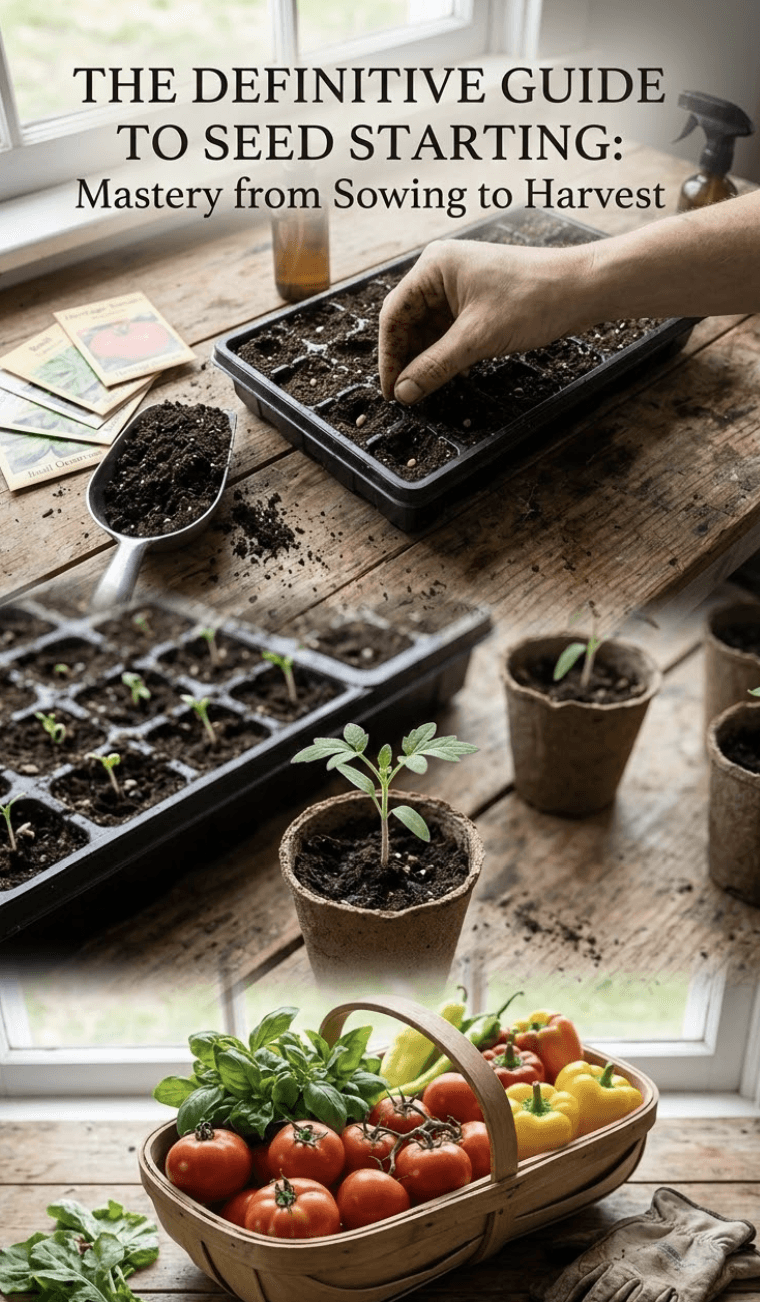
You must start the seeds indoors or in a heated greenhouse six to eight weeks before your last spring frost date.
Tomato seeds require significant heat to germinate efficiently. If you put the seedling trays in a cold, 60°F room, the seeds will sulk, rot, or take three weeks to emerge. You must use electric seedling heat mats to hold the soil temperature at a constant 80°F (27°C). Under these conditions, the Cherokee Purple seeds will explode out of the dirt in five to seven days.
Once the seedlings have developed their first set of "true leaves," they must be potted up into larger containers (usually 3-inch or 4-inch pots). Heirloom tomatoes grow massive, aggressive root systems very early. If you leave them in a tiny cell tray for too long, they will become "root-bound." The taproot will circle the bottom of the plastic cell, choking itself. A root-bound tomato seedling is permanently stunted and will never achieve its maximum yield potential in the field.
Field Preparation and Calcium Management
The Cherokee Purple is an indeterminate tomato.
Unlike a "determinate" bush tomato that grows to a set height of three feet, produces all its fruit at once, and dies, an indeterminate tomato is a vining plant. It will continue to grow taller and produce new flowers until the first hard frost of autumn kills it.
Because it is a massive, long-lived plant, it requires incredibly rich, deeply amended soil. Before transplanting, you should heavily top-dress the bed with finished compost and a balanced organic fertilizer.
More importantly, you must ensure your soil has adequate bio-available calcium. Heirloom tomatoes are notorious for developing Blossom End Rot—a physiological disorder where the bottom of the tomato turns black, sunken, and leathery. This is not a fungal disease; it is a localized calcium deficiency in the fruit tissue.
While adding gypsum or agricultural lime to the soil can help, the most common cause of Blossom End Rot is actually fluctuating soil moisture. Calcium is transported into the plant through water. If the soil dries out completely, the calcium transport shuts down, and the rapidly expanding fruit at the top of the plant is starved of calcium, causing the cells to collapse.
Consistent, deep watering via drip irrigation is mandatory.
Trellising: Taming the Beast
A healthy Cherokee Purple tomato plant can easily reach ten or twelve feet in height over the course of a long summer. You cannot simply stick a flimsy three-foot wire tomato cage from a big-box hardware store into the ground and expect it to hold the plant. The cage will collapse under the weight of the fruit within a month.
You must implement a heavy-duty commercial trellising system.
If you are growing outdoors in the field, the Florida Weave (also known as the Basket Weave) is the most efficient method. You drive heavy steel T-posts deep into the ground every three plants. As the tomatoes grow, you weave heavy synthetic baling twine back and forth between the posts, essentially sandwiching the tomato plants between two tight walls of string.
If you are growing in a high tunnel greenhouse, the Lower and Lean system (using roller hooks and drop strings suspended from the ceiling) is the ultimate method for maximizing yield, allowing the vine to grow thirty feet long over the course of the season.
The Pruning Imperative
Because the Cherokee Purple is a vigorous indeterminate heirloom, it will attempt to grow into a massive, sprawling, impenetrable jungle of leaves.
You must aggressively prune the plant to maintain a single central leader (or at most, two leaders).
Every time a main leaf branch meets the central stem, the plant will push out a new, secondary shoot right in the "crotch" of that joint. These are called suckers. If you let a sucker grow, it will become a massive new branch, producing its own flowers and its own suckers.
You must walk your tomato rows twice a week, locating these suckers while they are small, and physically snapping them off with your thumb and index finger.
By pruning the plant to a single vine, you force the plant to channel all of its metabolic energy into sizing up the fruit on the main stem, rather than wasting energy growing a thousand tiny, insignificant branches.
More importantly, pruning creates massive airflow through the canopy.
Mitigating Early Blight and Septoria
Heirloom tomatoes have zero genetic resistance to fungal pathogens. They are incredibly susceptible to Early Blight (Alternaria solani) and Septoria Leaf Spot.
These fungal spores live in the soil. When it rains, the water droplets splash the mud (and the spores) up onto the lowest leaves of the tomato plant. Once the fungus establishes on the lower leaves, it rapidly works its way up the plant, turning the foliage yellow, brown, and crispy, eventually defoliating the entire plant and exposing the fruit to severe sunscald.
Pruning is your first line of defense. By maintaining a single leader, the wind can easily blow through the row, drying the morning dew off the leaves rapidly. Fungal spores require stagnant, wet leaves to germinate.
Secondly, you must perform bottom pruning. Once the plant is three feet tall, you must use sterile pruners to completely cut off the lowest 12 to 18 inches of leaves, creating a physical gap between the soil and the foliage. This severely limits the ability of the soil-borne spores to splash up onto the plant.

Harvesting and the Flavor Profile
Harvesting a Cherokee Purple tomato requires a delicate touch and a keen eye.
Do not wait for the tomato to become completely soft and mushy on the vine. And do not expect the entire tomato to turn uniformly purple. The "shoulders" (the top area near the stem) of a Cherokee Purple will often remain stubbornly green, even when the rest of the tomato is perfectly ripe.
You must harvest based on the "break" in color and a slight, yielding pressure when you gently squeeze the bottom of the fruit. If you wait for the green shoulders to turn purple, the bottom of the tomato will be completely overripe and rotting.
When you bring a Cherokee Purple to a farmers market, you must handle it like a fragile glass ornament. The skin is incredibly thin—which is part of what makes it so wonderful to eat, but it also makes it highly susceptible to bruising.
When you finally slice into a Cherokee Purple, do not ruin it by putting it in the refrigerator. Cold temperatures permanently destroy the volatile flavor compounds in a tomato, turning the texture mealy and the flavor dull. Keep it on the counter at room temperature.
Slice it thick, hit it with a pinch of flaky sea salt, and place it on a piece of toasted sourdough bread with a smear of high-quality mayonnaise. That single sandwich will justify every ounce of labor, every pruned sucker, and every drop of sweat you poured into the soil over the last five months. It is the undisputed king of the summer garden.
Expert Insights & FAQs
What does "Potato Leaf" vs. "Regular Leaf" mean, and which is the Cherokee Purple?
Tomato plants generally have two leaf types. "Regular leaf" varieties have serrated, jagged edges (like a classic tomato leaf). "Potato leaf" varieties have smooth, solid edges, resembling the leaves of a potato plant. The original, true Cherokee Purple is a "regular leaf" variety.
Should I pick off the flowers that form on my small seedlings before I transplant them?
Yes. If your seedling is still in its little nursery pot and starts forming yellow flowers, gently pinch them off. You want the young plant to focus 100% of its biological energy on growing a massive root system and leafy frame when you first put it in the ground, not on trying to ripen a tiny, premature tomato.
Can I save the seeds from my Cherokee Purple to plant next year?
Absolutely! Because the Cherokee Purple is an open-pollinated heirloom (not a hybrid), its seeds will grow "true to type." If you ferment, dry, and save the seeds from a healthy tomato this year, they will grow into identical Cherokee Purple plants next spring.
How long does it take for a Cherokee Purple to produce fruit?
It is a relatively late-season tomato. It typically takes about 80 to 90 days from the day you transplant the seedling into the garden until you are harvesting your first fully ripe tomato. Patience is required!
Are Cherokee Purple tomatoes more susceptible to disease than store-bought varieties?
Generally, yes. Modern hybrid tomatoes are specifically bred in labs to resist common garden diseases like Verticillium wilt and Fusarium wilt. Heirlooms like the Cherokee Purple do not have those bred-in genetic resistances. You must be proactive: use mulch to prevent soil splashing, prune for good airflow, and water only at the base of the plant.
Why do my Cherokee Purple tomatoes keep splitting open before they are ripe?
Splitting and cracking are caused by erratic watering. If the soil dries out and is suddenly flooded with a heavy watering or a rainstorm, the inside of the fruit swells faster than the thin heirloom skin can stretch. Maintain consistent, even soil moisture and use a thick layer of organic mulch to prevent this.
Can I grow a Cherokee Purple tomato in a container on my patio?
Yes, but you need a massive container. Because it is a vigorous indeterminate vine with an expansive root system, a standard 5-gallon bucket will not cut it. You need a container that holds a minimum of 15 to 20 gallons of high-quality potting soil, and you still must provide a heavy-duty trellis or stake for it to climb.
Why are the tops of my Cherokee Purple tomatoes still green even though the bottom is soft?
Do not panic! This is completely normal and is a genetic hallmark of the Cherokee Purple. They are famous for retaining "green shoulders" even when the fruit is fully ripe, soft, and ready to eat. If you wait for the top to turn completely purple, the rest of the tomato will be an overripe, mushy disaster.
Johnnie McCormick
Zone 7b/8a - North Central Alabama
Johnnie McCormick is a gardening hobbyist and the founder of My Garden Spot. Raised in north-central Alabama, his passion for gardening began in his youth. In 2008, he established a large market garden, teaching himself high-yield growing methods. In the years since, he has operated seasonal seedling sales for transplants, specializing in heirloom tomatoes, peppers, eggplants, decorative ground covers like Ajuga (Bugleweed), marigolds, nasturtiums, and fresh kitchen-window herb arrangements (basil, cilantro). Today, he gardens in the hills between Birmingham and Jasper, Alabama (Zone 7b/8a), sharing practical, community-focused gardening resources.
Verified Authoritative Citations & References
In alignment with our strict E-E-A-T research and verification guidelines, this guide cross-references data from the United States Department of Agriculture (USDA) and Cooperative Extension Service programs.
- Cornell Cooperative Extension: Home Vegetable Gardening Guide and vegetable variety recommendations. gardening.cals.cornell.edu
- Penn State Extension: Master Gardener Manual and companion planting matrices. extension.psu.edu
- Alabama Cooperative Extension System (ACES): Raised bed construction plans and regional seed planting calendars. aces.edu
- USDA NRCS: Cover crops and biological soil health guidelines. nrcs.usda.gov

Please log in to view comments.