How Do You Transition from a Backyard Hobby Gardener to a Commercial Market Gardener on a Quarter Acre?

How Do You Transition from a Backyard Hobby Gardener to a Commercial Market Gardener on a Quarter Acre?
Every market grower I have ever known started as an enthusiastic backyard gardener who fell completely in love with growing food. You start with three timber raised beds, marvel at your first homegrown Cherokee Purple slicing tomato, and within two summers, your backyard is overflowing with squash, pole beans, and leafy greens. Your neighbors stop answering the door in August because they cannot absorb any more free zucchini. You start daydreaming at your office desk about turning your green thumb into a legitimate enterprise.
Stepping across the threshold from passionate hobbyist to commercial market gardener is not simply a matter of planting more seeds. It is a fundamental operational transformation. In a backyard garden, your primary metric is personal enjoyment; an unproductive squash plant or a weed patch in late July is merely an aesthetic annoyance. On a commercial quarter-acre micro-farm, your metric is revenue per square foot, labor efficiency per bed-foot, and consistent, unbroken harvest cycles.
A quarter of an acre encompasses 10,890 square feet. Deduct space for vehicle access, perimeter fencing, a tool shed, a seedling propagation nursery, and a post-harvest wash-pack station, and you are left with roughly 6,000 to 7,500 square feet of actual growing area. Handled poorly, that quarter-acre will break your back, devour your savings, and yield nothing more than frustration. Designed with mechanical discipline, standardized bed geometry, and biological soil fertility, that same footprint can reliably produce between $25,000 and $45,000 in gross annual revenue.
Back in 2008, when I expanded my own home plot into our first commercial beds down here in Alabama, I learned these lessons the hard way. I planted dozens of diverse heritage varieties with zero thought toward uniform harvest windows, dragged garden hoses around until my knuckles bled, and washed salad greens in plastic kitchen colanders until midnight before Saturday market. This guide is the precise operational blueprint I wish someone had handed me twenty years ago—covering everything from spatial geometry and tool capitalization to crop revenue math, wash-pack engineering, and commercial customer acquisition.
The Fundamental Mindset Shift: Production Economics vs. Garden Variety
The most dangerous pitfall for an aspiring grower is attempting to scale a hobby garden layout into a business. In a home kitchen garden, biological diversity is celebrated for its own sake. You might plant six different tomato varieties, three kinds of winter squash that trail across walkways, and a patch of sweet corn that occupies prime sunny ground for ninety days only to yield a handful of ears.
Commercial agriculture demands ruthless spatial efficiency. Every square foot of cultivated soil represents capital expenditure and ongoing human labor. If a bed is not actively producing a crop, germinating a succession, or resting under a weed-suppressing occultation tarp, it is losing money.
Calculating Bed-Foot Economics
Commercial growers measure their operations in "bed-feet"—the linear length of a standardized bed. On a quarter-acre layout using standard 50-foot beds, you will manage between 30 and 45 active production beds.
To build a viable commercial model, you must categorize crops by their gross revenue density and days to maturity (DTM):
| Crop Category | Example Crops | Days to Maturity (DTM) | Realistic Yield / 50-ft Bed | Gross Revenue / Bed / Cut | Annual Rotations / Bed | Annual Potential / Bed |
|---|---|---|---|---|---|---|
| Quick-Turn Leafy Greens | Salanova lettuce, mesclun mix, arugula | 28–42 days | 25–35 lbs | $250–$350 ($10/lb) | 4 to 6 | $1,000 – $2,100 |
| High-Density Root Crops | French breakfast radishes, baby Tokyo turnips | 24–35 days | 100–120 bunches | $300–$360 ($3/bunch) | 3 to 5 | $900 – $1,800 |
| Fruiting Solanaceous | Indeterminate heirlooms, bell peppers | 75–100 days | 150–250 lbs | $600–$1,000 ($4/lb) | 1 (long season) | $600 – $1,000 |
| Culinary Herbs | Italian flat-leaf parsley, Genovese basil | 45–60 days (cut-and-come) | 40–60 bunches | $120–$180 ($3/bunch) | Multi-cut (6–8 cuts) | $720 – $1,440 |
| Space Hogs (Avoid on 1/4 Acre) | Sweet corn, winter squash, pumpkins | 90–120 days | 50–70 units | $100–$150 | 1 | $100 – $150 |
When you analyze this matrix, the commercial path becomes crystal clear. A bed dedicated to sweet corn occupies valuable soil for four months and yields $120 in total revenue. That exact same bed, planted in quick-turn baby greens or French breakfast radishes using precision succession planting, can be harvested, cleared, and replanted five times between March and November, generating upwards of $1,800.
As a commercial grower, your baseline target should be generating a minimum of $1,200 to $2,000 in gross revenue from every single standardized 50-foot bed over the course of the growing year.
Spatial Engineering: The 30-Inch Standardized Permanent Bed System
If you take only one technical concept from this guide, let it be this: standardization is the engine of farm profitability.
Backyard gardeners build beds of arbitrary widths—some three feet wide, some four feet wide, some bordered with treated landscape timbers, others built from stacked cinder blocks. In a commercial enterprise, uneven bed dimensions destroy operational efficiency. You cannot standardize insect netting, you cannot use fixed-width cultivation tools, and you waste endless hours re-measuring drip lines.
Why Thirty Inches Is the Global Industry Benchmark
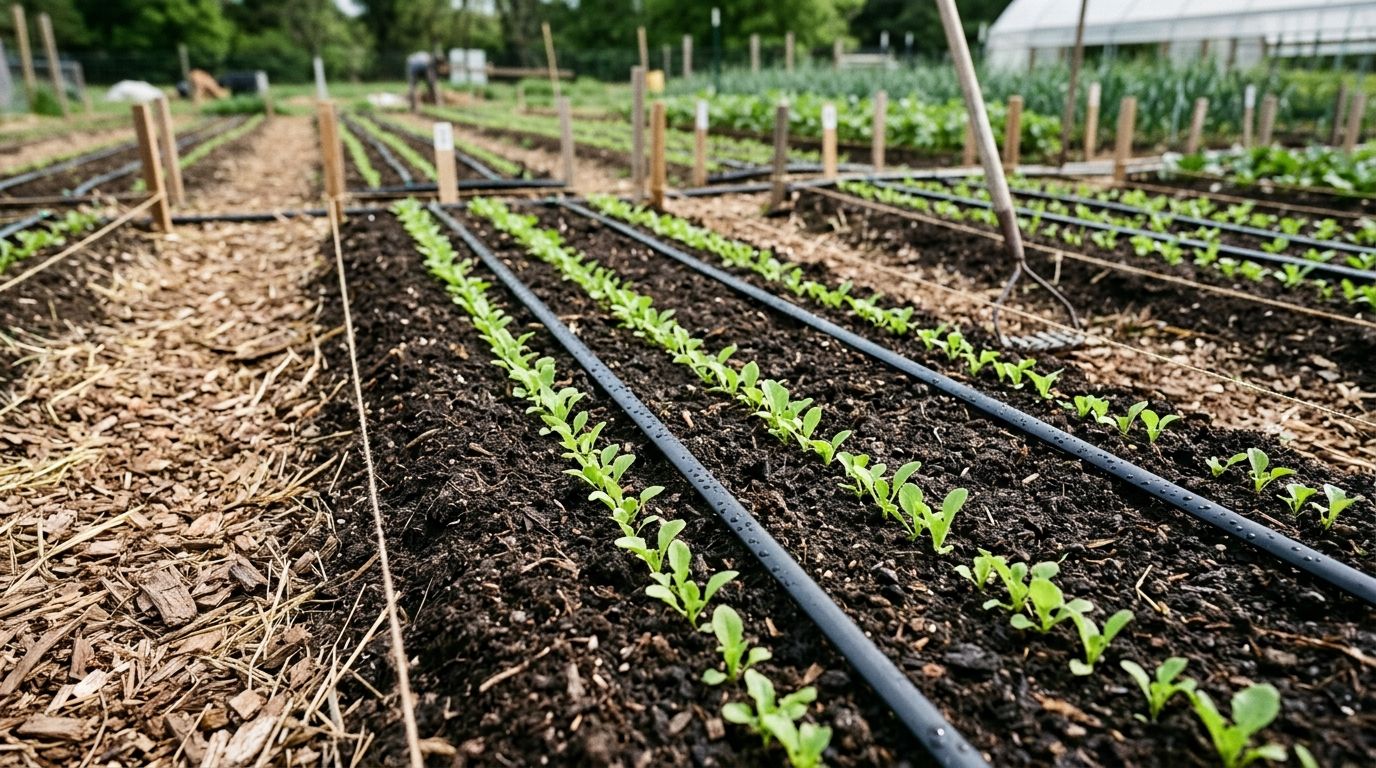
Pioneered by market gardening innovators like Eliot Coleman and Jean-Martin Fortier, the 30-inch bed top width (with 18-inch walkways) has become the universal standard for human-scale biointensive agriculture.
There are clear physiological and mechanical reasons for this exact dimension:
- Ergonomic Straddling: A 30-inch bed allows a human worker to comfortably straddle the growing row with one foot in each pathway without hyperextending hip joints or straining knees. Hand weeding, precision seeding, and harvesting can occur from either side without stepping on the cultivated bed top.
- Tool Compatibility: The entire catalog of professional market gardening equipment—including the broadfork, the flame weeder, the Tilther, the Jang precision seeder, the wire weeder, and the Paperpot transplanter—is engineered specifically for 30-inch bed tops.
- Walkway Efficiency: An 18-inch walkway is wide enough to push a heavy, produce-laden two-wheel wheelbarrow or carry harvest totes without brushing against crop foliage, yet narrow enough to prevent excessive real estate waste. On a quarter acre, walkways consume roughly 37% of your field footprint; widening paths to 24 inches steals hundreds of square feet of active revenue potential.
Laying Out Your Production Blocks
On a quarter acre, do not treat your property as one sprawling garden. Subdivide your growing field into uniform production blocks.
A typical quarter-acre farm block layout consists of:
- Block Dimensions: 50 feet long by 32 feet wide.
- Bed Count per Block: Exactly 8 beds per block (8 beds × 30 inches = 20 feet of bed top; 8 pathways × 18 inches = 12 feet of paths; total block width = 32 feet).
- Perimeter Roadways: Establish 6-foot wide central turf or crushed limestone roadways between blocks to allow for compost carting, mower access, and harvest transport.
By grouping your farm into 8-bed blocks, crop rotation and field planning become simple mathematical exercises. Block 1 might be designated for early spring brassicas, Block 2 for allium and root crops, Block 3 for solanaceous trellised crops, and Block 4 for high-frequency succession salad greens.
You can use our interactive Garden Bed & Soil Calculator to compute exact cubic yards of organic compost and fertility amendments needed to establish these standardized dimensions across your property.
Soil Preparation and Biological Capital: The No-Till Transition
Most home gardeners believe that transitioning to a larger plot requires buying or renting a large rear-tine rototiller. That assumption is one of the most expensive and biologically destructive mistakes you can make.
Rototilling shatters natural soil aggregates, pulverizes mycorrhizal fungal hyphae, creates an impenetrable hardpan plow layer at a depth of six to eight inches, and brings millions of dormant weed seeds directly to the soil surface where sunlight triggers germination. Within three weeks of rototilling a quarter acre, you will find yourself drowning in crabgrass, pigweed, and foxtail.
The Deep Compost Mulch (No-Till) Methodology
Commercial market gardens operate on the deep compost mulch system. Instead of turning the native soil upside down, you build fertility and friability upwards from the native surface:
- Scalping and Smothering: Mow existing vegetation as close to the soil surface as mechanically possible. Rather than spraying glyphosate, lay heavy UV-stabilized woven black silage tarps (silage plastic or landscape fabric) over the area for 3 to 6 weeks during warm weather. This process, known as occultation, draws earthworms to the surface, decomposes vegetative thatch, and germinates weed seeds in the dark, killing them before planting.
- Subsoil De-Compaction: Use a heavy-duty, five-tine steel broadfork across the bed footprint. Step onto the crossbar, rock your body weight backwards, and crack the subsoil without inverting the layers. This breaks compaction, introduces oxygen deep into the profile, and creates channels for root penetration and water drainage.
- Compost Application: Spread a full 2 to 3-inch layer of clean, biologically active, weed-free compost across each 30-inch bed top. For a 50-foot bed, this equates to roughly 0.75 to 1.0 cubic yards of bulk compost per bed.
- Permanent Walking Paths: Shovel native soil from the 18-inch walkways onto the bed shoulders to crown the beds slightly, then immediately cover the pathways with thick arborist wood chips or untreated pine shavings. This keeps walkways clean, mud-free, and suppresses pathway weed pressure permanently.
Once this infrastructure is established, you will never rototill again. In subsequent seasons, you merely broadfork the bed once in the spring, rake the surface flat with a 30-inch aluminum landscape rake, and replenish with a thin 0.5-inch dusting of compost between crop successions.
The soil structure remains porous, earthworm populations multiply exponentially, and your weeding labor drops by up to 80% compared to traditionally tilled soil.
Crop Selection and Revenue Math: Calculating Income Per Bed-Foot
A backyard gardener selects crops based on culinary curiosity. A commercial grower selects crops based on economic velocity.
On a quarter-acre commercial micro-farm, your labor is your primary bottleneck. You do not have the land or machinery to compete with wholesale commodity vegetable farms that sell cabbage for $0.80 a head or sweet potatoes for $0.60 a pound. If you attempt to grow bulk storage crops on a quarter acre, you will work eighty hours a week and earn less than minimum wage.
To generate a full-time livelihood or substantial supplementary income from a limited footprint, your crop portfolio should follow the 80/20 Market Garden Rule: 80% of your beds must be allocated to high-turnover, high-margin specialties, while only 20% should be reserved for seasonal anchors that draw customers to your stand.
High-Margin Cornerstone Crops
- Cut-and-Come-Again Salad Mix: Premium baby leaf lettuce (such as Salanova varieties), specialized mesclun blends, wild arugula, and baby mustard greens. These crops mature in 28 to 35 days, yield roughly 25 to 30 pounds per 50-foot bed per cut, and command $10.00 to $14.00 per pound at farmers markets and upscale restaurants. A single bed harvested three times across a 40-day window generates $750 to $1,000, and the bed can be replanted four to five times throughout the year.
- Bunching Root Vegetables: French Breakfast radishes, D'Avignon radishes, and Hakurei Japanese salad turnips. These are not storage turnips that sit in the field for months. Hakurei turnips mature in 32 days, are sweet and crisp enough to eat raw like an apple, and sell rapidly for $3.50 to $4.50 per bunch (6–8 turnips per bunch). A 50-foot bed planted in three dense rows yields 100 to 120 bunches, grossing $350 to $480 in just five weeks.
- Culinary Bunched Herbs: Genovese basil, flat-leaf Italian parsley, fresh cilantro, and dill. Herbs command extraordinary price-per-pound ratios. Fresh basil bunched into 2-ounce units sells for $2.50 to $3.00 at retail, equating to over $20.00 per pound.
- High-Tunnel Trellised Heirloom Tomatoes: While solanaceous crops take longer to mature (75–85 days), heirloom tomatoes (like Cherokee Purple, Brandywine, and Striped German) command $4.00 to $6.00 per pound when grown to cosmetic perfection under plastic rain-exclusion shelters. When pruned to single leaders and trellised vertically, a 50-foot bed can support 35 plants yielding 12 to 15 pounds per plant, generating over $2,000 across a summer season.
Check our in-depth agronomic analysis on pricing early spring greens for profit to see exact breakdown spreadsheets on seed costs versus net return per pound.
Succession Scheduling and Nursery Operations
In a home garden, you start flats of tomato and pepper seeds in late winter, transplant them in spring, and let the garden ride through autumn.
In commercial market gardening, planting is a weekly operational task. If you harvest twenty beds of salad mix in May, you must have thousands of healthy transplants or primed seeds ready to drop into those exact beds twenty-four hours later. If a bed sits empty for two weeks waiting for seed to germinate, that dead time permanently slashes your season-long gross revenue.
Establishing the Commercial Seedling Nursery
You cannot rely on buying transplants from home improvement centers or local retail nurseries. Commercial success requires managing your own propagation setup:
- Infrastructure: A modest 8x12-foot wood-framed seedling nursery greenhouse, or even a dedicated basement room with four heavy-duty wire utility racks outfitted with high-output LED shop lights or T5 fluorescent fixtures.
- Soil Blocking vs. Plug Trays: While backyard gardeners use plastic 6-packs, market gardeners standardize on 128-cell and 72-cell plug trays or use handheld soil blockers. Soil blockers create compressed cubes of potting medium with no plastic pots, virtually eliminating transplant shock and preventing root circling.
- Environmental Controls: Utilize waterproof seedling heat mats with digital temperature probes set to 72°F (22°C) for rapid, uniform germination of solanaceous and cucurbit crops, paired with oscillating fans to stimulate strong stems and prevent fungal damping-off.
Weekly Farm Rhythm (March - October)
├── Monday Morning: Harvest greens for Monday restaurant delivery; bed turnover
├── Tuesday: Weed management with stirrup hoes; nursery seeding of next successions
├── Wednesday: Mid-week direct seeding with precision planter; irrigation checks
├── Thursday: Cultivation; harvest and packing for Friday restaurant delivery
├── Friday: Main harvest day for Saturday Farmers Market (wash, spin, pack, cold storage)
└── Saturday: Farmers Market sales (6:30 AM - 1:00 PM); rest & restocking
Map your direct-seeding dates, transplant windows, and frost thresholds using our interactive Local Planting Calendar to prevent gaps in your farm's weekly harvest flow.
Essential Tool Inventory on a $3,500 Bootstrapped Budget
One of the greatest virtues of the human-scale market garden model is that you do not need a $45,000 four-wheel diesel tractor or heavy PTO implements. In fact, a tractor is detrimental on a quarter acre because its wide turning radius wastes massive amounts of perimeter land and compacts your permanent beds.
You can fully equip a high-production quarter-acre market farm with specialized, hand-operated tools for an initial capital investment between $3,000 and $4,500.
The Essential Commercial Tool Kit
Priority Equipment Capitalization Budget
├── 1. Primary Bed Prep: Heavy-duty 5-tine steel Broadfork ($220)
├── 2. Precision Direct Seeder: Jang JP-1 Clean Seeder with calibrated rollers ($450)
├── 3. Weed Management:
│   ├── 30-inch Red Dragon Propane Flame Weeder kit ($180)
│   ├── 5-inch Oscillating Stirrup Hoe ($65)
│   └── Wire Weeder & Collinear Hoe set ($85)
├── 4. Field Prep: 30-inch Aluminum Landscape Bed Prep Rake ($95)
├── 5. Greens Harvesting: 15-inch Serrated Harvest Knife or Quick-Cut Greens Harvester ($120 - $650)
├── 6. Occultation & Protection:
│   ├── Two 24x100-ft 6-mil UV-Treated Silage Tarps ($320)
│   └── 500 ft ProtekNet 25g Insect Netting ($280)
└── 7. Irrigation Core: Mainline poly tubing, pressure regulator, filter, and 1,500 ft drip tape ($450)
Total Estimated Capitalization: ~$2,265 - $2,895
The Jang JP-1 Seeder is the crown jewel of this toolkit. Unlike inexpensive push seeders designed for home gardens that drop seeds erratically and jam constantly, the Jang uses precision-molded sponge or roller wheels designed to drop exact single seeds (like coated lettuce, carrots, or radishes) at precise two-inch, three-inch, or four-inch spacings. This single tool eliminates hundreds of hours of manual hand-thinning, saving labor costs that pay for the tool in its first thirty days of field operation.
Post-Harvest Infrastructure: The Linear Wash, Pack, and Cold Chain
Growing flawless vegetables is only half the battle. If your post-harvest handling is inefficient or unsanitary, your produce will wilt, rot in storage, or fail commercial food safety expectations.
In a backyard garden, you pick lettuce into a plastic bowl and carry it into the kitchen sink. In a commercial market garden, harvest efficiency requires a linear, one-way wash-pack workflow.
Designing a Clean Linear Wash Station
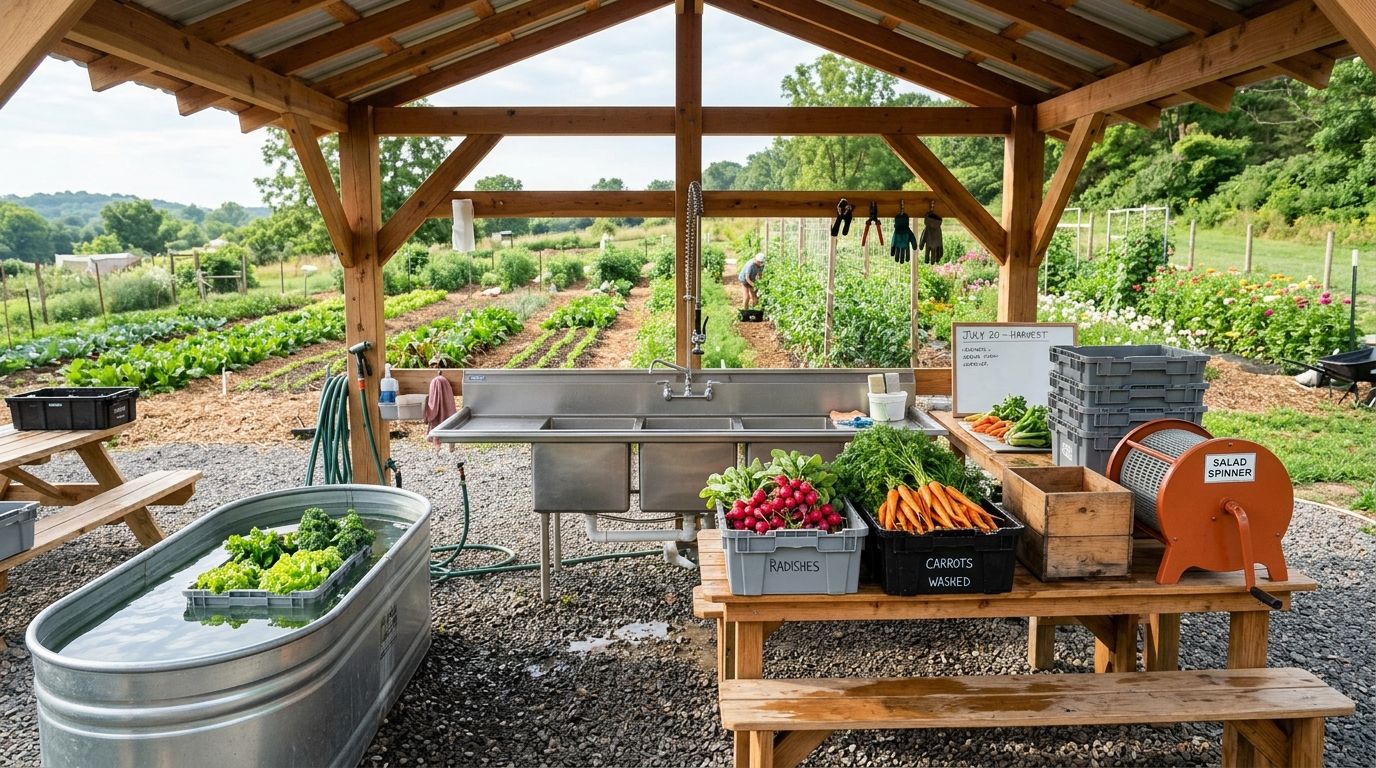
Set up your wash-pack station under a shaded pavilion, pole barn, or open-sided canopy with clean gravel or concrete flooring:
- Dirty Inflow Zone: Field harvest totes filled with freshly cut produce arrive from the field and are placed on elevated wooden pallets or stainless steel dunnage racks. Field mud must never touch clean surfaces.
- Wash and Dunk Tanks: For salad greens, use two 100-gallon galvanized oval stock tanks or food-grade poly tubs. The first tank acts as a bubbler dunk tank (aerated with a simple submersible aquarium bubbler or jacuzzi air pump) to float away field dirt, insects, and debris. The second tank provides a clean-water cold rinse.
- Centrifugal Spin Drying: Wet salad greens rot within 48 hours. Remove moisture using a converted washing machine on spin cycle or a commercial hand-crank 5-gallon salad spinner. Thoroughly spun greens stored at 36°F (2°C) will maintain crisp, supermarket-quality shelf life for twelve to fourteen days.
- Packing and Labeling Table: A clean stainless steel table where produce is weighed, bunched with rubber bands or food-grade twist ties, and bagged in micro-perforated polypropylene produce bags.
- The Cold Chain (Walk-In Cooler): A standard kitchen refrigerator cannot handle the field heat of forty pounds of warm lettuce harvested at 8:00 AM in June. Commercial growers build an inexpensive 8x8-foot walk-in cooler inside a shed or garage using R-25 rigid foam insulation boards and a standard 10,000 BTU window air conditioner equipped with a CoolBot temperature controller. A CoolBot digitally overrides the A/C unit's compressor sensor, allowing a standard $350 window air conditioner to cool a heavily insulated room down to 36°F (2°C) without freezing the coils, saving you thousands of dollars over expensive commercial refrigeration units.
For additional structural layouts and drainage guidelines, review our guide on designing an efficient small-farm wash and pack station.
Sales Channels: Farmers Markets, Restaurant Chefs, and Micro-CSAs
A garden full of ripe, unharvested vegetables is not an asset; it is a ticking financial liability. Before you drop a single seed into your 30-inch beds, you must have established clear market channels capable of absorbing your weekly production volume.
On a quarter acre, your optimal commercial sales strategy relies on a diversified three-legged stool:
Quarter-Acre Revenue Allocation
├── Leg 1: Weekly Community Farmers Market (50% of volume; retail margins; cash flow)
├── Leg 2: Direct Restaurant Chef Accounts (30% of volume; steady wholesale volume; mid-week harvest)
└── Leg 3: Hyper-Local Neighborhood Micro-CSA (20% of volume; upfront capital; loyal baseline)
Leg 1: The Saturday Farmers Market
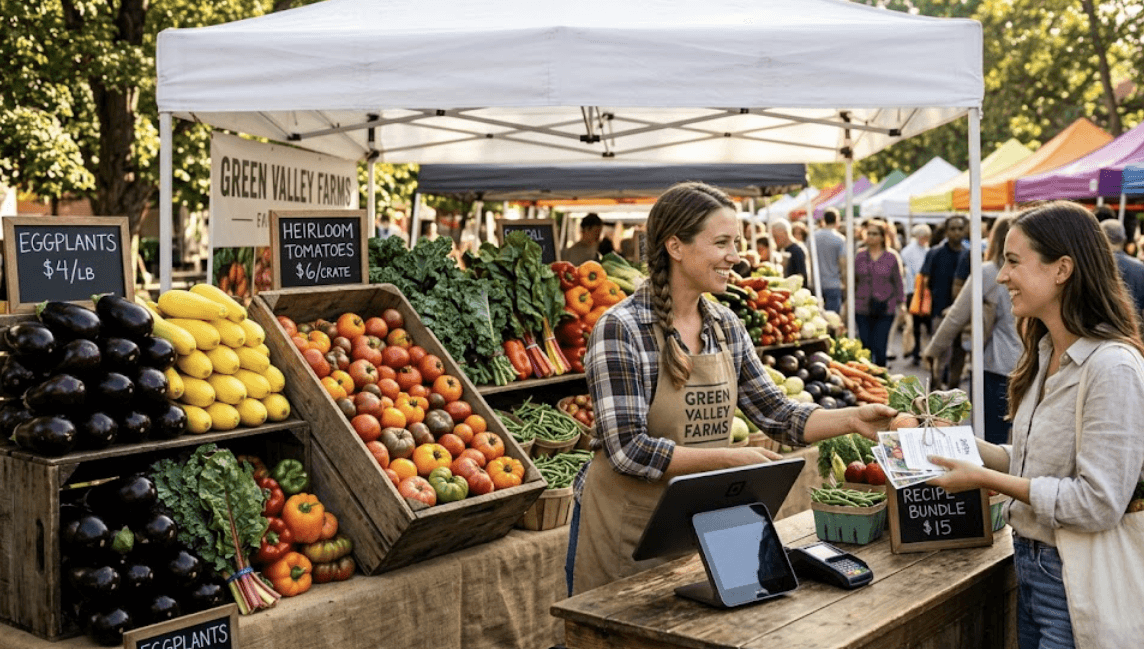
The Saturday morning market is your primary retail engine. You capture full retail pricing ($4.00 per head of lettuce, $3.50 per bunch of radishes, $5.00 per half-pound bag of salad mix).
To succeed at a market:
- Abundant Display: Pile your produce high. Customers gravitate toward abundance; sparse displays signal picking over or low quality. Use angled wooden crates and clean chalkboard signs clearly stating varieties and prices.
- Sampling: Offer clean, chilled samples of your sweet salad turnips or specialty heirloom cherry tomatoes. One bite of a crisp, sweet Hakurei turnip converts a skeptical shopper into a lifelong customer ninety percent of the time.
Leg 2: Direct Restaurant Accounts
Selling to farm-to-table restaurants provides invaluable mid-week cash flow and stabilizes your harvest schedule. While restaurant chefs purchase at wholesale prices (typically 20% to 30% below farmers market retail), they purchase in reliable weekly volume:
- The Chef Protocol: Never show up at a restaurant during the lunch or dinner rush. Visit between 2:00 PM and 3:30 PM on Tuesday or Wednesday. Bring a clean, iced sample box containing pristine salad mix, edible flowers, and specialty radishes. Hand it directly to the Executive Chef.
- Weekly Fresh Sheet: On Sunday evening, email or text a concise "Fresh Sheet" listing exactly what crops are available, the unit sizes (e.g., 5-lb bulk bags), prices, and your Wednesday morning delivery cutoff. Chefs value reliability, consistent quality, and prompt delivery above all else.
Leg 3: The 15-Member Backyard Micro-CSA
Community Supported Agriculture (CSA) involves members paying for an entire season of weekly produce boxes upfront in early spring. On a quarter acre, you should not attempt a 100-member CSA program—that scale requires acres of land.
However, a curated 15 to 20-member Micro-CSA within your immediate neighborhood or workplace is the perfect complement to your market garden. Selling fifteen shares at $30 per week across a 20-week season injects $9,000 of upfront working capital directly into your farm bank account in February when you need to purchase seeds, compost, and irrigation supplies.
Explore our comprehensive curriculum in the CSA Program Masterclass for detailed box planning spreadsheets and member agreement templates.
Regulatory Compliance, Taxes, and Risk Management
Transitioning from hobbyist to commercial grower means you are establishing a bona fide business enterprise. Ignoring legal, tax, and insurance responsibilities exposes your personal assets to catastrophic liability.
Business Structuring and IRS Schedule F
- Form a Dedicated LLC: Do not operate as an informal sole proprietor. Form a Limited Liability Company (LLC) through your state's Secretary of State office. An LLC creates a legal firebreak between your personal assets (your family home, savings accounts) and farm liabilities.
- Dedicated Farm Bank Account: Never commingle personal funds with farm revenue. Open a commercial checking account under your LLC's name and Federal Employer Identification Number (EIN). Run every seed purchase, fuel receipt, tool expense, and customer payment through this account.
- IRS Schedule F (Profit or Loss From Farming): As a commercial producer, you file IRS Schedule F alongside your personal Form 1040. This allows you to deduct legitimate business expenses—including seeds, compost, potting soil, irrigation supplies, farm software subscriptions, vehicle mileage for deliveries, and depreciation on tools and infrastructure. Review IRS Section 183 ("Hobby Loss Rules") to ensure your operation demonstrates a clear profit motive by generating a net profit in at least three out of five consecutive tax years.
- Commercial Farm Liability Insurance: Your standard homeowner's insurance policy explicitly excludes commercial agricultural activities. If a market customer trips over your harvest display or claims foodborne illness from unwashed greens, your personal policy will deny coverage. Secure a basic $1,000,000 commercial farm general liability and product liability policy through an agricultural insurer (such as Farm Bureau or specialized market farm underwriters). These policies typically cost between $400 and $750 annually—an indispensable investment for peace of mind.
For academic guidelines on navigating farm business structures and small-acreage capitalization, consult the educational resources provided by ATTRA Sustainable Agriculture (National Center for Appropriate Technology), which offers extensive peer-reviewed guides on enterprise budgeting and small farm risk management.
The 12-Month Transition Timeline: Step-by-Step
Transitioning to a quarter-acre commercial micro-farm is a marathon, not a sprint. Follow this chronological operational schedule to navigate your first commercial year without burning out:
Quarter-Acre Commercial Launch Timeline
├── Month 1-2 (November - December): Planning & Business Setup
│   ├── Form LLC, obtain EIN, open commercial bank account, secure farm liability insurance.
│   └── Map out 30-inch bed blocks; calculate seed orders and order catalog equipment.
├── Month 3-4 (January - February): Nursery Setup & Occultation
│   ├── Assemble indoor nursery racks, heat mats, and LED lighting.
│   ├── Lay heavy occultation tarps over the field to terminate cover crops and weed thatch.
│   └── Pre-sell 15 Micro-CSA shares to secure initial working capital.
├── Month 5-6 (March - April): Infrastructure & Early Field Plantings
│   ├── Remove tarps; broadfork beds; apply 2-3 inches of clean bulk compost.
│   ├── Install drip irrigation mainlines and timers; build wash-pack station.
│   └── Direct-seed early radishes, turnips; transplant early Salanova lettuce and brassicas.
├── Month 7-8 (May - June): Peak Spring Harvest & Market Launch
│   ├── Launch weekly Saturday Farmers Market booth; establish first 3 restaurant chef accounts.
│   └── Maintain strict weekly succession planting schedules (never let a bed sit empty).
├── Month 9-10 (July - August): Summer Rotation & Heat Management
│   ├── Transition cold greens under 30-40% shade cloth; manage high-tunnel trellised heirlooms.
│   └── Clear finished spring blocks; broadfork and replant for autumn harvest successions.
└── Month 11-12 (September - October): Fall Harvest & Winter Field Prep
    ├── Harvest cool-weather autumn roots, greens, and winter storage crops.
    ├── Sow winter rye/hairy vetch cover crops or lay silage tarps for winter weed occultation.
    └── Review Schedule F tax spreadsheets; audit crop revenue per bed-foot for next season.
Transitioning from a backyard hobby gardener to a commercial market gardener is one of the most rewarding journeys an agricultural enthusiast can undertake. It demands humility, physical endurance, and absolute operational discipline. When you walk out into your standardized 30-inch beds at sunrise, load crates of pristine, nutrient-dense produce that you grew with your own hands, and supply your local community with real, honest food, you realize that small-scale regenerative farming is not just a business—it is a purposeful and fulfilling way of life.
Expert Insights & FAQs
Can you realistically make a profit on only a quarter of an acre?
Yes. Using biointensive methods on standardized 30-inch permanent beds with high-turnover crops like baby salad greens, radishes, salad turnips, and herbs, growers realistically generate between $25,000 and $45,000 in gross revenue on a cultivated quarter acre.
How many standardized 30-inch beds fit on a quarter acre?
A quarter acre encompasses 10,890 square feet. After deducting perimeter fencing, tool sheds, propagation areas, roadways, and wash-pack stations, growers typically establish between 30 and 45 permanent 50-foot beds.
Do you need a tractor to farm a quarter acre commercially?
No. A four-wheel tractor is counterproductive on a quarter acre because it causes soil compaction and requires wide turnarounds. Human-scale market farming tools like broadforks, wheel hoes, and precision push seeders are faster, cheaper, and more space-efficient.
How much startup capital is needed to launch a quarter-acre market garden?
You can fully equip a quarter-acre market garden for roughly $3,000 to $4,500. This covers a broadfork, Jang precision seeder, hand cultivation hoes, silage occultation tarps, drip irrigation lines, and basic post-harvest wash tanks.
What are the most profitable crops for small-scale market gardens?
High-density quick-turn greens (Salanova lettuce, mesclun mix, arugula), bunching roots (French breakfast radishes, Hakurei turnips), culinary herbs (basil, cilantro), and vertically trellised heirloom tomatoes generate the highest return per square foot.
How much time per week does managing a commercial quarter acre require?
During the peak production season (May through October), a quarter-acre market garden requires roughly 25 to 35 hours of focused physical labor per week, encompassing seeding, weeding, harvesting, wash-pack handling, and marketing.
What legal structure should a beginner market gardener choose?
Most market gardeners establish a single-member Limited Liability Company (LLC) to separate personal assets from farm liabilities, paired with an Employer Identification Number (EIN), commercial farm liability insurance, and a dedicated farm checking account.
How do you keep salad greens fresh after harvest without commercial refrigeration?
Market gardeners construct an affordable walk-in cold room using an 8x8 insulated shed outfitted with R-25 rigid foam panels and a standard 10,000 BTU window air conditioner controlled by a CoolBot device, maintaining 36°F (2°C) for a fraction of commercial cost.
Johnnie McCormick
Zone 7b/8a - North Central Alabama
Johnnie McCormick is a gardening hobbyist and the founder of My Garden Spot. Raised in north-central Alabama, his passion for gardening began in his youth. In 2008, he established a large market garden, teaching himself high-yield growing methods. In the years since, he has operated seasonal seedling sales for transplants, specializing in heirloom tomatoes, peppers, eggplants, decorative ground covers like Ajuga (Bugleweed), marigolds, nasturtiums, and fresh kitchen-window herb arrangements (basil, cilantro). Today, he gardens in the hills between Birmingham and Jasper, Alabama (Zone 7b/8a), sharing practical, community-focused gardening resources.
Verified Authoritative Citations & References
In alignment with our strict E-E-A-T research and verification guidelines, this guide cross-references data from the United States Department of Agriculture (USDA) and Cooperative Extension Service programs.
- USDA Agricultural Marketing Service (AMS): Community Supported Agriculture (CSA) standards and local market surveys. ams.usda.gov
- Penn State Extension: Small Farm Economics, financial planning, and crop pricing research documents. extension.psu.edu
- Cornell Cooperative Extension: Market gardening business planning and local sales guidelines. smallfarms.cornell.edu
- Alabama Cooperative Extension System (ACES): Local food regulations, CSA legal permits, and farm safety standards. aces.edu



Please log in to view comments.