
Vermicomposting at Scale: Build a Continuous Flow Worm Bin
The Limitations of Traditional Worm Bins
For the casual backyard gardener, a standard plastic tote filled with shredded paper, a few handfuls of vegetable scraps, and a pound of Red Wiggler worms (Eisenia fetida) is perfectly adequate. It diverts a small amount of household waste from the landfill and provides a modest yield of high-quality fertilizer for a few potted plants.
However, if you are attempting to integrate vermicomposting into a sustainable homestead with large market garden zones, the plastic tote method represents a catastrophic bottleneck.
As a standard enclosed bin fills up, the weight of the material compresses the lower layers. This compaction squeezes out the oxygen, leading to an anaerobic environment. Anaerobic bacteria quickly take over, producing noxious odors, shifting the pH to highly acidic levels, and creating toxic conditions that will kill the worm population. Furthermore, harvesting a traditional bin is incredibly labor-intensive. You must dump the entire contents onto a tarp, manually pick through the muck to rescue the worms, and inevitably lose a significant percentage of your breeding stock in the process.
To achieve scale, you need a system that mimics the natural, horizontal, and vertical movement of epigeic (surface-dwelling) earthworms while mechanically assisting the harvest. You need a Continuous Flow-Through (CFT) bin.
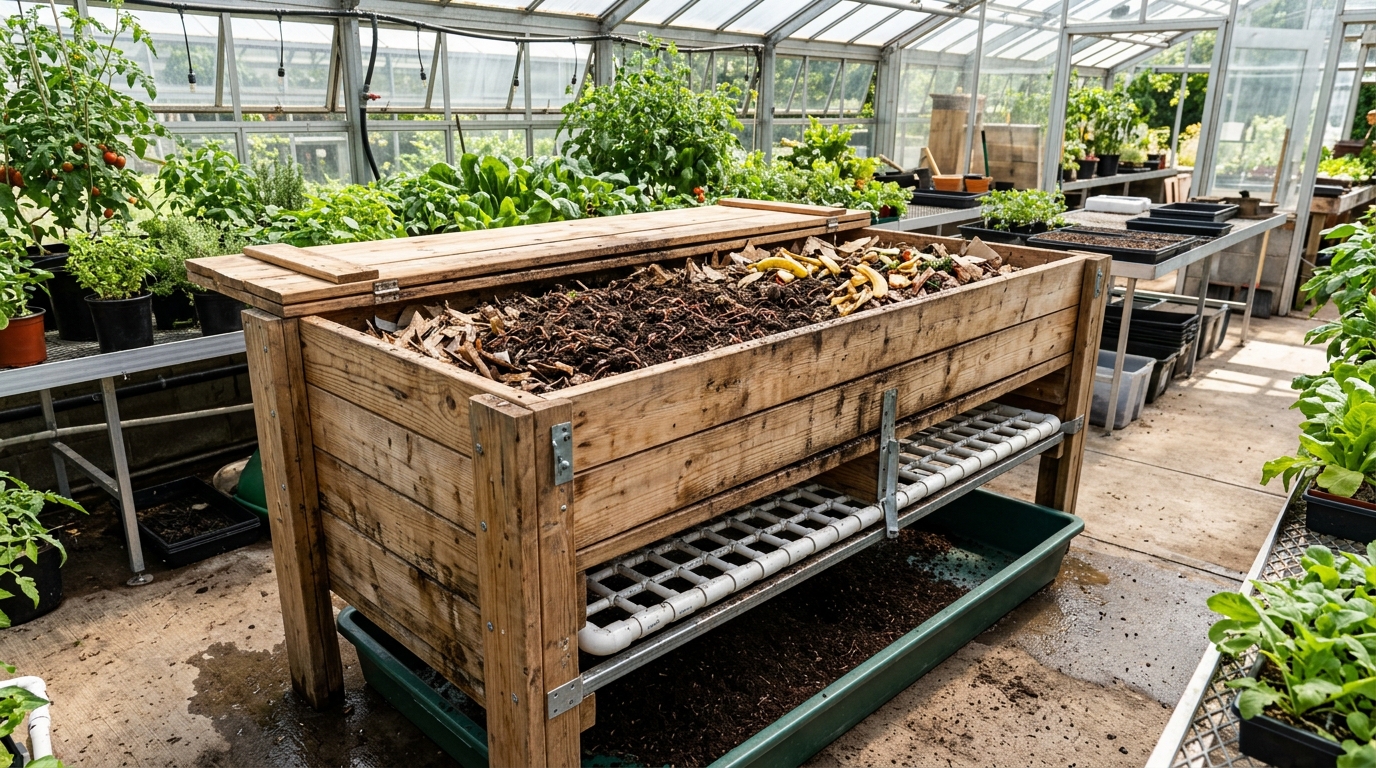
The Anatomy of a Continuous Flow-Through (CFT) Bin
A CFT bin is not a container; it is an open-ended biological reactor. The fundamental principle is that worms instinctively move upward toward fresh food and oxygen, leaving their nutrient-dense waste (castings) behind in the lower strata.
The Suspension Grate
The defining feature of a CFT is that it has no solid bottom. Instead, the material is suspended on a rigid grate. In commercial operations, this grate is often a motorized metal breaker bar. For the homesteader, it is typically constructed from heavy-duty PVC pipes spaced exactly 2 inches apart, or tightly strung high-tensile wire.
This grate sits approximately 18 to 24 inches off the ground. The entire weight of the compost matrix rests on this grid. Because the material is slightly moist and deeply entangled, it bridges the gaps and does not immediately fall through.
The Aerobic Profile
In a CFT, the active biological zone is strictly the top 4 to 6 inches. This is where you add fresh shredded cardboard, aged manure, and vegetable scraps. The worms live almost exclusively in this top layer. As they consume the material and excrete castings, the matrix slowly sinks. By the time the material reaches the bottom grate (usually a process taking 60 to 90 days), it has been processed multiple times. The bottom layer contains virtually zero worms, zero unprocessed food, and is heavily compacted into pure, homogenous vermicompost.
The Harvesting Mechanism
Harvesting a CFT takes minutes rather than hours. You simply drag a custom-built scraping tool (like a heavy-duty garden rake with shortened tines) across the bottom PVC grate. This breaks the surface tension of the compacted castings, causing them to rain down into a collection tray placed beneath the bin. The entire compost column drops down an inch or two, creating space at the top of the bin for fresh food and bedding. The worms are entirely undisturbed during this process.
Constructing Your Own Homestead CFT
Building a CFT requires basic carpentry skills and a solid understanding of physics. Wet compost is extraordinarily heavy; a bin measuring 4 feet long, 2 feet wide, and 3 feet deep can weigh over 800 pounds when operating at full capacity. If you prefer to follow a detailed blueprint rather than designing from scratch, it is a high quality how to post on Instructables (https://www.instructables.com/Continuous-Flow-Worm-Bin/) and we recommend you go check them out if you want to build one of your own.
Materials and Framework
Do not use cheap, untreated pine or particleboard. The extreme humidity and microbial activity inside the bin will rot standard lumber in less than a year. While treated lumber resists rot, the chemical preservatives (like copper azole) can be highly toxic to the worm population. The gold standard for a homestead CFT is naturally rot-resistant wood, such as Cedar, Redwood, or Black Locust.
Construct the primary frame using 4x4 posts for the legs. The walls should be built from 2x6 planks. The bin should be slightly wider at the bottom than at the top (a 5-degree outward slope). This "draft angle" prevents the heavy compost matrix from sticking to the walls as it sinks, ensuring smooth, continuous flow without bridging or hanging up.
The PVC Harvesting Grid
The bottom grid is the most critical component. Drill 1-inch holes along the bottom frame rails, spaced precisely 2 inches on center. Thread 3/4-inch Schedule 40 PVC pipes through these holes to create the grate. Ensure the pipes are securely fastened but not glued; you may need to replace them if one bows or snaps under the immense weight.
The False Bottom Start
When you first commission a CFT, you cannot simply dump worms and food onto the bare PVC grate; they will fall straight through. You must create a "false bottom." Lay several layers of thick, overlapping corrugated cardboard flat across the PVC pipes. Next, add a 4-inch layer of dry shredded newspaper. Only then do you add your active worm culture and their existing bedding.
It will take several weeks for the cardboard false bottom to rot and for the worm castings to build up enough dense structure to bridge the PVC gaps on their own. During this initial phase, do not attempt to harvest.
Mastering the Carbon-to-Nitrogen Ratio in Vermicomposting
The greatest threat to a CFT system is not escaping worms; it is a biological collapse caused by an imbalance in the Carbon-to-Nitrogen (C:N) ratio.
The Danger of Nitrogen Overload
If you treat your CFT like a standard garbage disposal and dump massive quantities of high-nitrogen "greens" (coffee grounds, fruit scraps, grass clippings) into the top without adequate carbon, you will trigger a thermal event. Bacteria will aggressively attack the nitrogen, rapidly generating heat. A standard hot compost pile can reach 160°F (71°C). If the temperature inside your CFT exceeds 90°F (32°C), the entire worm population will either flee the bin or boil to death in their own bedding.
Furthermore, excessive nitrogen leads to anaerobic putrefaction. The classic symptom is an overwhelming stench. If your compost pile smells like ammonia, you have critically failed to balance the C:N ratio.
Carbon: The Engine of the CFT
To operate at scale, a CFT requires massive, continuous inputs of carbon "browns." Shredded corrugated cardboard is the undisputed king of vermicomposting carbon. It holds incredible amounts of moisture, maintains aerobic pockets (preventing compaction), and acts as a safe, neutral food source for the worms.
For every 5-gallon bucket of kitchen scraps or aged manure you add to the top of the CFT, you must add an equal or greater volume of dry, shredded cardboard. Mix it thoroughly into the top 3 inches of the active layer. This ensures the system remains cool, aerobic, and smelling like a fresh forest floor.
Feedstocks for Scaling Up
A robust CFT can process staggering amounts of organic matter, but as a market gardener, you must secure massive, reliable feedstocks to keep the system running at maximum capacity.
Pre-Composted Manure
The absolute best feedstock for rapid vermicompost production is aged mammalian manure (horse, cow, or rabbit). However, you cannot use fresh, hot manure. Fresh manure contains extreme levels of ammonia and un-volatilized salts that will burn the worms' sensitive skin.
Manure must be pre-composted (aerothermally heated and turned) for at least 30 days to kill weed seeds and off-gas ammonia before it is introduced to the CFT. Furthermore, you must interrogate your manure source. Many pastures are sprayed with persistent broadleaf herbicides (like aminopyralid). These chemicals pass straight through the horse's digestive tract, straight through the worms, and will utterly destroy your tomato crop when you apply the castings. Always perform a bio-assay test on imported manure before introducing it to your farm ecosystem.
Crop Residue and Market Waste
If you run a CSA, your Wash and Pack station will generate hundreds of pounds of culls, carrot tops, and damaged greens every week. This is premium worm food. However, whole vegetables break down slowly. To accelerate the process and maximize the flow rate of your CFT, invest in an industrial food processor or a heavy-duty chipper/shredder to pulverize the crop waste before feeding it to the worms. Increasing the surface area allows bacteria to break down the food faster, which in turn allows the worms to consume the bacteria faster.
Harvesting, Curing, and Application
The ultimate goal of the CFT is the production of premium vermicompost—a biologically explosive substance that is arguably the most valuable input on a sustainable homestead.
The Harvesting Routine
Once the false bottom rots away and the bin reaches a steady state, you should harvest from the bottom PVC grate every 7 to 14 days. Use your scraping tool to pull down a 1-inch layer of castings across the entire footprint of the bin.
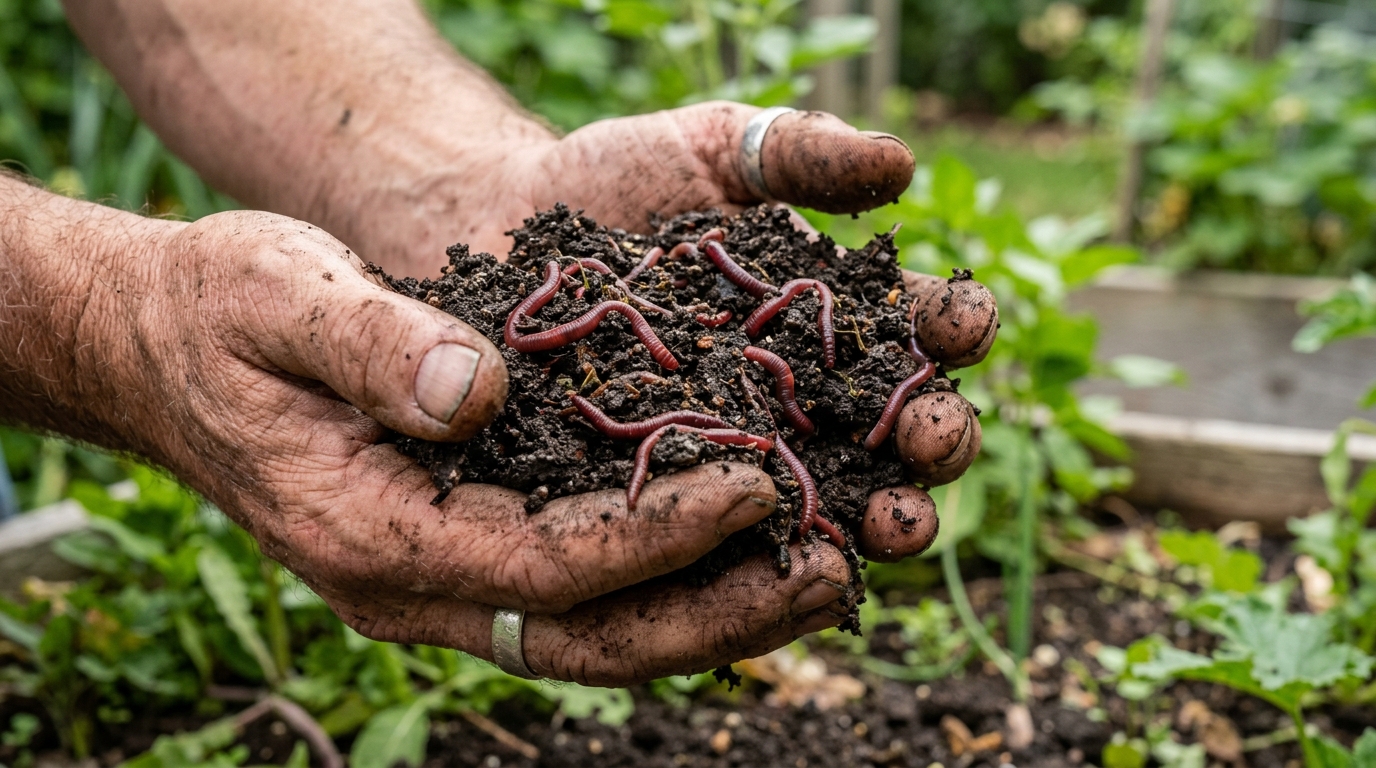
The harvested material should be dark, crumbly, and smell intensely of rich earth. It should contain almost zero recognizable pieces of bedding or food, and you should see very few, if any, worms.
Curing the Castings
Freshly harvested castings from a CFT are often slightly too wet for immediate use or screening. Spread them out on a large tarp in a shaded, well-ventilated area (never in direct sunlight, which will sterilize the microbial life). Allow them to air dry for a few days until they reach the consistency of slightly damp coffee grounds.
Once cured, you can pass the castings through a 1/8-inch hardware cloth screen to remove any rogue pieces of un-composted wood chips or stray worms.
Application Strategies
Vermicompost is not a bulk fertilizer; it is a biological inoculant. It is too precious to use as a deep mulch. Instead, use it strategically.
The highest and best use of premium worm castings is in your seed starting mix. Blending just 10% to 20% vermicompost into your standard potting soil will drastically increase seedling vigor, enhance root development, and provide a massive boost of localized disease resistance.
In the field, use castings as a targeted root drench. Brew the castings actively in a highly aerated compost tea brewer to multiply the beneficial bacteria and fungi exponentially, and apply it directly to the root zone of your high-value crops through your drip irrigation system. This targeted biological application is a cornerstone of advanced organic pest management, as robust, biologically fortified plants naturally resist aphid and fungal attacks.
Deep Dive: Managing Worm Population Density and Pathogens
Operating a CFT at peak efficiency requires an understanding of population dynamics. Eisenia fetida populations self-regulate based on the availability of surface area, oxygen, and food.
The Carrying Capacity
A well-managed CFT can sustain an astonishing density of up to 2 pounds of worms per square foot of surface area. At this density, the worms are consuming their own body weight in organic matter every 2 to 3 days. However, if the population exceeds the carrying capacity, they will begin attempting a mass migration.
If you walk into your greenhouse in the morning and find thousands of worms crawling up the wooden walls of the CFT or trying to escape over the lip, you have triggered a biological panic. This is rarely caused by overpopulation; it is almost always caused by an environmental stressor.
Diagnosing Mass Migrations
Check the temperature of the core immediately. If it is over 85°F, you have overfed nitrogen. Check the moisture. Worms breathe through their skin; if the bin is soaking wet and muddy, they are drowning. If the bin is bone dry, they are suffocating. The moisture level should feel exactly like a wrung-out sponge.
If the environment is perfect but the population is simply too massive, you must actively divide the colony. Skim the top 2 inches of the active layer (which contains 90% of the worms) and use it to inoculate a second CFT bin.
Pathogen Reduction and the 131°F Rule
One major regulatory and safety concern with vermicomposting at a commercial scale is pathogen reduction. Unlike a traditional aerothermal compost pile, a CFT does not reach the 131°F (55°C) threshold required by the FDA/USDA to legally destroy human pathogens (like E. coli or Salmonella) found in raw manure.
Because the worms would die at those temperatures, vermicomposting relies on biological competition and passage through the worm's gut to reduce pathogens. While studies show worms significantly reduce E. coli levels, if you are selling vegetables to the public, you should strictly pre-compost any manure to the legal 131°F standard before feeding it to the worms. This guarantees the absolute safety of the final castings applied to your crops.
Deep Dive: Managing Worm Population Density and Pathogens
Operating a CFT at peak efficiency requires an understanding of population dynamics. Eisenia fetida populations self-regulate based on the availability of surface area, oxygen, and food.
The Carrying Capacity
A well-managed CFT can sustain an astonishing density of up to 2 pounds of worms per square foot of surface area. At this density, the worms are consuming their own body weight in organic matter every 2 to 3 days. However, if the population exceeds the carrying capacity, they will begin attempting a mass migration.
If you walk into your greenhouse in the morning and find thousands of worms crawling up the wooden walls of the CFT or trying to escape over the lip, you have triggered a biological panic. This is rarely caused by overpopulation; it is almost always caused by an environmental stressor.
Diagnosing Mass Migrations
Check the temperature of the core immediately. If it is over 85°F, you have overfed nitrogen. Check the moisture. Worms breathe through their skin; if the bin is soaking wet and muddy, they are drowning. If the bin is bone dry, they are suffocating. The moisture level should feel exactly like a wrung-out sponge.
If the environment is perfect but the population is simply too massive, you must actively divide the colony. Skim the top 2 inches of the active layer (which contains 90% of the worms) and use it to inoculate a second CFT bin.
Pathogen Reduction and the 131°F Rule
One major regulatory and safety concern with vermicomposting at a commercial scale is pathogen reduction. Unlike a traditional aerothermal compost pile, a CFT does not reach the 131°F (55°C) threshold required by the FDA/USDA to legally destroy human pathogens (like E. coli or Salmonella) found in raw manure.
Because the worms would die at those temperatures, vermicomposting relies on biological competition and passage through the worm's gut to reduce pathogens. While studies show worms significantly reduce E. coli levels, if you are selling vegetables to the public, you should strictly pre-compost any manure to the legal 131°F standard before feeding it to the worms. This guarantees the absolute safety of the final castings applied to your crops.
Exhaustive Vermicomposting FAQ
Can I use regular earthworms from my garden in a CFT?
No. Common garden earthworms (like Nightcrawlers, Lumbricus terrestris) are anecic worms. They burrow deep into the mineral soil and come to the surface to pull down leaves. They will not survive in the shallow, high-organic-matter environment of a CFT. You must use epigeic (surface-dwelling) composting worms, specifically Red Wigglers (Eisenia fetida) or European Nightcrawlers (Eisenia hortensis).
What foods will kill my worms?
Avoid adding large quantities of citrus peels, onions, and garlic, as the high acidity and volatile oils can burn the worms. Never add meat, dairy, or oily foods to a CFT; these will quickly putrefy, go anaerobic, and attract massive infestations of maggots and rodents.
How do I stop fruit flies from invading the bin?
Fruit flies and fungus gnats are inevitable if you leave fresh food exposed on the surface. The solution is simple: always bury the fresh food under a thick, 2-inch layer of dry shredded cardboard or aged compost. If the flies cannot access the rotting fruit, they cannot lay their eggs.
Does a CFT bin need to be insulated in the winter?
Yes, if it is located outdoors or in an unheated barn. Red Wigglers will slow down their feeding at 50°F and will die if they freeze solid. In cold climates, wrap the exterior of the CFT in rigid foam insulation. Alternatively, running a thermostatically controlled soil heating cable through the active upper layer can keep the worms highly active and processing food even in the dead of winter.
Can I use pine shavings as bedding?
It is not recommended. Pine shavings contain high levels of resins and terpenes that are irritating to the worms. Furthermore, wood shavings break down incredibly slowly compared to shredded cardboard or autumn leaves, meaning you will end up with recognizable wood chips in your final harvested castings.
Exhaustive Vermicomposting FAQ
Can I use regular earthworms from my garden in a CFT?
No. Common garden earthworms (like Nightcrawlers, Lumbricus terrestris) are anecic worms. They burrow deep into the mineral soil and come to the surface to pull down leaves. They will not survive in the shallow, high-organic-matter environment of a CFT. You must use epigeic (surface-dwelling) composting worms, specifically Red Wigglers (Eisenia fetida) or European Nightcrawlers (Eisenia hortensis).
What foods will kill my worms?
Avoid adding large quantities of citrus peels, onions, and garlic, as the high acidity and volatile oils can burn the worms. Never add meat, dairy, or oily foods to a CFT; these will quickly putrefy, go anaerobic, and attract massive infestations of maggots and rodents.
How do I stop fruit flies from invading the bin?
Fruit flies and fungus gnats are inevitable if you leave fresh food exposed on the surface. The solution is simple: always bury the fresh food under a thick, 2-inch layer of dry shredded cardboard or aged compost. If the flies cannot access the rotting fruit, they cannot lay their eggs.
Does a CFT bin need to be insulated in the winter?
Yes, if it is located outdoors or in an unheated barn. Red Wigglers will slow down their feeding at 50°F and will die if they freeze solid. In cold climates, wrap the exterior of the CFT in rigid foam insulation. Alternatively, running a thermostatically controlled soil heating cable through the active upper layer can keep the worms highly active and processing food even in the dead of winter.
Can I use pine shavings as bedding?
It is not recommended. Pine shavings contain high levels of resins and terpenes that are irritating to the worms. Furthermore, wood shavings break down incredibly slowly compared to shredded cardboard or autumn leaves, meaning you will end up with recognizable wood chips in your final harvested castings.
Step-by-Step Instructions
Framework Construction and Dimensional Planning
The foundation of vermicomposting at scale lies in robust dimensional planning. A continuous flow bin holds a massive amount of weight. A fully loaded CFT bin consisting of damp bedding, wet food scraps, and finished castings can easily weigh between 1,500 and 2,000 pounds. Your framework must possess serious structural integrity.
Optimal Dimensions
For a mid-scale market garden or homestead, the industry standard for a standalone CFT bin is 4 feet wide by 8 feet long, with an internal depth of 3 feet.
- Why 4 feet wide? Ergonomics. When feeding the worms or performing surface maintenance, an average adult can comfortably reach 2 feet inward from either side. A wider bin forces you to lean over the edges awkwardly, which becomes unsustainable at scale.
- Why 8 feet long? This matches standard plywood and lumber lengths, minimizing cuts and waste during your build. It also provides 32 square feet of surface area, yielding a highly productive farm.
- Why 3 feet deep? This is the magic number for continuous flow biology. The top 6 inches serve as the "active feeding zone." The middle 18 inches act as the "curing zone," where castings dry slightly, and the microbial life finishes processing the organic matter. The bottom 12 inches form the "harvest zone," where the weight of the material above compresses the castings just enough to be sliced by the cutting bar.
Material Selection
Construct the main upright legs using heavy 4x4 pressure-treated posts to prevent rot where the legs contact the ground. However, do not use pressure-treated lumber for any surface that will come into direct contact with the compost or worms. The copper and chemical biocides used in treated wood can leach into the environment and harm the delicate epigeic earthworm population.
Instead, use standard 3/4-inch exterior-grade plywood for the interior walls. To dramatically extend the life of this untreated plywood, line the inside of the bin walls with heavy pond liner or thick EPDM plastic. This protects the wood from constant moisture and creates a slippery surface, preventing the descending mass of castings from adhering to the walls via friction.
Designing the False Bottom (The Harvesting Grate)
The most critical engineering feature of CFT worm bin plans is the false bottom, or the harvesting grate. This grate must support thousands of pounds of damp material while still allowing the finished castings to fall through when mechanically agitated.
The Physics of the "Bridging Effect"
You might assume that wet compost resting on a grate would simply fall through the holes continuously. However, damp worm castings possess unique structural properties. When packed together under the weight of the material above them, they compress and interlock, creating a biological "bridge."
To achieve this bridging effect perfectly, the grate gaps must be precisely calibrated. If the gaps are too wide (e.g., 3 inches), the bridging fails, and unfinished compost will avalanche out the bottom. If the gaps are too narrow (e.g., 1 inch), the cutting bar will constantly jam, and the castings will compact into an impenetrable brick.
Constructing the Grate
The absolute best material for a DIY CFT grate is 1/2-inch EMT electrical conduit. It is cheap, perfectly smooth, incredibly strong, and rust-resistant.
- Drill a series of 5/8-inch holes horizontally through the bottom frame rails of your long (8-foot) walls.
- Space these holes exactly 2 inches on center. This leaves a physical gap of 1.5 inches between each steel tube—the mathematical sweet spot for the bridging effect.
- Slide the 4-foot lengths of EMT conduit through the holes, creating a seamless, highly durable steel floor.
To prevent the metal tubes from bowing or sagging under the massive weight of the castings, you must install a strong center support. Run a heavy 2x4 directly under the middle of the conduit grate, running the entire 8-foot length of the bin. This center beam ensures your 1/2-inch conduit never bends, which would widen the gaps and compromise your bridging effect.
Engineering the CFT Worm Bin Cutting Bar
If the grate is the foundation of the CFT, the cutting bar is its heart. When it is time to harvest, the cutting bar is dragged horizontally across the top of the conduit grate, slicing the bottom-most inch of compressed castings and causing them to fall through the gaps into your collection trays below.
Designing a functional CFT worm bin cutting bar requires careful consideration of shear force and friction.
The Anatomy of the Bar
The cutting bar itself is typically fabricated from a piece of 1.5-inch steel angle iron. The length of the angle iron should be cut roughly 1/2-inch shorter than the internal width of your bin (e.g., 47.5 inches for a 4-foot wide bin) so it can travel smoothly without biting into the side walls.
Because dragging a blunt piece of angle iron through highly compressed, damp castings requires immense force, we must reduce the surface friction. We do this by attaching a cutting wire to the front of the angle iron.
- Drill holes at both ends of the angle iron.
- Run a thick, high-tensile steel wire (like a guitar string or thin braided steel cable) tightly across the front of the angle iron, sitting about 1/2-inch ahead of the metal edge.
- As the bar is pulled forward, the thin, taut wire slices cleanly through the dense castings like a wire through a block of clay. The angle iron following immediately behind acts as a breaker bar, crumbling the sliced castings and forcing them down through the 2-inch gaps in the EMT conduit grate.
The bar simply rests completely untethered on top of the EMT conduit grid. It is held firmly down against the grid purely by the massive weight of the compost above it.
Installing the Winch and Cable System
Moving a heavy steel cutting bar through 2,000 pounds of dense, compacted earth cannot be done by hand. You must engineer a system that provides significant mechanical advantage.
The Hand-Crank Winch
To power the system, mount a heavy-duty, geared boat winch (capable of pulling at least 1,500 lbs) to the exterior of one end of your 8-foot bin.
Cable Routing
You will need to pull the cutting bar smoothly from one end of the 8-foot bin to the other. To prevent the bar from twisting diagonally and jamming against the walls, you must pull it equally from both ends of the angle iron.
- Attach a strong steel eyebolt to each end of your angle iron cutting bar.
- Run a 3/16-inch galvanized steel cable from the boat winch, splitting it via a heavy-duty marine yoke or utilizing a dual-spool winch, so two parallel cables run cleanly down the length of the bin.
- Attach these cables to the eyebolts on the cutting bar.
- The Return System: To pull the bar back to the starting position for the next harvest, you must install a second winch on the opposite end of the bin, repeating the cable process.
When it is time to harvest, you release the tension on the rear winch and slowly crank the front winch. The mechanical gearing multiplies your physical input, smoothly dragging the cutting bar along the conduit floor, shaving off a perfectly uniform layer of finished, high-value vermicast.
Best Bedding for Large Scale Worm Farms and C:N Balancing
With the mechanical construction complete, the focus shifts entirely to biology and thermodynamics. The success of vermicomposting at scale depends heavily on establishing a stable habitat before a single worm is introduced.
Establishing the Initial Bedding Depth
Because of the 2-inch gaps in your conduit grate, you cannot simply throw loose food scraps into an empty CFT bin; they will fall straight through. You must establish a thick, structural "plug" to kickstart the bridging effect.
Line the bottom of the conduit grate with a single, flat layer of plain corrugated cardboard. This cardboard acts as a temporary floor. On top of the cardboard, you must add 10 to 12 inches of highly absorbent, carbon-rich bedding. The best bedding for large scale worm farms is a mix of shredded corrugated cardboard, pre-composted (aged) horse manure, and moistened peat moss or coco coir.
Preventing Thermal Die-Off (The C:N Ratio)
The most common and devastating mistake in commercial vermiculture is triggering a thermophilic (hot) compost reaction. Earthworms (Eisenia fetida) thrive in mesophilic temperatures—ideally between 65°F and 80°F. If the bin temperature spikes above 90°F, the worms will flee to the edges; if it hits 95°F, you will experience a mass die-off.
Heating is caused by an unbalanced Carbon to Nitrogen (C:N) ratio. If you overload a large bin with highly nitrogenous "green" inputs (like fresh grass clippings, restaurant vegetable scraps, or coffee grounds), aerobic bacteria reproduce exponentially, generating immense metabolic heat.
To prevent this in a deep bin, your overarching C:N ratio must remain near 30:1. Always buffer high-nitrogen inputs with massive amounts of carbon (shredded paper, dried leaves, or aged straw).
Utilizing Botanicals to Attract and Support Earthworms
Interestingly, we can look to centuries-old horticultural wisdom to optimize our worm bins. In traditional compost setups, certain specific additions heavily influence worm behavior. For instance, Valerian is attractive to earthworms and therefore particularly useful in the compost pile[cite: 1]. Incorporating bruised or dried valerian leaves into your initial bedding mix can rapidly draw your introduced worms deep into the bedding profile, accelerating their acclimation.
Similarly, deep-rooted weeds play a structural role in soil systems. Dandelion roots decompose to provide subterranean channels for earthworms, which, in turn, enrich the soil with their castings[cite: 1]. You can replicate this by incorporating coarse, dry organic matter (like chopped sunflower stalks or dried dandelion roots) into your bedding layer. As this coarse material decays, it maintains crucial oxygen channels deep within the CFT bin, preventing anaerobic compaction and giving the worms safe transit routes through the curing zone.
Stocking the Bin and Scaling the Feed
With a deep, carbon-rich, structurally sound bedding layer established and moistened to the consistency of a wrung-out sponge, you are ready to inoculate the system.
Stocking Density
For maximum efficiency, a commercial CFT bin should be stocked at a density of 1/2 pound to 1 pound of worms per square foot of surface area. For a standard 4x8 bin (32 square feet), this requires a significant initial investment of 16 to 32 pounds of Eisenia fetida (Red Wigglers).
Place the worms directly on the surface of the damp bedding. Do not bury them. If the environment is hospitable, they will instinctively dive downward to avoid the light. Earthworms enter the compost pile and assist the other microorganisms in the breaking-down process[cite: 1], acting as the apex predators of your controlled ecosystem, consuming the bacteria and fungi that are actively decomposing the organic matter.
Surface Feeding Protocols
In a continuous flow system, you never bury the food. All new organic matter is applied in thin, 1-inch to 2-inch layers directly on the top surface of the bin.
This surface-feeding strategy maintains the vertical gradient of the bin. The worms migrate upward into the fresh layer to feed, leaving their heavy, processed castings in the lower strata. If you bury food deep in a CFT bin, you risk creating isolated pockets of anaerobic rot that will produce toxic ammonia and alcohol gases, poisoning the ascending worm population. Always cover fresh food layers with a thin dusting of carbon (like dry shredded paper) to deter fungus gnats and fruit flies.
How to Harvest Castings from a Continuous Flow Bin
The true magic of the Continuous Flow Through design is only realized months after construction. A newly established bin requires patience; you should not attempt to harvest castings for the first 3 to 4 months. The bin must reach its full operational depth, and the biological "bridge" across your EMT conduit grate must fully compress and cure.
Once the material in the bin reaches the top edge of your 3-foot walls, the system is fully primed. You are now ready to execute a harvest without ever disturbing the active, feeding worms at the surface.
- Preparation: Slide low-profile collection trays (like mortar mixing tubs or specialized sleds) directly underneath the conduit grate.
- The Pull: Engage your hand-crank winch. As you turn the handle, the tension on the steel cable will slowly drag the heavy angle-iron cutting bar across the grate.
- The Shear: You will hear the satisfying sound of the cutting wire slicing through the dense, cured vermicast. Because the top 6 inches of the bin is where the worms reside, the bottom-most layer being sheared is 100% pure, worm-free castings.
- Collection: The sliced castings will crumble and fall through the 2-inch gaps between the conduit pipes, dropping neatly into your collection trays.
- The Reset: Once the bar reaches the far end of the bin, the entire mass of compost inside the bin will uniformly drop downward by exactly one inch. You can now add an inch of fresh food and bedding to the top of the bin.
This cycle—top feeding and bottom harvesting—can continue indefinitely. The environment remains completely undisturbed, resulting in happier worms, faster processing times, and a highly lucrative, infinitely scalable system for the regenerative market gardener.
Conclusion
Transitioning to vermicomposting at scale requires a fundamental shift in both mechanical engineering and biological management. By constructing a robust Continuous Flow Through (CFT) worm bin, you eliminate the back-breaking labor of sorting and sifting traditional tub systems. Understanding the precise gap spacing for your conduit grate, engineering a high-tensile cutting bar, and managing the thermodynamics of your C:N ratios ensures a flawless, uninterrupted production cycle.
Whether you are brewing aerated compost teas, amending no-till market garden beds, or selling premium inoculants to local growers, a well-managed CFT bin is an unparalleled engine of fertility.
Frequently Asked Questions
1. How to harvest castings from a continuous flow bin? Harvesting from a CFT bin involves using a mechanical winch system to drag a steel cutting bar horizontally across the bottom grate of the bin. The bar cleanly slices off the bottom-most inch of compressed, finished castings, which then fall through the grate gaps into collection trays below, leaving the active worms at the top of the bin completely undisturbed.
2. What is the best bedding for large scale worm farms? The ideal bedding for commercial scale vermiculture provides high carbon, excellent moisture retention, and structural loft. A mixed matrix of shredded corrugated cardboard, pre-composted (aged) horse manure, and moistened peat moss or coco coir is considered the gold standard to prevent compaction and maintain a healthy C:N ratio.
3. How do you design a CFT worm bin cutting bar? A functional cutting bar is typically made from a heavy piece of 1.5-inch steel angle iron cut slightly shorter than the bin's internal width. A high-tensile steel wire (like a guitar string) is stretched tightly across the front of the angle iron. The wire slices the dense castings, while the angle iron acts as a breaker bar to push the material through the grate.
4. What is commercial vermiculture? Commercial vermiculture is the large-scale, professional breeding of composting earthworms (usually Eisenia fetida) and the bulk production of their nutrient-rich waste, known as worm castings or vermicast. It utilizes engineered systems like CFT bins to maximize output and minimize labor.
5. Why is my continuous flow worm bin heating up? A CFT bin heats up when the Carbon to Nitrogen (C:N) ratio is dangerously low. Adding too much high-nitrogen material (like fresh grass clippings or dense food scraps) without buffering it with enough high-carbon bedding (like shredded cardboard) triggers a thermophilic (hot compost) bacterial reaction. This can quickly exceed 90°F and kill the worm population.
6. Can I use a CFT worm bin outdoors in winter? It depends entirely on your hardiness zone and insulation. In freezing climates, an uninsulated, outdoor CFT bin will freeze solid, killing the worms. In cold zones, CFT bins must be housed in insulated sheds, heated greenhouses, or deep basements to keep the core temperature within the mesophilic range (55°F to 80°F).
7. How many worms do I need for a 4x8 CFT worm bin? For maximum operational efficiency, a commercial CFT bin should be stocked at a density of 1/2 to 1 pound of worms per square foot. A standard 4x8 foot bin provides 32 square feet of surface area, requiring a stocking investment of 16 to 32 pounds of Red Wigglers to reach peak continuous flow capacity.
8. Do I need to sift worm castings from a CFT bin? Generally, no. If the CFT is managed correctly and allowed to cure deeply, the castings harvested by the cutting bar from the bottom of a 3-foot deep bin are highly refined, uniform, and largely devoid of unprocessed material or stray worms. They are usually ready for immediate garden application or bagging.
Expert Insights & FAQs
What is a Continuous Flow Through (CFT) worm bin?
A CFT worm bin is an engineered system designed for large-scale vermicomposting. It allows continuous feeding from the top and harvesting of finished worm castings from the bottom, mimicking natural worm behavior and preventing disturbance to the active feeding zone.
Why is a CFT bin superior to standard worm bins for commercial vermiculture?
Standard worm bins scale poorly, often becoming compacted and making casting harvesting labor-intensive and disruptive. CFT bins prevent these issues, offering an efficient way to produce hundreds of pounds of vermicast for market gardens or homesteads.
Johnnie McCormick
Zone 7b/8a - North Central Alabama
Johnnie McCormick is a gardening hobbyist and the founder of My Garden Spot. Raised in north-central Alabama, his passion for gardening began in his youth. In 2008, he established a large market garden, teaching himself high-yield growing methods. In the years since, he has operated seasonal seedling sales for transplants, specializing in heirloom tomatoes, peppers, eggplants, decorative ground covers like Ajuga (Bugleweed), marigolds, nasturtiums, and fresh kitchen-window herb arrangements (basil, cilantro). Today, he gardens in the hills between Birmingham and Jasper, Alabama (Zone 7b/8a), sharing practical, community-focused gardening resources.
Verified Authoritative Citations & References
In alignment with our strict E-E-A-T research and verification guidelines, this guide cross-references data from the United States Department of Agriculture (USDA) and Cooperative Extension Service programs.
- USDA Natural Resources Conservation Service (NRCS): Soil Quality and Cation Exchange Capacity technical references. nrcs.usda.gov
- Cornell Cooperative Extension: Home Gardening Guide, Vegetable Varieties, and High-Yield Greenhouse management sheets. gardening.cals.cornell.edu
- Penn State Extension: Master Gardener Manual, Soil Buffering Ratios, and Small Farm Economics research documents. extension.psu.edu
- Alabama Cooperative Extension System (ACES): Soil testing procedures, compost formulation standards, and regional planting guidelines. aces.edu
Please log in to view comments.