Accepting SNAP and EBT for Your Local Produce Shares and Farmstand

How Do You Accept SNAP and EBT for CSA Produce Shares and Farmstands?
1. Introduction to SNAP and Its Impact on Local Food Systems
The integration of SNAP benefits into local agricultural systems represents a profound shift in both economic viability for small farms and nutritional access for marginalized communities. Historically, SNAP funds were overwhelmingly captured by massive, corporate grocery chains and convenience stores, leaving local farmers excluded from a multi-billion-dollar federal food economy. However, recent regulatory shifts and the proliferation of accessible Point of Sale (POS) technologies have dramatically lowered the barrier to entry for direct-to-consumer agricultural operations. By intentionally structuring your Farmstand or Community Supported Agriculture (CSA) model to accept Electronic Benefits Transfer (EBT), you are not merely performing a community service; you are actively diversifying your revenue streams and insulating your farm against localized economic downturns.
To fully grasp the magnitude of this opportunity, one must understand the macroeconomic flow of SNAP dollars. When a federal benefit is spent at a local farm, the economic multiplier effect is substantially higher than when spent at a multinational retailer. The money remains within the regional economy, circulating among local supply stores, laborers, and municipal tax bases. Furthermore, programs like Double Up Food Bucks (DUFB) in various states artificially inflate the purchasing power of SNAP recipients when buying fresh, locally grown produce, effectively subsidizing the true cost of regenerative agriculture without forcing the farmer to lower their premium retail prices. This creates a rare, symbiotic economic environment where the consumer receives highly nutritious, premium heirloom produce at a steep discount, while the farmer receives their full, required profit margin.
However, bridging the gap between federal bureaucracy and the dirt-under-the-fingernails reality of market farming requires meticulous planning. The USDA Food and Nutrition Service (FNS) operates with intense regulatory oversight, requiring stringent application processes, flawless accounting models, and specialized, encrypted hardware. The transition to becoming a SNAP-authorized retailer is not a casual weekend project; it demands the same level of rigorous logistical planning as designing a highly efficient irrigation system or mastering exact internal link: /planting-calendar succession sowing. You are effectively opening a highly regulated financial portal on your farm.
Moreover, the sociological implications of this integration cannot be understated. Farmstands and CSAs have historically struggled with a perception of elitism—purveyors of expensive, boutique vegetables accessible only to the upper-middle class. Accepting EBT radically dismantles this paradigm. It democratizes access to high-quality, nutrient-dense food, aligning the core mission of many regenerative farmers (healing the land and the community) with concrete, actionable financial architecture. It transforms the farmstand from a niche specialty shop into a fundamental pillar of local food sovereignty.
2. The USDA FNS Application: A Step-by-Step Bureaucratic Guide
The absolute first, unavoidable hurdle in this process is conquering the United States Department of Agriculture’s Food and Nutrition Service (FNS) authorization application. Do not let the dense bureaucratic language deter you; thousands of small farmers successfully navigate this portal every year. The process begins not in the soil, but in the digital realm, by creating a USDA eAuthentication account. This is a secure, multi-factor authenticated digital identity that grants you access to the FNS portal. It is crucial to register using the exact, legal name of your farm entity, whether that is a Sole Proprietorship, an LLC, or an S-Corp, as any discrepancies between your eAuth account, your FNS application, and your associated bank accounts will trigger immediate, lengthy delays.
Once your eAuth account is active, you will initiate the actual application, specifically seeking out Form FNS-252, which is tailored for Direct Marketing Farmers and Farmers Markets. This specific designation is critical because it exempts you from certain inventory requirements that apply to traditional brick-and-mortar grocery stores. FNS-252 recognizes that your inventory is inherently seasonal and highly variable. You will need to provide extremely detailed information regarding your business structure, exact physical locations (including all farmers markets you attend and the address of your on-farm stand), and your projected operating months.
The documentary evidence required is rigorous and non-negotiable. You must upload high-resolution, legible copies of photo identification (driver's license or passport) and Social Security cards for all owners, partners, or corporate officers. This is because SNAP authorization carries severe federal penalties for fraud, and the USDA requires absolute accountability. Furthermore, you will need to provide a voided check or official bank letter to establish the direct deposit routing for the Electronic Benefits Transfer settlements. FNS will conduct a background check to ensure no owners have a history of SNAP fraud or specific financial crimes.
After you have meticulously filled out the application and uploaded the required documents, you must physically or digitally sign the certification and submit it into the void of the federal review queue. The stated processing time is generally 30 to 45 days, but this can fluctuate wildly depending on the time of year and the backlog at your regional FNS office. During this waiting period, it is highly advisable to begin researching and procuring your POS hardware, as you cannot legally process a transaction until you possess both your physical FNS number and your certified hardware. You must proactively monitor your email and your FNS portal dashboard, as reviewers will frequently request minor clarifications or resubmissions of blurry documents.
3. Legal Compliance and Eligible Food Items
Securing your FNS number is only the beginning; maintaining it requires absolute, unyielding adherence to SNAP eligibility rules. The USDA FNS operates under a zero-tolerance policy for trafficking (exchanging SNAP benefits for cash) and strict penalties for selling ineligible items. As a Direct Marketing Farmer, the rules generally work in your favor, as the vast majority of raw agricultural products are inherently eligible, but the edge cases are where farmers frequently run into devastating compliance audits. You must train yourself and every single farm employee to instantly recognize the demarcation line between eligible and ineligible goods.
Eligible food items encompass all raw, whole fruits and vegetables, herbs, meats, dairy, and grains. Crucially for farmers, SNAP benefits can legally be used to purchase seeds and food-producing plants that will grow food for the household. This means you can sell tomato transplants, seed potatoes, and packets of heirloom lettuce seeds using EBT. This is a massive, often overlooked revenue stream in the spring. If you use a exact internal link: /garden-calculator to help your customers map out their backyard plots, you can successfully market entire starter garden packages directly to SNAP recipients.
The ineligible list is equally explicit and heavily enforced. You cannot, under any circumstances, accept EBT for hot, prepared foods intended for immediate consumption. If you sell a raw, whole pumpkin, it is eligible. If you roast that pumpkin, puree it, and sell hot pumpkin soup at your farmstand, it is instantly ineligible. Furthermore, non-food items are strictly prohibited. You cannot sell cut flowers, ornamental gourds, beeswax candles, goat milk soap, or pet food using EBT. Even if a customer begs, pleading that the soap is natural, accepting EBT for it is a federal violation that can result in permanent disqualification from the SNAP program and severe financial penalties.
Compliance extends beyond the point of sale into your marketing and physical store layout. FNS regulations require you to clearly display the 'We Accept EBT' signage provided by the USDA. However, you must be careful not to stigmatize or segregate SNAP customers. Your pricing must be identical for SNAP and non-SNAP customers; you cannot legally charge an EBT surcharge to cover your transaction fees, nor can you require a minimum purchase amount for EBT transactions. Your accounting system must flawlessly differentiate between eligible and ineligible sales.
4. Selecting the Right POS Hardware and Wireless Infrastructure
The physical reality of processing an EBT transaction in a muddy field or a bustling outdoor farmers market requires ruggedized, specialized technology. Unlike standard credit cards, which can often be keyed in manually or processed via simple, unencrypted swipers, EBT cards are strictly PIN-based to prevent fraud. This means you absolutely must have a Point of Sale (POS) terminal equipped with a certified PIN pad. The customer must physically possess the card and physically enter their secret PIN. This immediately disqualifies many cheap, basic smartphone swipers.
When selecting hardware, you have two primary divergent paths: utilizing the free/subsidized equipment sometimes offered by your state’s EBT processor, or purchasing a private third-party system. State-provided machines are often robust and eliminate monthly gateway fees, but they are frequently completely siloed from your main credit card processing system, meaning you have to operate two separate terminals (one for EBT, one for Visa/Mastercard) and manually reconcile two different accounting ledgers at the end of a grueling market day.
Third-party systems (like Square, TotilPay, or Mobile Market+) offer seamless integration, allowing you to process EBT, credit, and cash through a single, elegant interface. However, these systems incur monthly software fees and require the purchase of specialized Bluetooth PIN pads that pair with your tablet or smartphone. For a professional farmstand or a high-volume CSA, the integrated third-party route is almost always superior, as the time saved in accounting and the streamlined customer experience vastly outweigh the software subscription costs.
Regardless of the system you choose, connectivity is the absolute ultimate bottleneck. EBT transactions require a live, real-time connection to the federal database to verify the customer's balance and authorize the transfer. If you operate in a rural area with spotty cellular coverage, a standard wireless terminal will fail constantly, leading to frustrated customers and lost sales. You must rigorously test the cellular networks (Verizon, AT&T, T-Mobile) at your exact farmstand location and purchase hardware that utilizes the strongest carrier, or invest in a high-powered cellular booster or localized Wi-Fi mesh network to ensure your POS terminal has an unbreakable uplink to the financial gateway.
5. Integrating EBT into the CSA (Community Supported Agriculture) Model
The Community Supported Agriculture (CSA) model, in its purest, traditional form, is completely legally incompatible with SNAP regulations. The historic CSA model relies on members paying hundreds of dollars upfront in February to secure a share of the harvest in June. The USDA explicitly prohibits the use of SNAP benefits to pay for food that will be received more than 14 days in the future. Furthermore, SNAP benefits are distributed monthly, and low-income households simply do not have the liquid capital to pay for a season upfront. Therefore, integrating EBT requires a radical structural pivot in how you manage, track, and bill your CSA members.
To remain compliant, you must adopt a Pay-As-You-Go or Weekly Installment model exclusively for your SNAP members. Under this system, the customer commits to the full season, but they only swipe their EBT card for the exact value of the share on the exact day they pick it up. If a weekly share costs $25, they swipe for $25 when they receive the box. This fundamentally shifts the financial risk back onto the farmer, as you lose the upfront capital infusion, but it is the only legal pathway to accept federal benefits for a subscription model.
Managing a Pay-As-You-Go system requires immaculate bookkeeping. You must track which SNAP members showed up, who successfully processed their payment, and who missed a week. Because you cannot keep an EBT card on file or automatically charge it (physical presence and PIN entry are mandatory), a missed pickup means missed revenue. Many successful farms mitigate this by requiring a nominal, non-SNAP cash deposit upfront to hold the spot, or by maintaining a highly communicative, compassionate relationship with their SNAP members to ensure consistent attendance.
Furthermore, you must carefully navigate the logistical bottleneck of processing payments during a busy CSA pickup rush. While your standard members simply grab their box and leave, your SNAP members must interact with the POS terminal. Designing a smooth, respectful, and efficient checkout flow is critical to avoid stigmatizing the SNAP members by making them wait in a separate, highly visible payment line. Using a exact internal link: /tools/companion-planting-visualizer to plan the physical flow of your farmstand space can ensure that the POS terminal is located in a discreet yet efficient location, blending the EBT processing seamlessly into the broader energetic flow of the market day.
6. Accounting, Tax Implications, and Financial Reconciliation
Accepting federal funds introduces a layer of financial scrutiny that demands absolute professional accounting standards. When an EBT transaction is processed, the funds are electronically transferred from the federal reserve, routed through a designated third-party processor (TPP), and deposited directly into your farm’s bank account, usually within 48 to 72 hours. This money is legally identical to cash revenue in terms of your federal income tax obligations. You must report all SNAP revenue on your Schedule F (or corresponding corporate tax return) exactly as you would a cash sale.
However, the critical distinction lies in sales tax. Under federal law, items purchased with SNAP benefits are strictly exempt from all state, county, and local sales taxes. If your farm is located in a jurisdiction that taxes grocery items, your POS system must be sophisticated enough to automatically strip the sales tax from the eligible items the exact moment the EBT payment type is selected. If your system mistakenly charges a SNAP recipient sales tax, or deducts tax from their EBT balance, you are committing a federal violation.
Daily financial reconciliation is the only defense against accounting chaos. At the close of every market day, you must run a Batch Report or End of Day settlement on your EBT terminal. This report dictates exactly how much money the federal gateway owes you. You must then cross-reference this batch report with your actual bank deposits two days later to ensure no transactions were dropped, rejected, or subjected to hidden processor fees.
Because EBT processors often batch their deposits separately from standard credit card processors (Visa/Mastercard), your bank statements will show multiple, disjointed deposits for a single market day. Your bookkeeping software (like QuickBooks or FarmOS) must have designated, isolated ledger accounts specifically for 'EBT Revenue In-Transit' to prevent massive headaches during tax season. If the USDA FNS decides to randomly audit your farm, they will demand to see a perfect, uninterrupted paper trail proving that every single dollar of EBT revenue perfectly matches the sale of a federally eligible, raw agricultural product.
| Financial Stream | Tax Status | Reconciliation Tool | Deposit Timeframe |
|---|---|---|---|
| EBT/SNAP Revenue | Subject to Income Tax | End-of-Day POS Batch Report | 48-72 Hours |
| Sales Tax on EBT | Strictly Exempt | Automated POS Deduction | N/A |
| DUFB Matching Funds | Subject to Income Tax | State/NGO Invoice Logs | 1-4 Weeks |
| Standard Credit Cards | Subject to Income Tax | Gateway Settlement Report | 24-48 Hours |
7. The Double Up Food Bucks (DUFB) Phenomenon
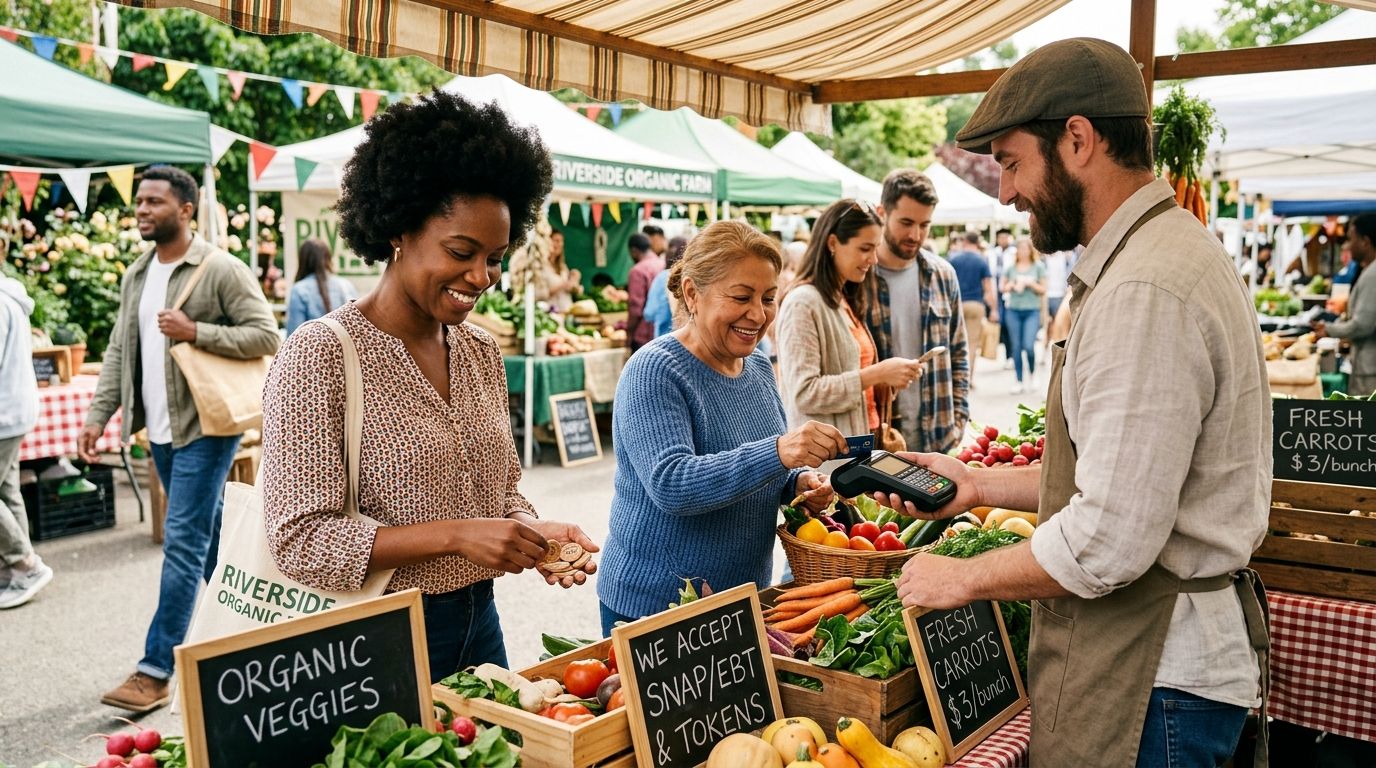
If accepting standard SNAP benefits is a step forward, participating in a Double Up Food Bucks (DUFB) or similar local incentive program is an absolute quantum leap for a farm’s revenue and community impact. The fundamental flaw of SNAP is that twenty dollars simply does not buy very much highly nutritious, locally grown, organic food. DUFB programs solve this by artificially inflating the value of the benefit. When a customer spends twenty dollars of their SNAP EBT on eligible produce at your farmstand, the DUFB program gives them an additional twenty dollars in specialized tokens, physical vouchers, or digital credits that can only be spent on locally grown fruits and vegetables.
For the farmer, this is a financial masterstroke. You sell forty dollars worth of premium produce. The customer only depletes twenty dollars from their federal EBT account. The remaining twenty dollars is reimbursed directly to you by the non-profit organization or state agency administering the DUFB grant. You retain your full retail price margin, the customer walks away with double the volume of healthy food, and the philanthropic funds are injected directly and exclusively into the localized agricultural economy. It is one of the rare instances where agricultural policy perfectly aligns with both capitalistic and humanitarian goals.
Implementing DUFB requires an entirely separate application process, usually managed by a state-level agricultural coalition or a large regional food bank, rather than the federal USDA. The accounting and tracking requirements for DUFB are historically complex. If the program uses physical wooden tokens (a common method at farmers markets), you must rigorously secure these tokens like cash, count them at the end of the day, and submit them manually with physical invoices to the administering agency for reimbursement, which can severely delay your cash flow.
Modern, highly advanced DUFB programs are transitioning to digital loyalty systems integrated directly into third-party POS tablets, allowing the matching funds to be calculated and applied automatically at checkout. Regardless of the mechanism, heavily marketing your participation in DUFB is critical. You must actively educate your local community, hang massive signage, and leverage local social service agencies to broadcast that ten dollars effectively equals twenty dollars at your specific farmstand, instantly neutralizing the price disparity between your heirloom produce and the cheap, processed food at the corporate grocery store.
8. Marketing EBT Acceptance Without Stigmatization
The phrase 'If you build it, they will come' is a catastrophic fallacy when applied to marginalized food systems. Simply acquiring a POS terminal and hanging a tiny, generic EBT sticker on your cashbox will not magically draw a new demographic to your farm. Low-income shoppers have historically been conditioned by high prices and exclusive marketing to assume that organic, local farmstands are not spaces intended for them. Overcoming this deep-seated, systemic socioeconomic barrier requires aggressive, highly empathetic, and incredibly targeted marketing strategies.
First, your physical space must clearly and proudly broadcast your authorization. Utilize the official, high-visibility USDA 'We Accept EBT' banners, but integrate them beautifully into your broader farm aesthetics. Do not banish the signage to a dusty corner. Furthermore, your digital presence must echo this commitment. Every social media post, every email newsletter, and the permanent header of your website must explicitly state that SNAP, EBT, and DUFB are warmly accepted. If you use a exact internal link: /planting-calendar to advertise what crops are coming into season, ensure you explicitly state, 'All incoming spring greens are eligible for EBT and Double Up purchases.'
However, the most effective marketing is not done through broad advertising, but through deep, localized, systemic networking. You must build active, physical relationships with the institutions that already interface with SNAP recipients. Take stacks of your farm's flyers directly to local WIC (Women, Infants, and Children) clinics, county social service offices, local food pantries, and community health centers. Educate the social workers and caseworkers about your farm, your pricing, and your location, so they can directly and confidently refer their clients to you.
Critically, you must aggressively train your farmstand staff to handle EBT transactions with absolute normalization and profound respect. The checkout process must be identical to a credit card transaction—no whispering, no calling a manager over, no hesitations. The language used should be empowering, never patronizing. You are not 'helping the poor'; you are successfully conducting a legitimate, high-value business transaction with a valued community member who is utilizing federal agricultural funds. Maintaining this strict professional dignity is the absolute bedrock of building long-term, fiercely loyal EBT customer bases.
9. Handling Transaction Failures and Offline Processing
In the chaotic, mud-soaked reality of outdoor market farming, technology will inevitably and spectacularly fail. A fierce thunderstorm will knock out the local cellular tower, your POS tablet will inexplicably drop its Bluetooth connection to the PIN pad, or the massive federal EBT gateway servers will temporarily crash under heavy national load. When a customer stands before you with a box of carefully selected produce and the digital terminal refuses to connect, you must possess a flawless, practiced contingency plan, because unlike a credit card, you cannot simply write down an EBT card number and run it later.
Federal law explicitly prohibits 'Store and Forward' or 'Offline' processing for EBT PIN transactions. Because SNAP funds are finite and tightly controlled, the system must verify the exact balance in real-time. If you cannot connect digitally, you must immediately pivot to the archaic, yet legally robust, USDA Manual Voucher system. Your state processor is required to provide you with a stack of serialized carbon-copy paper vouchers. You must physically write the customer's exact 16-digit EBT card number, the exact transaction amount, and your FNS authorization number onto this voucher.
The critical, absolute most important step is the Voice Authorization. You must use your cell phone (or a landline) to call the official EBT Merchant Voice Authorization Hotline. You will navigate an automated system, punch in your FNS number, the customer's card number, and the amount. The automated system will instantly verify the funds and provide you with a 6-digit Voice Authorization Code. You must write this exact code onto the paper voucher, and the customer absolutely must physically sign the voucher. Only then can you release the food to the customer.
Failing to get the Voice Authorization Code, or failing to have the customer sign the paper, means you have literally given the food away for free; the government will never reimburse you. Once the digital system comes back online (or when you return from the market to your farm office), you must manually enter the details of the authorized paper voucher into your POS terminal under a specific 'Clear Voucher' function. This finally pulls the reserved funds from the federal system and triggers the deposit into your bank account. It is tedious, frustrating, and incredibly necessary.
10. Navigating the WIC Farmers Market Nutrition Program (FMNP)
While SNAP EBT is the massive, heavy cruiser of federal food assistance, the WIC Farmers Market Nutrition Program (FMNP) and the Senior Farmers Market Nutrition Program (SFMNP) are the highly specialized, highly targeted tactical vessels. These programs are entirely legally and operationally distinct from SNAP. They do not use the standard EBT card system. Instead, they provide incredibly specific demographics (low-income pregnant women, nursing mothers, young children, and low-income seniors) with specialized funds that can only be spent on raw, locally grown, unprocessed fruits and vegetables directly from authorized farmers.
Crucially, you cannot accept FMNP simply because you have a SNAP FNS number. FMNP is administered at the state level, usually by the State Department of Agriculture or Department of Health, rather than the federal USDA. You must undergo a completely separate, state-specific application and training process to become an authorized FMNP grower. The rules regarding eligible items are vastly more restrictive than SNAP. While SNAP allows the purchase of seeds and imported bananas, FMNP strictly demands that the produce be grown locally (often defined as within state borders) and completely unprocessed (a washed and bagged salad mix might be eligible for SNAP, but illegally processed under FMNP rules).
Historically, FMNP was distributed as physical, highly secure paper checks. Farmers had to meticulously stamp these checks with their unique authorized grower number and physically deposit them at a bank, frequently dealing with horrific bounced checks if a bank teller processed them incorrectly. However, many progressive states are rapidly modernizing the FMNP system, replacing the archaic paper checks with digital smartphone apps or specialized QR codes.
If your state has modernized to digital eFMNP (Electronic FMNP), you will likely be required to download a specific, state-mandated scanning app onto your farm smartphone. You use the camera to scan the customer’s QR code, instantly verifying the funds and processing the transaction without the nightmare of paper banking. Integrating FMNP alongside SNAP requires your farmstand to be a highly agile financial hub, capable of seamlessly switching between EBT PIN pads, state-level QR scanners, and standard credit card readers, all while maintaining a cheerful, welcoming disposition.
11. The Economics of Farmstand Scalability with EBT
There is a deeply entrenched, highly toxic myth within the small-scale agricultural community that accepting federal food benefits is a form of philanthropic charity that inevitably drags down the farm's profit margins. This is an economic fallacy born of misunderstanding. Integrating EBT, when combined with aggressive incentive programs like DUFB, is actually one of the most powerful, highly scalable financial growth engines available to a direct-to-consumer farm. It fundamentally unlocks a massive, entirely untapped reservoir of federally guaranteed capital that is actively seeking localized outlets.
Consider the basic economics of scale on a market farm. Your highest costs are fixed: tractor depreciation, greenhouse infrastructure, land taxes, and the base labor required to manage the ecosystem. When you only sell to the upper-middle class, your market cap is violently restricted by the local demographics of affluence. If you hit market saturation within that affluent demographic, your farm stagnates; you cannot grow more food because you have no one to sell it to. By opening your payment gateways to EBT, you instantly, violently expand your Total Addressable Market (TAM) by incorporating the 10% to 15% of your local population utilizing SNAP.
This sudden influx of new customers allows you to safely and confidently scale up your production volume. As you produce more volume, your fixed overhead costs are distributed across a much larger number of units (pounds of tomatoes, bunches of kale), significantly lowering your Cost of Goods Sold (COGS). Even though you are not charging the SNAP customer more, your overall farm profitability increases because you are operating at a much higher, more efficient volume.
Furthermore, SNAP dollars act as an incredible macroeconomic shock absorber. During periods of severe local economic recession or widespread layoffs, standard retail spending at farmers markets plummets rapidly as affluent consumers tighten their discretionary budgets. However, during these exact same recessions, enrollment in SNAP drastically increases. If your farm is fully authorized and highly trusted within the EBT community, your revenue will miraculously stabilize or even grow during an economic downturn, heavily insulated by the counter-cyclical nature of federal food assistance programs. It is a brilliant, highly resilient business architecture.

12. Security, Fraud Prevention, and USDA Audits
The federal government does not distribute billions of dollars without expecting absolute, unyielding accountability. The USDA FNS employs highly sophisticated, algorithmic data-mining software to constantly monitor every single EBT transaction processed across the country in real-time. They are aggressively, relentlessly hunting for patterns indicative of 'trafficking'—the illegal exchange of SNAP benefits for cash, drugs, or ineligible items. As a Direct Marketing Farmer, you are not immune to this surveillance; you are actively participating in it.
Trafficking algorithms look for highly specific, suspicious anomalies. If your farmstand suddenly processes an abnormal cluster of massive, exact-dollar transactions (e.g., ten consecutive charges for exactly $150.00) late at night when the farmers market is clearly closed, the USDA system will instantly flag your FNS number. If a customer repeatedly depletes their entire monthly SNAP balance at your farmstand within two minutes of the funds being deposited, you will be flagged. Once flagged, you will be subjected to a grueling, unannounced federal audit.
During an audit, federal investigators will demand to see your exact, detailed sales ledgers, your banking deposit records, and physical proof that you possessed enough eligible agricultural inventory to legally justify the amount of EBT revenue you processed. If you claim to have sold $5,000 worth of SNAP-eligible tomatoes in January in a freezing climate without proof of a massive, heated greenhouse operation, you will fail the audit. Furthermore, they may deploy undercover investigators to your farmstand, intentionally attempting to buy hot food, soap, or demand cash back on an EBT card to see if your employees violate the law.
The penalties for failure are catastrophic. At minimum, you will face severe financial fines and restitution of the disputed funds. For intentional trafficking, you will be permanently, irrevocably disqualified from ever accepting SNAP benefits again, and you may face federal criminal prosecution for wire fraud. Therefore, massive, paranoid security protocols are mandatory. You must physically secure your POS terminals to prevent unauthorized access, strictly train your staff, instantly terminate any employee caught violating the rules, and maintain your agricultural bookkeeping with the precision of a Wall Street accounting firm. Your farm's integrity and its very survival depend on absolute, unyielding compliance.
Expert Insights & FAQs
How long does the USDA FNS application process take for a farm?
The standard processing time for a Direct Marketing Farmer FNS application is officially 30 to 45 days after all required documentation has been perfectly submitted. However, minor errors, blurry photo ID uploads, or seasonal application backlogs can easily delay the process to 60 or 90 days.
Can I legally charge SNAP customers a fee to cover the credit card processing costs?
Absolutely not. Federal law strictly and explicitly prohibits SNAP authorized retailers from charging any surcharges, processing fees, or minimum purchase amounts to EBT customers. The transaction cost must be entirely absorbed by the farm as a standard cost of doing business.
Are cut flowers and ornamental plants eligible for EBT purchase?
No. Cut flowers, ornamental gourds, decorative wreaths, and any plant not explicitly grown for human consumption are strictly prohibited. However, seeds and starts for food-producing plants, like tomato seedlings or basil plants, are fully and legally eligible.
What happens if the cellular network goes down at the farmers market?
You cannot process EBT transactions offline. You must utilize the official USDA Manual Paper Voucher system, call the federal Voice Authorization Hotline to lock in the funds, write the authorization code on the voucher, and have the customer physically sign it before handing over the produce.
Do I have to pay state sales tax on items sold through EBT?
No. Federal law mandates that all eligible food items purchased with SNAP/EBT benefits are strictly exempt from all state, county, and local sales taxes. Your POS system must automatically remove the tax burden when the EBT payment method is selected.
Can I accept SNAP benefits for my traditional, upfront-payment CSA model?
No, the USDA prohibits using SNAP funds to pay for food more than 14 days in advance. To accept EBT for a CSA, you must legally restructure the program into a Pay-As-You-Go or weekly installment model where the customer pays at the exact moment of pickup.
Is the Double Up Food Bucks (DUFB) program automatically included with my FNS number?
No. DUFB and similar incentive programs are entirely separate grants usually administered by state-level non-profits or agricultural coalitions. You must undergo a completely separate application and training process to be authorized to distribute and redeem DUFB incentives.
What is the penalty for selling hot, prepared food to a customer using EBT?
Selling hot, prepared food meant for immediate consumption is a severe federal violation. Penalties can range from massive financial fines, temporary suspension of your FNS authorization, or permanent, irrevocable disqualification from the SNAP program.
Johnnie McCormick
Zone 7b/8a - North Central Alabama
Johnnie McCormick is a gardening hobbyist and the founder of My Garden Spot. Raised in north-central Alabama, his passion for gardening began in his youth. In 2008, he established a large market garden, teaching himself high-yield growing methods. In the years since, he has operated seasonal seedling sales for transplants, specializing in heirloom tomatoes, peppers, eggplants, decorative ground covers like Ajuga (Bugleweed), marigolds, nasturtiums, and fresh kitchen-window herb arrangements (basil, cilantro). Today, he gardens in the hills between Birmingham and Jasper, Alabama (Zone 7b/8a), sharing practical, community-focused gardening resources.
Verified Authoritative Citations & References
In alignment with our strict E-E-A-T research and verification guidelines, this guide cross-references data from the United States Department of Agriculture (USDA) and Cooperative Extension Service programs.
- USDA Agricultural Marketing Service (AMS): Community Supported Agriculture (CSA) standards and local market surveys. ams.usda.gov
- Penn State Extension: Small Farm Economics, financial planning, and crop pricing research documents. extension.psu.edu
- Cornell Cooperative Extension: Market gardening business planning and local sales guidelines. smallfarms.cornell.edu
- Alabama Cooperative Extension System (ACES): Local food regulations, CSA legal permits, and farm safety standards. aces.edu

Please log in to view comments.