How Do You Build, Legalize, and Run a Profitable Backyard Farmstand or Driveway Honesty Box?

How Do You Build, Legalize, and Run a Profitable Backyard Farmstand or Driveway Honesty Box?
There is an electrifying sensation the first time a car pulls up to the end of your driveway, a complete stranger steps out, slips a folded five-dollar bill into a wooden box, and drives away with a bag of lettuce you cut from your garden that morning.
Up until that exact moment, gardening is an expense. You buy compost, drip fittings, seed packets, and organic fertilizer. You pour hundreds of hours of sweat into preparing beds and pulling weeds. But the second that first dollar drops into the box, the entire equation shifts. Your backyard garden stops being an expensive recreational hobby and officially transforms into a revenue-generating micro-enterprise.
A roadside farmstand or driveway honesty box is the absolute lowest-barrier entry point into commercial market gardening. You do not need to wake up at 4:30 AM to haul tents, tables, and weights to a downtown farmers market. You do not have to pay stall fees, negotiate with demanding restaurant chefs, or commit to delivering weekly CSA boxes across town. Your storefront sits right at the edge of your property, open on your own schedule, converting your garden surplus into cold, hard cash while you are inside eating dinner or working out in the beds.
Yet running a successful driveway stand is far more nuanced than setting a wobbly card table near your mailbox with a cardboard sign reading "Extra Squash." Without understanding local zoning bylaws, cottage food regulations, structural weatherproofing, theft psychology, and retail merchandising, an ambitious grower can run straight into municipal fines, spoiled produce, or stolen cash boxes.
I set up my first driveway farmstand back in 2008 down here in central Alabama. Over the past nearly two decades, I have experienced every conceivable triumph and headache this sales channel can throw at you—from torrential thunderstorms soaking cardboard egg cartons to figuring out how to stop teenagers from fishing twenty-dollar bills out of an honesty slot with double-sided tape on a wire hanger.
This comprehensive guide breaks down the entire operational playbook: navigating the legal and zoning landscape, building a weather-resilient physical structure, engineering foolproof payment systems, curating high-margin inventory, and building a fiercely loyal hyper-local customer base.
The Legal and Regulatory Framework: Zoning, Permits, and Food Safety
Before you purchase a single cedar 2x4 or paint an open sign, you must establish whether you can legally sell produce from your property. Agricultural regulations in North America are hyper-local; rules that apply in an unincorporated rural county can be entirely different from the municipal codes enforced five miles down the road inside city limits.
Understanding Right-to-Farm and Agricultural Exemptions
In almost every American state, Right-to-Farm Acts protect bona fide agricultural operations from nuisance lawsuits and restrictive local ordinances. However, whether a quarter-acre or half-acre suburban backyard qualifies as an "agricultural operation" depends heavily on statutory definitions.
- Raw Agricultural Commodities (RACs): The sale of whole, uncut, unprocessed fruits, vegetables, culinary herbs, and nuts is virtually unrestricted across the United States. Under federal FSMA (Food Safety Modernization Act) rules and state agricultural department codes, selling a head of lettuce, a bunch of carrots, or a pint of unsliced tomatoes from the ground where they were grown does not require a commercial food processing license or a health inspection. The product has not been altered; it is considered an agricultural raw commodity.
- Cottage Food Laws: The moment you cut, cook, pickle, bake, or preserve an agricultural product, you step out of the raw commodity classification and into the realm of food processing. If you want to sell sourdough bread, strawberry jam, dried tea blends, or pickled peppers alongside your fresh vegetables, you must comply with your state's specific Cottage Food Laws. While most states allow home bakers to sell non-hazardous foods without a commercial kitchen, many require specific warning labels (e.g., "Made in a home kitchen not inspected by the Department of Health"), a nominal annual registration, or food handler certification.
- Shell Eggs: Backyard chicken eggs are a phenomenal draw for a driveway stand, but states regulate egg sales strictly based on flock size. In Alabama, Georgia, and many other states, small producers with fewer than 500 to 3,000 birds are exempt from mandatory USDA egg candling and grading facilities, provided the eggs are clean, stored at or below 45°F (7°C), packaged in clean cartons labeled with the farm name, address, collection date, and marked as "Ungraded Farm Eggs."
Municipal Zoning Ordinances and HOA Covenants
While state agricultural departments are generally supportive of small farmers, local municipal zoning boards and Homeowners Associations (HOAs) are frequently where backyard growers encounter friction.
- Commercial Activity in Residential Zones: Most suburban municipalities classify driveway stands under "Home Occupations." Check your city or county zoning ordinances for clauses regarding accessory structures, on-site retail traffic, and off-street parking. In many jurisdictions, seasonal roadside farmstands selling produce grown on-site are permitted "by right," provided the structure is temporary, does not exceed a certain footprint (typically 50 to 100 square feet), and is set back at least 15 to 20 feet from the public road right-of-way.
- Road Right-of-Way Restrictions: Never place a farmstand within the municipal or county road right-of-way (often extending 10 to 15 feet from the edge of the asphalt or ditch line). Doing so gives the department of transportation the authority to impound your stand or cite you for obstructing sightlines for vehicular traffic.
- HOA Covenants: If you live within a neighborhood governed by a mandatory HOA, private deed covenants almost universally prohibit visible retail commerce, exterior commercial signage, and roadside traffic. If you are under an HOA, an outdoor driveway honesty box will likely draw immediate violation letters. In that scenario, your legal alternative is an "Online Pre-Order Porch Pickup" model, where neighbors purchase online and pick up their bagged orders from a discreet bench on your covered front porch.
For deeper technical guidance on roadside marketing legalities and farmstand permitting, consult the University of Vermont Extension Agricultural Business and Marketing Resources, which publishes authoritative studies on direct-to-consumer farm retail compliance.
Farm Liability and Property Insurance
Do not assume your standard homeowner's insurance policy covers commercial retail activity on your driveway. If a customer trips over a landscaping rock, gets stung by a wasp on your property, or claims foodborne illness, your homeowner's insurance carrier could deny coverage on the grounds that you were conducting an unendorsed commercial business.
Protect yourself by securing a dedicated Farm Liability Insurance Policy or adding a commercial agricultural rider to your existing homeowner's policy. For a small backyard operation generating under $25,000 annually, a $1,000,000 general aggregate liability policy typically costs between $300 and $550 per year. It provides complete peace of mind, protecting your personal home and assets while your stand operates unattended.
Architectural Anatomy of a High-Performance Farmstand
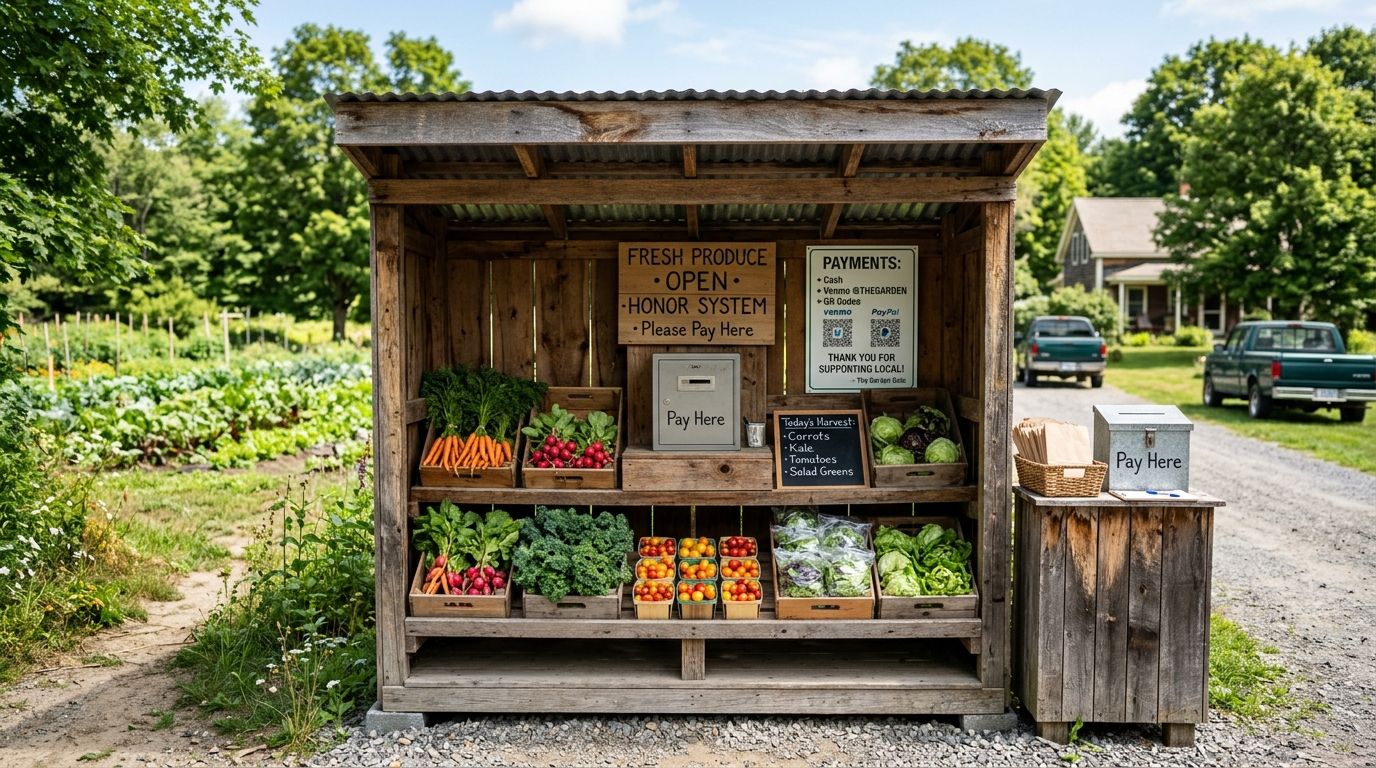
A farmstand must perform three distinct architectural functions: it must attract passing motorists from fifty yards away, protect delicate produce from blistering sun and torrential rain, and withstand unattended exposure to the elements for years.
Site Selection and Traffic Physics
Where you place your stand relative to the roadway determines your daily sales volume. A stand hidden behind an overgrown hedge or placed on a blind curve where cars travel at 55 mph will fail, regardless of how beautiful your produce looks.
- Stopping Sight Distance (SSD): A vehicle traveling at 45 mph requires roughly 360 feet to perceive a visual cue, brake safely, and execute a turn. Your farmstand structure—or your advance road signage—must be clearly visible well before the driver reaches your driveway.
- Safe Pull-Off and Turnaround: Customers will not stop if pulling over feels dangerous or if they fear backing out into oncoming high-speed traffic. Ensure your driveway entrance offers a dedicated gravel apron or wide pull-off area capable of accommodating at least two parked vehicles without blocking your family driveway.
- Solar Orientation and Microclimate: Never face the open front of your farmstand directly toward the south or west. In the Northern Hemisphere, afternoon southern and western sun exposure creates intense radiant heat that will turn crisp lettuce, spinach, and cilantro into unmarketable compost within two hours. Face the open mouth of your kiosk toward the North or East, where it remains in shaded, ambient cool throughout the hottest hours of the day.
Framing and Construction Specs
A sturdy, weather-resistant farmstand kiosk can be built over a single weekend using standard dimensional lumber and basic carpentry tools for less than $400 in materials.
| Component | Recommended Material | Architectural Function |
|---|---|---|
| Foundation Skids | Two 4x4-inch Pressure-Treated Skids | Elevates structure 4 inches above bare ground; allows the entire kiosk to be hooked to a truck hitch and moved if necessary. |
| Floor Framing | 2x4-inch PT Joists with 3/4-inch Exterior Plywood | Creates a rigid, rot-resistant deck capable of supporting 500+ lbs of heavy coolers and harvest crates. |
| Wall Framing | 2x4-inch Construction-Grade SPF Studs | 16-inch on-center wall framing provides rock-solid structural backing for interior shelving and exterior cladding. |
| Exterior Siding | Rough-sawn Cedar, Board & Batten Pine, or Reclaimed Pallet Wood | Delivers an authentic, high-value pastoral aesthetic that commands premium organic retail pricing. |
| Roof Structure | Corrugated Galvalume Metal over 2x4 Rafters with a 3:12 Pitch | Sheds heavy rain, withstands fallen branches, and reflects solar radiant heat away from the produce compartment. |
| Overhang Eaves | Minimum 12 to 18-inch Front and Side Roof Overhangs | Prevents driving rain from blowing into produce displays; casts permanent shade across top shelves. |
Thermal Management: Keeping Cool Without Running Grid Power
Produce respiration is an exponential reaction to temperature. For every 10°F (5.5°C) increase above optimal storage temperatures, a head of lettuce consumes its stored sugars and transpires moisture three times faster.
Unless you run a 110V electrical line out to your driveway to power a commercial glass-door merchandiser, you must use passive thermodynamic principles to keep your produce crisp:
- Double-Wall Insulation: Line the ceiling and back wall of your kiosk with 1.5-inch R-10 foil-faced polyisocyanurate rigid foam insulation boards hidden behind thin cedar siding. The foil face reflects radiant roof heat upwards, keeping interior ambient temperatures 10°F to 15°F cooler than the outside air.
- Rotomolded Marine Coolers: For temperature-sensitive items like bagged baby salad greens, spinach, and farm eggs, avoid displaying them loose on open shelves during summer afternoons. Instead, house them inside high-efficiency rotomolded marine coolers (such as Yeti, RTIC, or Coleman Xtreme) placed on a designated counter within the stand.
- Frozen Water Jug Buffering: Never use loose crushed ice inside produce coolers; ice melt pools at the bottom of the cooler, submerging vegetable bags and causing rapid bacterial rot ( Erwinia soft rot). Instead, freeze gallon jugs of drinking water solid. Place two frozen gallon jugs on the bottom of each cooler, cover them with an elevated plastic draining rack, and arrange bagged greens on top. This maintains a steady 38°F to 42°F (3°C to 5°C) air envelope inside the cooler for eight to ten hours without soaking the produce.
- Passive Ridge Ventilation: Hot air naturally rises. Incorporate a 2-inch screened air gap beneath the roof ridge to allow trapped warm air to vent passively out the top, drawing cooler air across the lower shelves from shaded bottom vents.
Payment Infrastructure: Cash Boxes, Digital QR Codes, and Loss Mitigation
The defining feature of an "Honesty Box" is that it operates without a physical cashier. You trust your neighbors and community to take what they want and pay what they owe.
For beginners, this honor system is terrifying. The most common question asked by prospective farmstand operators is: "Won't people just steal everything?"
The data from thousands of small-scale farmstands across the country paints a remarkably consistent picture: shrinkage (unpaid product loss) across honor-system farmstands averages between 3% and 7%. In commercial retail grocery chains, loss from employee theft, customer shoplifting, and damaged goods routinely reaches 2% to 4%. When you factor in the massive financial overhead saved by not hiring an employee to stand by your driveway for eight hours a day ($120+ per day at minimum wage), absorbing a 5% inventory loss is an overwhelmingly profitable trade-off.
However, keeping loss below that 5% threshold requires intentional psychological and physical engineering.
Building an Unbreachable Cash Drop Box
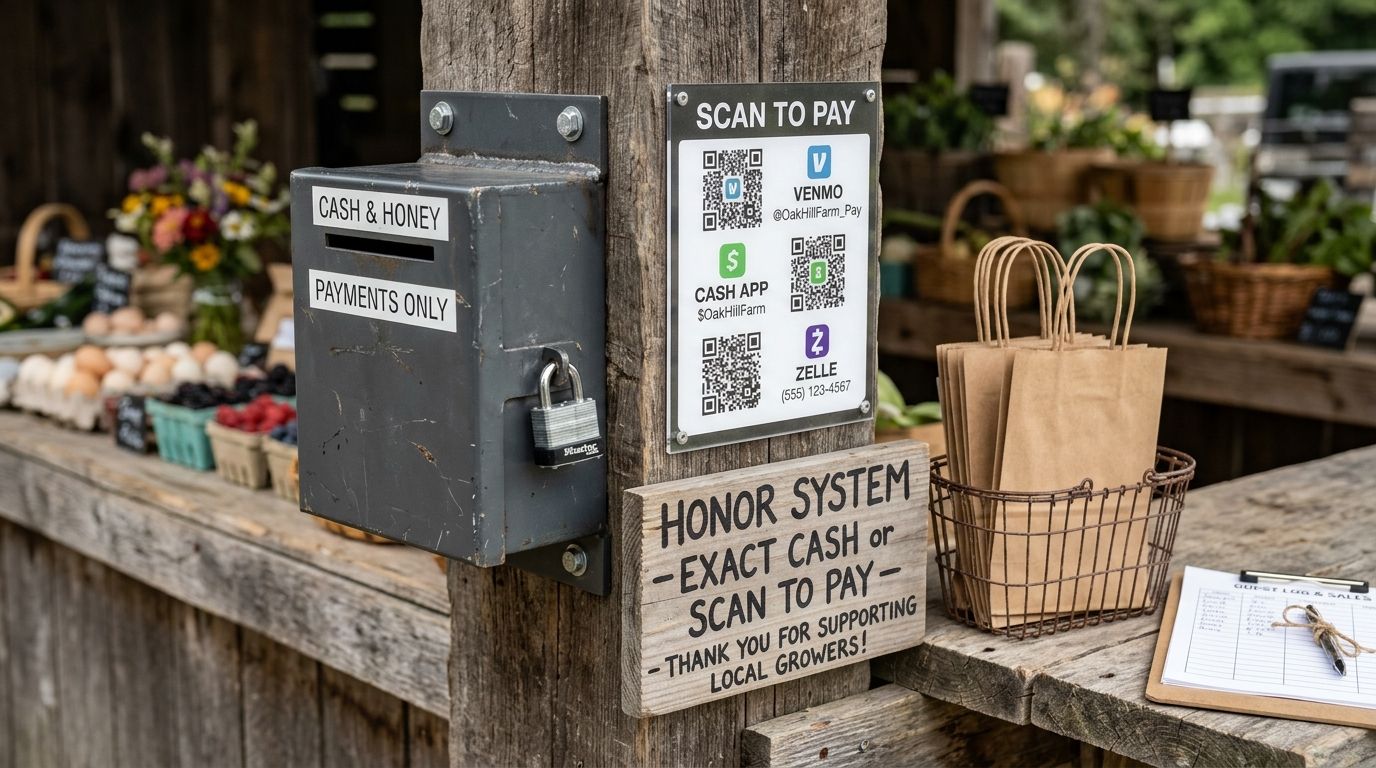
Never use an open cigar box, an unlocked metal cash tin, or a wooden slotted box with a cheap padlock screwed into soft pine. An opportunistic thief can pry open a small hasp with a pocketknife in four seconds.
Your cash box must be engineered as an immovable drop safe:
- Heavy-Gauge Welded Steel: Use a heavy 14-gauge or 12-gauge powder-coated steel depository drop box designed for commercial night drops. These boxes feature an internal jagged baffle or anti-phishing teeth behind the deposit slot, making it physically impossible for someone to insert fingers, wire hooks, or adhesive tape to retrieve folded cash.
- Through-Bolt Mounting: Do not mount the box with simple 1-inch wood screws. Fasten the box directly to a structural 4x4 or 4x6 post using four 3/8-inch galvanized carriage bolts with washers and locking nuts secured inside the locked compartment. To steal the box, a thief would have to saw through a four-inch timber post with a chainsaw.
- Heavy Padlock or Commercial Cam Lock: Secure the retrieval door with a shielded, hardened-steel disc padlock (such as an ABUS or Master Lock Discus) that cannot be cut with standard handheld bolt cutters.
- Routine Daily Empties: Establish a strict daily habit of emptying the cash box every evening before dusk. Never leave cash in the box overnight. Leaving large sums of cash sitting in an outdoor box overnight invites deliberate vandalism.
The Modern Digital Revolution: QR Code Payments
In 2008, 95% of farmstand transactions were physical cash. Today, fewer than 20% of American consumers carry cash on a daily basis. If your farmstand only accepts paper currency and coins, you are abandoning up to 70% of your potential gross revenue. Motorists will pull over, admire your heirloom tomatoes, realize their wallet only contains debit cards, and drive away empty-handed.
Eliminating this friction requires turning your farmstand into a multi-channel digital checkout:
- Dual QR Payment Signage: Create a professional, weather-resistant acrylic or laminated aluminum sign displaying high-contrast QR codes linked directly to your commercial business profiles on Venmo, Cash App, Zelle, and PayPal.
- Handle and Username Redundancy: Below each QR code, print your exact account handle (e.g.,
@OakHillFarm_Pay) and phone number in bold, clean lettering. Occasionally, older smartphones struggle to scan printed QR codes in bright sunlight; having the manual username allows customers to search and pay instantly without frustration. - Square Contactless Hardware (Optional): If your driveway is close enough to your house to connect to your home Wi-Fi network, you can mount an all-weather weatherproof housing containing an automated Square Terminal or tap-to-pay sensor. Customers simply tap their Apple Pay, Google Pay, or chip card on the sensor, which automatically logs the transaction into your accounting ledger.
Theft Mitigation Psychology: Behavioral Nudges
Petty theft is rarely committed by hardened professional criminals; it is almost entirely opportunistic, committed by individuals who convince themselves that "nobody is watching" or that "this is a massive farm that won't miss five dollars."
You can cut theft in half simply by altering the psychological environment of your stand:
- The Visible Camera Plaque: Mount a clean, highly visible weatherproof sign at eye level: "Smile! For your safety and farm security, this stand is monitored by 24/7 video surveillance." Even if you are simply using a $40 motion-activated cellular game camera or a solar-powered security camera tucked under the eaves, the mere presence of visible security signage eliminates 80% of opportunistic theft.
- The Neighborhood Guest Log: Place a wooden clipboard on the counter with a tethered pen and a lined notebook titled "Customer Guest Log & Feedback." Invite visitors to sign their name, note what they bought, and write down what crops they want to see next week. Psychologically, signing one's name shifts an anonymous stranger into an accountable community member. People do not steal from neighbors whose guest book they just signed.
- Warm Human Personalization: Frame a high-quality 8x10 photograph of your family standing in the garden, accompanied by a short handwritten note: "Welcome to our family micro-farm! We are the McCormicks. We hand-pick every vegetable in this stand each morning for our neighbors. Thank you for supporting honest local food." Humanizing the transaction destroys the cognitive dissonance required to steal. It is easy to take five dollars from a nameless corporate entity; it is excruciatingly uncomfortable to steal five dollars from a smiling family whose picture is looking right at you.
Merchandising, Pricing, and Product Curation
A backyard farmstand is not a wholesale packing house; it is a boutique retail destination. Your produce must look, smell, and feel head-and-shoulders above the tired, plastic-wrapped vegetables sitting under fluorescent grocery store lights.
Merchandising Principles: Abundance, Contrast, and Cleanliness
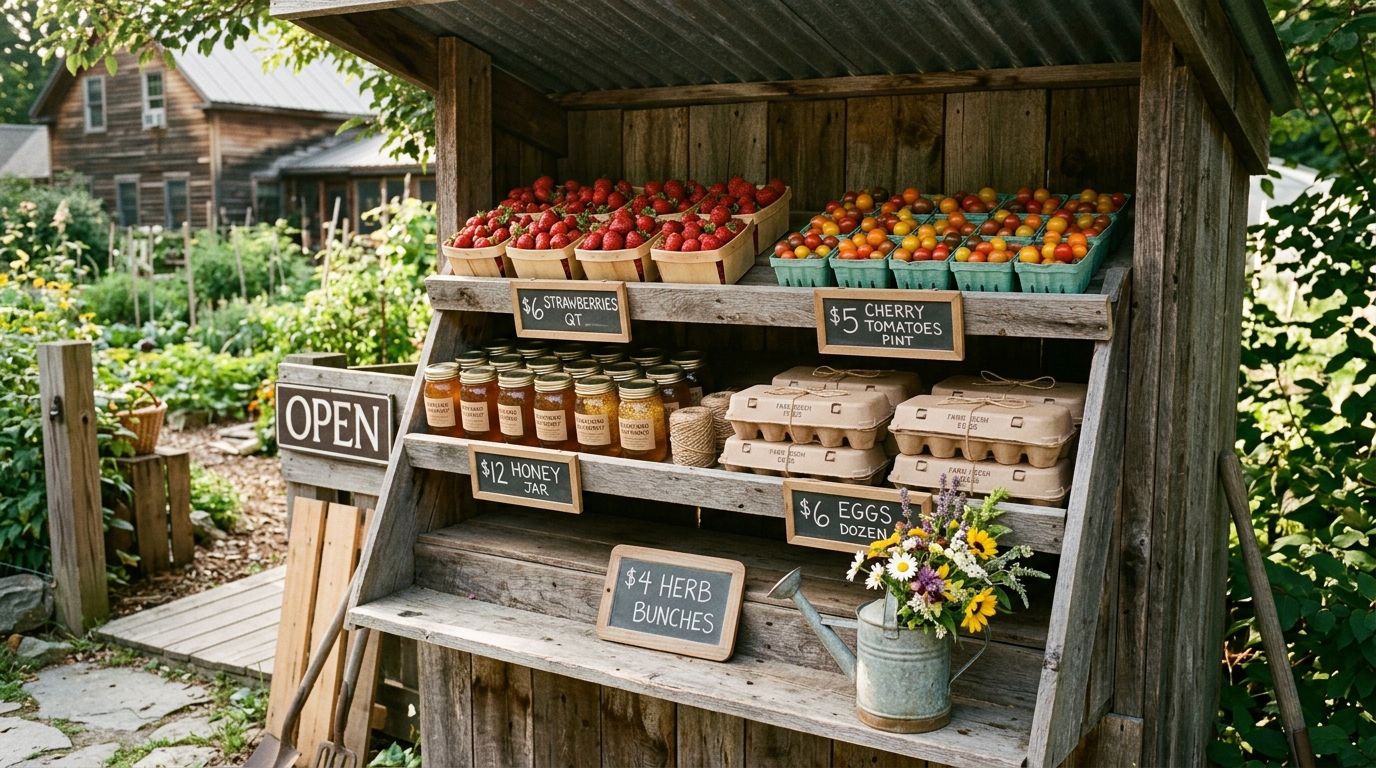
Consumers shop with their eyes. A barren shelf holding two lonely, bruised zucchini screams "leftovers." An artfully arranged stand brimming with contrasting colors and pristine wooden crates triggers an instinctual buying response.
- The Rule of Visual Contrast: Never place crops of the same color adjacent to one another. Do not put green head lettuce next to green kale and green cucumbers; the display washes out into an indistinct green blob. Alternate your visual palette: place bright orange bunched carrots next to dark green Tuscan kale, followed by vibrant red radishes, deep purple eggplant, and golden yellow squash.
- Elevated Displays (The Diamond Zone): In retail psychology, merchandise placed between waist height and eye level (30 to 50 inches from the ground) captures 80% of consumer attention. Never place unpackaged vegetables on the floor of the stand. Reserve your top and middle tilted shelves for high-margin, visually arresting impulse items (heirloom cherry tomato pints, fresh cut flowers, and local honey).
- Wooden Crates and Natural Packaging: Avoid neon plastic milk crates or flimsy supermarket grocery bags. Use unfinished pine harvest flats, split-wood peach baskets, green pulp berry baskets, and brown craft paper shopping bags with natural jute handles. Natural materials reinforce the organic, artisanal narrative that justifies your premium pricing.
The Grab-and-Go Pricing Architecture
An honor-system honesty box cannot handle complex pricing equations. If a customer has to weigh seven loose carrots on an uneven mechanical scale, multiply by $2.39 per pound, calculate tax, and realize they only have a ten-dollar bill, the sale is lost.
Standardize your farmstand pricing on flat, whole-dollar denominations:
- $3.00 Items: Bunched breakfast radishes, culinary herb bundles (rosemary, thyme, cilantro, mint), single slicing cucumbers, garlic heads.
- $4.00 Items: Bunched rainbow carrots, heads of crisp Salanova lettuce, bunches of curly or Lacinato kale, rainbow Swiss chard.
- $5.00 Items (The Workhorse Price Point): 5-ounce clear bags of washed, spun baby salad mix or baby arugula; 1-pint fiber baskets of multicolored heirloom cherry tomatoes; 1-quart baskets of fresh pickling cucumbers.
- $6.00 to $8.00 Premium Anchors: 1-dozen pasture-raised farm eggs ($6.00); 1-pound clamshells of gourmet culinary mushrooms ($8.00); 12-ounce glass jars of raw local honey ($8.00 to $12.00); hand-tied bouquets of cut flowers ($8.00 to $10.00).
Whole-dollar pricing ensures customers can easily combine items ($5 salad + $5 tomatoes + $6 eggs = $16, or an even $20 bill dropped into the box with a four-dollar tip). Never charge fractions of a dollar; eliminating loose change simplifies the honor system and drastically increases average transaction values.
Use our interactive Garden Calculator & Planting Planner to determine your exact seed-to-harvest input costs and target profit margins per square foot before setting your retail prices.
High-Margin "Hero Crops" for Driveway Stands
Not all garden vegetables are suited for a farmstand. Large, low-margin crops that occupy bed space for months (such as winter cabbage, field corn, or storage potatoes) are terrible enterprise choices for a driveway stand. You want high-value, quick-turn, perishable items that neighbors cannot find in peak freshness at Walmart.
| Hero Crop | Presentation Format | Unit Price | Shelf Life at Stand | Why It Sells |
|---|---|---|---|---|
| Gourmet Baby Salad Mix | 5 oz micro-perforated poly bag | $5.00 | 8 - 10 hours in cooler | High turnover; superior crispness compared to grocery clamshells; steady weekly staple. |
| Heirloom Cherry Tomatoes | 1-pint green pulp basket | $5.00 | 24 - 48 hours | Visually stunning colors (Sun Gold, Black Cherry); irresistible sweet snack for passing motorists. |
| Bunched Rainbow Carrots | 5 - 6 roots with feathery green tops | $4.00 | 12 - 18 hours | Green tops scream "picked today"; children love rainbow colors (purple, yellow, orange). |
| Pasture-Raised Eggs | Recycled brown paper carton tied with twine | $6.00 | 12 - 24 hours in cooler | The ultimate traffic driver; customers stop for eggs 52 weeks a year and buy vegetables on impulse. |
| Fresh Culinary Herb Bundles | Clear vented herb pouch with water sponge | $3.00 | 6 - 8 hours in shade | High profit margin per square foot; immediate aromatic aroma inside the stand kiosk. |
| Hand-Tied Cut Flower Bouquets | Kraft paper sleeve in galvanized flower bucket | $8.00 - $12.00 | 24 hours in fresh water | High impulse purchase; massive visual curb appeal from the road; 80%+ profit margin. |
Daily Operational Rhythms and Restocking SOPs
A driveway farmstand is not a passive vending machine. It requires daily operational discipline to maintain food safety, visual appeal, and customer trust. If a customer stops twice and finds wilted greens or empty shelves, they will never stop a third time.
The Morning Restock Checklist (7:00 AM - 8:30 AM)
Your stand must be stocked and pristine before the morning commute begins:
- Sweep and Sanitize: Sweep the kiosk floor to remove spider webs, blown leaves, and dirt. Wipe down wooden shelves and cooler interiors with a food-safe organic sanitizer (such as dilute food-grade hydrogen peroxide or vinegar solution).
- Harvest and Cool: Harvest cold-sensitive greens, herbs, and roots early while field heat is at its absolute lowest. Spin greens dry and chill in your farm walk-in cooler before loading into the farmstand coolers.
- Stock Coolers First: Place fresh frozen water jugs inside the produce coolers. Load bagged greens, eggs, and herbs.
- Arrange Open Displays: Stage room-temperature items on the wooden shelves: tomatoes, garlic, potatoes, onions, honey, and cut flowers.
- Update Chalkboard Signs: Write down today's harvest varieties and pricing in clean, legible handwriting on your main chalkboard slate. Erase yesterday's date and write today's date prominently to assure customers everything is freshly harvested.
- Deploy Road Signage: Put out your roadside sandwich board or flip your permanent road sign from "Closed" to "Open."
Daily Farmstand Operational Timeline
├── 07:00 AM: Field harvest greens & herbs; wash, spin & chill in walk-in cooler
├── 08:00 AM: Sweep stand; wipe shelves; stock coolers with fresh ice jugs & bagged produce
├── 08:30 AM: Update chalkboard prices & date; flip roadside sign to "OPEN"
├── 01:00 PM: Midday Check: refresh ice jugs, pull any heat-stressed produce, straighten displays
├── 06:30 PM: Evening Rush Check: ensure eggs and salad mix are restocked for dinner commuters
└── 08:00 PM: Closing SOP: retrieve cash drop box; move unsold greens to cooler; flip sign to "CLOSED"
The Midday Quality Audit (1:00 PM)
Take two minutes during your lunch break to inspect the stand. In the heat of the afternoon:
- Check the internal temperature of your produce coolers. Swap out melted ice jugs for fresh frozen ones if necessary.
- Re-align produce crates. As customers pick through displays, items become disheveled. Pull remaining inventory forward to maintain the illusion of an abundant, full shelf.
- Remove any damaged or wilting produce. One slimy lettuce leaf or soft tomato ruins the perception of the entire stand. Move past-prime produce to your farm compost pile or feed it to your laying hens.
The Evening Cash-Out and Close (8:00 PM / Dusk)
Operating an honesty box overnight in total darkness is an unnecessary security risk. Close the stand at dusk:
- Pull the Cash Safe: Unlock the steel drop box, count the physical cash, log the total in your daily revenue spreadsheet, and cross-reference against digital Venmo and Cash App notifications received that day.
- Secure Unsold Perishables: Move remaining bagged greens and farm eggs back into your walk-in farm cooler or home refrigerator. Hardy root crops, onions, garlic, and winter squash can remain locked inside the kiosk if protected from nocturnal wildlife (raccoons, possums, and rodents).
- Turn Off Lighting: Extinguish exterior solar accent lights and flip your road sign to "Closed."
Marketing and Community Customer Acquisition
Building a farmstand does not guarantee customers. Even if you live on a well-traveled rural or suburban road, motorists are creatures of habit. They drive past your property on autopilot, thinking about work, traffic, or school drop-offs. You must disrupt their routine and turn your driveway into a regular destination.
The "Rule of Three" Roadside Signage Strategy
A driver traveling at 45 mph cannot read a detailed produce menu on a single roadside sign. You must implement a three-stage progressive signage system along your road corridor (subject to local highway regulations):
- Sign 1 (300 Yards Ahead): Early Warning Sign. "Fresh Farmstand Ahead - 300 Yards on Right." This primes the driver's brain and gives them time to check their rearview mirror and begin decelerating.
- Sign 2 (100 Yards Ahead): Value Proposition Sign. "Fresh Sweet Strawberries & Farm Eggs Today!" Highlights your most compelling hero item to trigger the impulse stop.
- Sign 3 (Driveway Entrance): Action Sign. "TURN HERE - Farmstand Open." Large, bold letters accompanied by a high-contrast arrow pointing directly into your gravel driveway pull-off.
Use bold, sans-serif typography with high color contrast (e.g., dark hunter green or black text on a clean white background, or bright yellow lettering on dark wood). Keep wording to four words or fewer per sign.
Dominating Hyper-Local Social Media
Your best customers live within a three-mile radius of your driveway. Modern social media provides free, pinpointed access to this exact demographic:
- Neighborhood Facebook Groups & Nextdoor: Join every neighborhood association, town community, and local gardening group within a five-mile radius. Post a friendly, photo-rich update once or twice a week: "Good morning, neighbors! We just stocked the driveway farmstand on Old Mill Road with fresh-picked Cherokee Purple tomatoes, sweet Hakurei turnips, and brown farm eggs. Honor box is open until dusk!" Highlighting real photos of pristine food taken that morning generates immediate, passionate foot traffic.
- The "Farmstand Bell" Text or Email Alert: Place an email signup clipboard inside the kiosk or print a QR code linking to a simple Mailchimp or Substack newsletter. Send a short, one-paragraph alert every Friday afternoon: "What's in the stand this weekend." Dedicated regulars will plan their Saturday morning errands specifically around stopping at your stand before your popular items sell out.
- Google Business Profile: Create a free Google Business Profile for your micro-farm (e.g., "Oak Hill Farmstand & Honesty Box"). Set your category to "Farm" or "Produce Market." When local residents search Google Maps for "fresh produce near me" or "farm fresh eggs near me," your driveway stand will appear with your hours, photos, and customer reviews. This single digital asset drives dozens of high-intent travelers directly to your driveway every single month.
For detailed strategies on scaling your garden surplus into structured market channels, read our foundational guide on transitioning from a hobby gardener to a commercial market gardener on a quarter acre.
The 6-Month Farmstand Launch Checklist
Transforming your backyard garden into a thriving driveway enterprise requires a systematic progression. Follow this six-month roadmap to build, legalize, and launch your farmstand before the peak growing season arrives:
Driveway Farmstand Launch Roadmap
├── Month 1: Regulatory Audit & Site Planning
│   ├── Audit county zoning codes, road setback requirements, and right-to-farm statutes.
│   ├── Confirm cottage food exemptions and state egg licensing thresholds.
│   └── Assess driveway sightlines, vehicle stopping distance, and pull-off gravel space.
├── Month 2: Structural Design & Material Procurement
│   ├── Draft kiosk framing blueprint with 3:12 roof pitch and 18-inch front overhang.
│   ├── Source pressure-treated skids, exterior siding, and corrugated metal roofing.
│   └── Procure heavy 12-gauge steel drop box, carriage bolts, and hardened disc lock.
├── Month 3: Carpentry & Thermal Setup
│   ├── Build floor deck, frame stud walls, and install rafters and metal roofing.
│   ├── Install R-10 rigid ceiling insulation and passive ridge screen ventilation.
│   └── Build angled wooden produce shelving and install high-efficiency marine coolers.
├── Month 4: Payment Infrastructure & Branding
│   ├── Through-bolt steel drop box to structural post with anti-phishing teeth.
│   ├── Design and print weather-resistant acrylic QR payment signs (Venmo, Cash App, Zelle).
│   └── Mount eye-level security camera notice, guest sign-in clipboard, and family photo.
├── Month 5: Roadway Signage & Local Digital Launch
│   ├── Construct high-contrast roadside signs utilizing the "Rule of Three" stopping distance.
│   ├── Claim Google Business Profile listing and join local Nextdoor and Facebook groups.
│   └── Set up weekly succession plantings to ensure unbroken harvest supply.
└── Month 6: Grand Opening & Operational Rhythm
    ├── Launch stand with hero grab-and-go bundles ($5 salad bags, bunched roots, fresh eggs).
    ├── Implement 7:00 AM stocking SOP, 1:00 PM quality audit, and dusk cash retrieval.
    └── Track daily cash and digital receipts to calculate crop revenue per square foot.
A driveway farmstand or honor box is more than just a clever way to monetize garden excess. It weaves you into the social and nutritional fabric of your local community. You become the beloved neighborhood farmer whose driveway children point to excitedly from car windows, whose fresh eggs nourish families down the street, and whose crisp greens turn everyday dinners into celebrations of local abundance. Build it with craftsmanship, operate it with integrity, and your garden will reward you with both steady income and deep communal joy.
Expert Insights & FAQs
Is it legal to sell produce and vegetables from your driveway or yard?
In most US jurisdictions, selling whole, raw, unprocessed agricultural commodities grown on your property is legal by right under state Right-to-Farm protections. However, always verify municipal zoning ordinances regarding residential commercial activity, road setback requirements, and HOA covenants.
How do you stop people from stealing cash or produce from an honesty box?
Shrinkage on honor farmstands typically averages only 3% to 5%. Mitigate theft by through-bolting a heavy-gauge steel depository drop box with anti-phishing teeth to structural framing, displaying prominent security camera signage, offering digital QR code payments (Venmo, Cash App), and humanizing the stand with a family photo and guest log.
Do you need a commercial license or health inspection to run a backyard farmstand?
Whole, uncut raw fruits, vegetables, and culinary herbs do not require health department inspections or commercial kitchen licensing under federal FSMA rules. However, value-added goods like baked items, canned jams, or pickles require compliance with state Cottage Food laws.
What are the most profitable items to sell at a driveway farmstand?
High-turnover, perishable hero items generate the highest margins: 5-ounce washed baby salad mix bags ($5), heirloom cherry tomato pints ($5), bunched rainbow carrots and radishes ($4), fresh farm eggs ($6/dozen), and hand-tied cut flower bouquets ($8-$12).
How do you keep vegetables fresh and crisp outdoors without electricity?
Face the open mouth of your kiosk toward the North or East to avoid direct afternoon sun. Insulate the roof with R-10 foil-faced rigid foam, use passive ridge ventilation, and store delicate greens and eggs inside rotomolded marine coolers buffered with frozen gallon water jugs.
What percentage of customers pay with cash versus digital payments today?
Today, over 60% to 75% of farmstand transactions occur digitally. Displaying clear, high-contrast QR codes for Venmo, Cash App, Zelle, or PayPal on weather-resistant signs is essential to avoid losing sales from customers who do not carry paper cash.
Do you need commercial insurance for a roadside farmstand?
Standard homeowners insurance policies rarely cover commercial retail activities. It is strongly advised to secure an inexpensive Farm Liability Policy (typically $300 to $500 per year for $1,000,000 aggregate coverage) to protect your personal home and assets.
Can you run a driveway farmstand if you live in an HOA?
Most HOA covenants strictly prohibit visible commercial storefronts, signage, and roadside customer traffic. If governed by an HOA, adopt a discreet 'Porch Pickup' model where neighbors pre-order online and pick up bagged orders from a designated porch box.
Johnnie McCormick
Zone 7b/8a - North Central Alabama
Johnnie McCormick is a gardening hobbyist and the founder of My Garden Spot. Raised in north-central Alabama, his passion for gardening began in his youth. In 2008, he established a large market garden, teaching himself high-yield growing methods. In the years since, he has operated seasonal seedling sales for transplants, specializing in heirloom tomatoes, peppers, eggplants, decorative ground covers like Ajuga (Bugleweed), marigolds, nasturtiums, and fresh kitchen-window herb arrangements (basil, cilantro). Today, he gardens in the hills between Birmingham and Jasper, Alabama (Zone 7b/8a), sharing practical, community-focused gardening resources.
Verified Authoritative Citations & References
In alignment with our strict E-E-A-T research and verification guidelines, this guide cross-references data from the United States Department of Agriculture (USDA) and Cooperative Extension Service programs.
- USDA Agricultural Marketing Service (AMS): Community Supported Agriculture (CSA) standards and local market surveys. ams.usda.gov
- Penn State Extension: Small Farm Economics, financial planning, and crop pricing research documents. extension.psu.edu
- Cornell Cooperative Extension: Market gardening business planning and local sales guidelines. smallfarms.cornell.edu
- Alabama Cooperative Extension System (ACES): Local food regulations, CSA legal permits, and farm safety standards. aces.edu



Please log in to view comments.