How Do You Build and Manage a DIY Cold Frame to Extend Your Growing Season?

How Do You Build and Manage a DIY Cold Frame to Extend Your Growing Season?
For commercial market gardeners and self-reliant home growers alike, the calendar has always been the ultimate adversary. The first hard freeze of October and the stubborn, lingering frosts of late spring set rigid boundaries around what you can harvest. Most gardeners surrender to those boundaries. They watch the forecast, scramble to pick the last under-ripe green tomatoes before the frost hits, and resign themselves to eating grocery store greens until May.
You do not need an expensive commercial high tunnel, an engineered hoop house, or a heated greenhouse wired to an electrical panel to break free from these seasonal limitations. Long before modern agriculture relied on computerized climate control systems and propane heaters, 19th-century French market gardeners produced wagon loads of fresh radishes, tender butterhead lettuces, and crisp carrots in the dead of winter using simple, passive structures known as cold frames.
A cold frame is fundamentally a bottomless box placed directly over garden soil and capped with a transparent, light-transmitting lid. By capturing shortwave solar radiation during the day and preventing convective heat loss from freezing winds at night, a well-built cold frame effectively shifts your growing zone one and a half to two USDA plant hardiness zones to the south. If you garden in the frosty hills of Zone 6, a cold frame gives your crops the winter climate of northern Georgia or Alabama.
Building your own cold frame does not require precision cabinetry skills or high-end retail lumber. By understanding the physics of passive solar collection, sourcing upcycled materials, incorporating thermal mass, and mastering ventilation protocols, you can assemble a dependable season-extension unit for less than the cost of a single restaurant dinner.
1. Physics and Thermodynamics of Passive Solar Enclosures
To build a cold frame that keeps greens alive through zero-degree nights, you have to understand the thermodynamic forces at work inside a small enclosed space. A cold frame is not merely a wooden box; it is a miniature solar collector coupled directly to a thermal battery.
The Greenhouse Effect at Ground Level
During daylight hours, the sun emits high-energy, shortwave solar radiation. This shortwave radiation passes easily through transparent glazing—whether that glazing is single-pane reclaimed window glass or extruded polycarbonate.
Once inside the frame, this solar radiation strikes the dark surface of the soil, the wooden interior walls, and the leaf canopies of the crops. These surfaces absorb the shortwave light and convert it into heat energy.
When those heated surfaces attempt to cool off, they radiate that energy back outward as longwave infrared radiation (thermal energy). Glass and polycarbonate are largely opaque to longwave infrared radiation. The thermal energy cannot pass back out through the glazing; it is reflected back into the enclosure, warming the trapped air.
[ Shortwave Solar Radiation Passes Through Glazing ]
                         │
                         ▼
[ Energy Absorbed by Dark Soil, Plants, and Interior Walls ]
                         │
                         ▼
[ Re-radiated Outward as Longwave Infrared (Heat Energy) ]
                         │
                         ▼
[ Glazing Blocks Longwave Radiation / Heat Trapped in Box ]
                         │
                         ▼
[ Soil Acts as Thermal Battery, Storing Heat for Nighttime ]
The Three Modes of Heat Loss
At night, the sun shuts off, and the cold frame enters a defensive battle against heat loss. Heat escapes through three distinct physical mechanisms:
- Conduction: Heat transfers directly through solid materials. Heat moves from the warm interior air through the thin glass or polycarbonate glazing to the cold outside air. Single-pane glass has an exceptionally low insulating value (an R-value of roughly 0.9), meaning conductive heat loss through the lid is rapid.
- Convection: Air currents move heat away. Wind blowing across the exterior of a cold frame strips heat from the outer surfaces. More critically, gaps, cracks, and warped boards allow warm air to leak out and freezing exterior drafts to penetrate the box. Convective air leakage is the primary reason poorly constructed cold frames freeze solid.
- Thermal Radiation: Warm surfaces inside the box continuously radiate heat toward the freezing night sky. On clear, cloudless winter nights, radiant heat loss is severe because there is no cloud cover to reflect infrared energy back down to earth.
The Earth as a Thermal Mass Battery
A cold frame succeeds because it is bottomless. When you set a cold frame directly on the ground, you couple the interior airspace to the deep thermal mass of the earth.
Subsoil below the frost line maintains a steady temperature between 50°F and 55°F year-round. While the top three inches of garden soil fluctuate with the weather, that deep earth heat continually wicks upward toward the surface. During sunny days, the trapped greenhouse air warms the top six inches of soil.
At night, the soil acts like a heated radiant floor, slowly discharging its stored warmth into the enclosed air cavity. If you insulate the wooden sides of your frame and seal out wind drafts, that thermal battery will prevent the interior temperature from dropping to ambient outdoor lows, often keeping the enclosed air 10°F to 15°F warmer than the open garden.
2. Upcycling Materials on a Strict Homestead Budget
One of the great joys of building cold frames is that the best materials are often destined for the landfill. Building with salvaged and upcycled components keeps production costs near zero while producing a rugged, durable structure.
+-------------------------------------------------------------------------------+
|                       COLD FRAME GLAZING COMPARISON                           |
+-------------------+---------+---------------------+---------------------------+
| Glazing Type      | R-Value | Light Transmission  | Durability & Practicality |
+-------------------+---------+---------------------+---------------------------+
| Single-Pane Glass | ~0.9    | 88% - 90%           | Heavy, wind-resistant;    |
| (Reclaimed Window)|         |                     | breakable, heavy to lift  |
+-------------------+---------+---------------------+---------------------------+
| Double-Pane Glass | ~1.8    | 75% - 82%           | Excellent insulation;     |
| (Thermal Insulated|         |                     | heavy, risk of seal failure|
+-------------------+---------+---------------------+---------------------------+
| Twin-Wall Polycarb| ~1.5 -  | 78% - 82%           | Lightweight, shatterproof,|
| (6mm - 8mm)       | 2.1     |                     | long life, easy to hinge  |
+-------------------+---------+---------------------+---------------------------+
| 6-Mil Polyethylene| ~0.85   | 85% - 90%           | Cheap, easy to wrap; tears|
| Film (Greenhouse) |         |                     | easily, degrades in 3 yrs |
+-------------------+---------+---------------------+---------------------------+
Glazing Options: Finding the Right Lid
The transparent top—referred to in horticultural construction as the glazing or the sash—is the centerpiece of your cold frame.
- Reclaimed Wooden Windows: Architectural salvage yards, home remodel jobs, and online classifieds are packed with old wooden sash windows. These windows are ideal for cold frames. The dense, old-growth pine or fir frames are heavy enough that strong winter winds will not blow them open. Single-pane glass delivers high light transmission (roughly 90%), allowing low-angled winter sun to penetrate deeply.
- Tempered Glass Shower Doors: Sliding glass shower doors removed during bathroom renovations make outstanding, heavy-duty cold frame lids. They are constructed from thick tempered safety glass, making them exceptionally resistant to hail and heavy snow loads. Because they lack a wooden frame, you must construct a simple 2x2 wooden rim around the glass or use specialized glass-clamping hinges.
- Twin-Wall Polycarbonate Panels: If you are purchasing new materials, corrugated or multi-wall polycarbonate is the gold standard. A 6mm or 8mm twin-wall panel features an internal fluted rib structure that creates tiny, trapped air pockets. These air pockets double the insulating value (R-value of 1.5 to 2.1) compared to single-pane glass. Polycarbonate is virtually unbreakable, withstands heavy snow loads, and diffuses direct sunlight, preventing leaf scorch on tender greens.
Sourcing Untreated, Rot-Resistant Wood
When selecting lumber for the walls of your cold frame, durability and chemical safety must guide your choices.
- Never Use Pressure-Treated Lumber for Soil Contact: Modern pressure-treated wood is treated with micronized copper azole (MCA) or quaternary compounds to resist rot. While safer than old arsenic-treated wood, these copper compounds can leach into organic soil beds over time. Because you are growing food directly inside this tight boundary, keep synthetic chemical preservatives away from the root zone.
- Naturally Rot-Resistant Hardwoods and Conifers: Cedar, cypress, black locust, and redwood are the premier choices for organic garden structures. Their heartwood contains natural tannins, resins, and oils that repel termites, fungal rot, and bacterial breakdown. A box constructed from 1.5-inch rough-sawn cedar can sit directly on damp earth for ten to fifteen years without rotting.
- Upcycled Shipping Pallets (Stamped "HT"): For a zero-dollar build, wooden shipping pallets are an exceptional resource. Inspect the pallet stamps carefully. Only use pallets marked with the international IPPC stamp containing the letters "HT" (Heat Treated). This indicates the lumber was baked in a high-temperature kiln to kill wood-boring pests without chemicals. Never use pallets stamped "MB", which signifies fumigation with toxic methyl bromide gas.
- Standard Pine and Linseed Oil: If rough scrap pine or common SPF (spruce-pine-fir) 2x10 lumber is all you have available, use it with confidence. You can extend the field life of untreated pine by several seasons by coating the exterior with pure raw linseed oil. Linseed oil is pressed from flax seeds; it polymerizes inside the wood pores, creating a water-repellent barrier that is completely food-safe and non-toxic to living soil.
3. Geometric Design, Angles, and Solar Alignment
A cold frame should never be built as a flat, level box. A flat-topped box reflects away low winter sunlight, collects standing puddles of rainwater, and collapses under the weight of wet snow.
A high-performance cold frame features a slanted lid: the back wall is significantly taller than the front wall, creating a southward-angled roof plane.
Calculating the Optimal Glazing Angle
The angle of your cold frame lid dictates how much solar energy enters the box versus how much bounces off the glass surface.
In the dead of winter, the sun travels exceptionally low along the southern horizon. In the continental United States (latitudes between 32°N and 45°N), the noon sun angle drops to between 22° and 35° above the horizon during the winter solstice.
When sunlight strikes a pane of glass at an oblique angle, a high percentage of the light rays bounce off the reflective surface and are lost. To achieve maximum light transmission, sunlight should strike the glass as close to perpendicular (90 degrees) as possible.
The mathematical rule of thumb for cold frame roof pitch is: $$\text{Optimal Roof Angle} = \text{Local Latitude} + 10^\circ \text{ to } 15^\circ$$
For example, if you garden at 35°N latitude, an ideal winter solar collection angle sits around 45° to 50°.
In practice, a 45-degree angle results in an exceptionally tall, steep back wall that can be cumbersome to manage and prone to catching heavy winds. Most growers compromise with an operational slope of one inch of rise for every foot of run, or a pitch between 15° and 25°.
A frame that is three feet deep from front to back should feature a front wall roughly eight to ten inches tall and a back wall fourteen to eighteen inches tall. This drop provides adequate solar gain, allows snow to slide off the slick glass, and sheds rain completely.
       [ HIGH BACK WALL: 16" - 18" ]
                │\
                │ \  <── Glazing Slanted at 15° - 25°
                │  \     Toward Southern Winter Sun
                │   \
                │    \
                │     \
                └──────\── [ LOW FRONT WALL: 8" - 10" ]
                ▲
                │
     [ Facing True South ]
True South vs. Magnetic South
Your cold frame must face true south in the Northern Hemisphere. Do not rely on a standard magnetic compass without adjusting for local magnetic declination; in parts of the United States, magnetic north can deviate from true north by up to fifteen degrees.
Align the slanted face of your cold frame directly toward the midday sun at solar noon. If your garden site is obstructed—such as by a tall garage or a line of mature pine trees—orient the frame slightly toward the south-southeast rather than south-southwest.
Morning sun warms the frozen box rapidly, thawing cold-stressed leaves early in the day so photosynthesis can begin, whereas late afternoon sun arrives after the day's peak photosynthetic window has passed.
Choosing the Ideal Microclimate Location
Where you set your cold frame on your property is just as critical as how you build it:
- The Thermal Wall Backstop: Position the high back wall of the cold frame against the southern exterior wall of a heated home, an outbuilding, or a brick foundation. The wall shields the box from freezing northern winds and acts as a massive thermal battery, absorbing solar heat all day and radiating warmth back into the rear of the frame throughout the night.
- Elevation and Frost Pockets: Cold air is dense and heavy; on still nights, it flows downhill and settles in low-lying depressions, creating localized frost pockets. Position your cold frames on high ground or gentle south-facing slopes with excellent cold air drainage.
- Surface Water Drainage: Never place a cold frame in an area where winter rainwater or melting snow collects into standing pools. Saturated, waterlogged soil freezes solid much faster than well-drained soil, drowning plant roots and causing crown rot. Preparing your planting beds using a broadfork ensures that subsoil water drains away quickly while oxygen reaches the root zone.
4. Step-by-Step Construction Guide
This classic build is designed around a footprint of three feet deep by six feet wide—an ergonomic dimension that fits standard 30-inch garden beds and allows you to reach the rear wall easily without stepping inside the box. Adjust these dimensions to match the salvaged windows you source.
Materials and Tool Checklist
- Lumber: Two 2x12 boards (8 feet long) and two 2x8 boards (8 feet long) in untreated cedar, cypress, or white pine.
- Corner Cleats: One 2x2 board (8 feet long) cut into corner posts.
- Glazing: One or two salvaged window sashes totaling roughly 36 inches by 72 inches.
- Fasteners: One box of 3-inch exterior-grade ceramic-coated deck screws.
- Hardware: Three 3-inch heavy-duty galvanized utility hinges with removable pins.
- Gaskets: High-density closed-cell foam weatherstripping tape (3/8-inch wide).
- Tools: Circular saw or hand saw, cordless drill and driver bits, tape measure, carpenter's speed square, and eye protection.
Step 1: Prep and Dimension the Frame
Lay your salvaged window flat on a clean workbench or level lawn. Measure the exact length and width of the window frame.
Your wooden box must match the outer perimeter of this sash. If your window sash measures 36 inches wide by 72 inches long, your finished wooden box must have outer dimensions of 36 inches by 72 inches so the sash sits squarely on top without leaving air gaps.
Step 2: Cut the Slanted Side Walls
To create the slope, you will cut the side walls with a continuous angle connecting the tall back to the shorter front.
- Cut two boards for the back wall to 72 inches long from your 2x12 stock. Fasten them together vertically using 2x2 interior cleats to create a solid rear wall roughly 20 inches tall.
- Cut one board for the front wall to 72 inches long from your 2x10 stock, creating a front wall roughly 9.5 inches tall.
- Cut two side boards to 33 inches long (accounting for the 1.5-inch thickness of the front and back boards).
- On each side board, mark the back edge at 20 inches tall and the front edge at 9.5 inches tall. Draw a straight diagonal line between these two marks using a chalk line or long straightedge.
- Cut along this diagonal line using a circular saw. You now have two perfectly matched, angled side panels.
Step 3: Box Assembly and Structural Reinforcement
Assemble the four walls into a rigid rectangular box:
- Place a 2x2 wooden cleat in each of the four interior corners. These cleats provide thick, solid wood for your screws to bite into, preventing the box from racking when moved.
- Pre-drill pilot holes through the exterior face of the boards into the 2x2 cleats to prevent splitting.
- Drive three 3-inch deck screws through each joint. Use a speed square to confirm that all four corners form true 90-degree angles before driving the final fasteners.
+-------------------------------------------------------------------------------+
|                       COLD FRAME CORNER ASSEMBLY DETAIL                       |
+-------------------------------------------------------------------------------+
                 Back Wall (2" Thick)
                 ═════════════════════════════════╗
                 ║ [3" Deck Screws]               ║
                 ║        │                       ║
                 ║        ▼                       ║
     Side Wall   ║   ┌─────────┐                  ║
     (2" Thick)  ║   │ 2x2     │ [3" Screws]      ║
     ════════════╬═══│ Corner  │◄─────────        ║
                 ║   │ Cleat   │                  ║
                 ║   └─────────┘                  ║
                 ║                                ║
Step 4: Weatherstripping the Upper Rim
Air leaks are the enemy of winter freeze protection. An uneven window frame resting on rough wood leaves gaps through which warm air escapes.
Clean the top cut edges of the wooden box thoroughly with a wire brush. Adhere a continuous strip of 3/8-inch closed-cell foam weatherstripping tape along the entire top perimeter of the wooden frame.
When the window lid closes, its weight compresses this rubber foam gasket, creating a tight seal that blocks convective wind drafts.
Step 5: Hinging the Sash and Wind Chains
Set your window sash on top of the weatherstripped box.
- Align the back edge of the window frame flush with the tall back wall.
- Mount three heavy-duty galvanized hinges evenly spaced along the rear edge. Secure the hinges with 1.5-inch exterior screws driven into the solid wood of the sash and the box wall.
- Attach a light utility chain (roughly 24 inches long) between the side of the wooden box and the inside edge of the window frame. This safety stop prevents a sudden gust of wind from flinging the heavy glass lid completely backward, snapping the hinges and shattering the glass.
5. Ventilation Mechanics: Defeating the Overheating Trap
The most dangerous threat to cold frame crops is not freezing cold; it is excessive heat.
Novice growers assume that because it is winter, the inside of a cold frame will remain cold. That assumption kills crops. On a crystal-clear, sunny February day when the outside air is 38°F (3°C), the enclosed solar energy inside a sealed cold frame will cause temperatures to skyrocket past 95°F or 100°F (38°C) within an hour.
The Biology of Heat Damage in Winter Greens
Cold-hardy crops like spinach, mâche, kale, and winter lettuce are biologically adapted to cold weather. They maintain high sugar levels and low transpiration rates.
When trapped in a sealed, 100-degree cold frame, three physiological crises hit the plant simultaneously:
- Severe Water Stress: The high heat drives rapid transpiration. The plant pumps water out through its leaf stomata. However, because the soil below remains cold (often around 40°F), the plant's roots cannot absorb water quickly enough to keep up with leaf transpiration. The leaves collapse and wilt completely.
- Enzyme Breakdown: The protective enzymes and proteins synthesized by the plant for freeze resistance begin denaturing under high heat, stripping the plant of its cold hardiness.
- Premature Bolting: Heat signals to biennial brassicas and spinach that spring has arrived and summer drought is imminent. The plant halts vegetative leaf production, sends up a bitter flower stalk, and bolts, ending your harvest.
[ Outside Air: 38°F / Bright Winter Sun ]
                   │
                   ▼
[ Solar Energy Accumulates in Sealed Frame ]
                   │
                   ▼
[ Interior Reaches 100°F+ in Under 90 Minutes ]
                   │
  ┌────────────────┴────────────────┐
  ▼                                 ▼
[ Rapid Water Loss via Transpiration ] [ Thermal Stress Signals Early Bolting ]
  │                                 │
  ▼                                 ▼
[ Roots in Cold Soil Cannot Keep Up ]  [ Bitter Flower Stalks Emerge ]
  │                                 │
  └────────────────┬────────────────┘
                   ▼
[ Total Crop Collapse / Harvest Ruined ]
Manual Propping vs. Automatic Vent Openers
To keep your cold frame productive, you must establish an active ventilation routine:
- The Manual Stepped Prop: Cut a short 1x2 or 2x2 board into a notched prop stick with steps cut at 2 inches, 6 inches, and 12 inches. Every morning before leaving for work, check the sky. If the day promises bright sunshine, prop the lid open two to four inches to allow hot air to vent. Return before sunset to lower and latch the lid, trapping the late afternoon heat inside for the night.
- The Automatic Wax-Cylinder Vent Opener: For commercial operations or growers who cannot be home during the day, install an automatic greenhouse vent opener (such as a Bayliss or Univent). These mechanical cylinders require zero electricity. They contain a mineral wax that expands as temperatures rise above 65°F (18°C), pushing a hydraulic piston that automatically lifts the heavy glass lid open. As evening approaches and temperatures drop, the wax contracts, and the weight of the sash pulls the lid tightly closed. An automatic vent opener eliminates the risk of cooked crops.
For authoritative university extension research on microclimate management, thermal mass dynamics, and automated ventilation, SDSU Extension provides extensive engineering and field production data.
6. Boosting Thermal Mass and the Biological "Hotbed"
When Arctic air masses plunge down from Canada, ambient temperatures can drop below zero degrees Fahrenheit. Even a well-built cold frame with weatherstripped seals will struggle to stay above freezing when ambient air drops into single digits.
To survive extreme cold events, you can actively boost the thermal storage capacity of your frame using passive thermal mass or biological heating.
Adding Water Jug Thermal Batteries
Water has one of the highest specific heat capacities of any substance on earth: 4.184 Joules per gram per degree Celsius. It absorbs an enormous amount of thermal energy as it warms, and releases that heat very slowly as it cools.
To stabilize nighttime temperatures inside your cold frame:
- Collect clean, one-gallon plastic milk jugs or five-gallon food-grade buckets.
- Fill them with water and add a few drops of dark food coloring or black ink (dark water absorbs solar radiation much faster than clear water).
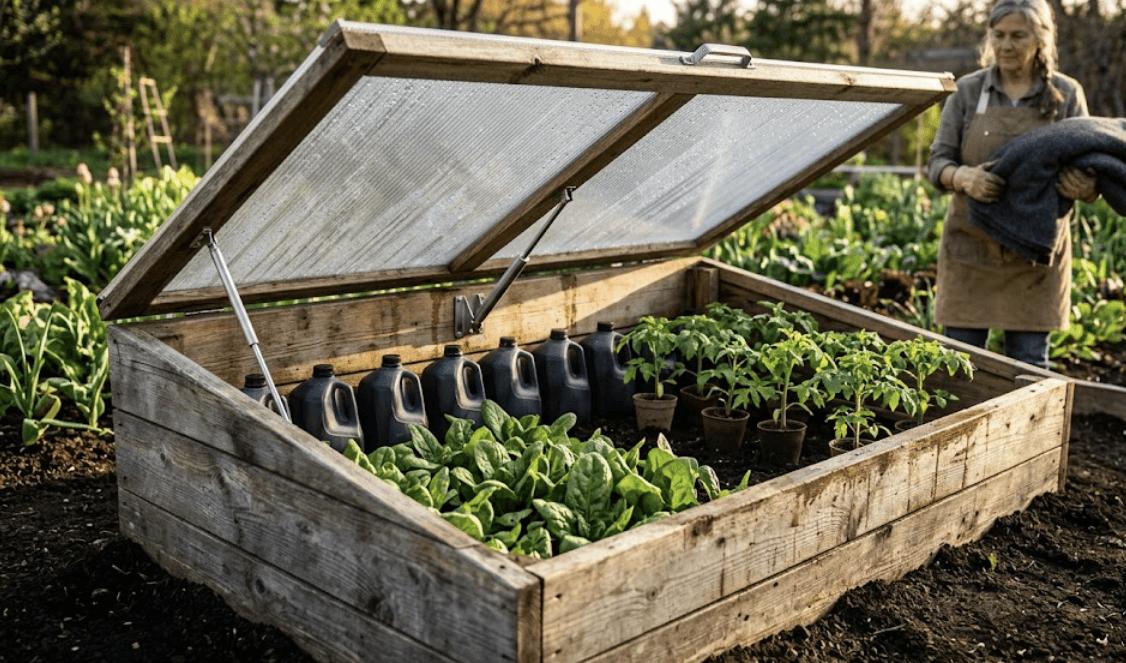
- Line the tall north wall of your cold frame with these water containers, tucking them directly behind your crop rows.
- During sunny days, the water jugs absorb excess heat, helping to prevent the air from overheating. At night, as the air temperature falls toward freezing, the water jugs slowly radiate their stored heat directly into the plant canopy. This simple addition buffers interior temperatures by an extra 4°F to 8°F during deep winter freezes.
+-------------------------------------------------------------------------------+
|                       INTERIOR COLD FRAME THERMAL LAYOUT                      |
+-------------------------------------------------------------------------------+
   [ TALL BACK WALL - NORTH ]
   ──────────────────────────────────────────────────────────────────────────
   [ WATER JUG THERMAL BATTERIES ]  (Absorb day heat, radiate at night)
   ══════════════════════════════════════════════════════════════════════════
   [ ROW 1: Cold-Hardy Greens ]     (Winterbor Kale, Tatsoi, Scallions)
   ··········································································
   [ ROW 2: Compact Salad Crops ]   (Winter Bloomsdale Spinach, Mâche)
   ──────────────────────────────────────────────────────────────────────────
   [ LOW FRONT WALL - SOUTH ]
The 19th-Century Biological "Hotbed"
If you want to grow heat-loving crops early in the spring or keep tender vegetables thriving in northern winter climates, you can convert your passive cold frame into an active, biologically heated hotbed.
A hotbed harnesses the natural thermophilic decomposition of high-nitrogen organic matter to generate sustained underground heat.
To construct a hotbed:
- Dig out the soil inside your cold frame to a depth of eighteen to twenty-four inches.
- Pack the bottom twelve to sixteen inches of the excavation with fresh, steaming horse manure mixed heavily with straw bedding. Equine manure is packed with active aerobic bacteria and has an ideal carbon-to-nitrogen balance for rapid heating.
- Tamp the manure down firmly and saturate it with water to ignite thermophilic decomposition.
- Cover the manure with an eight-to-ten-inch layer of rich, finished compost and sandy garden soil.
- Within forty-eight hours, the bacteria inside the manure layer will begin decomposing the straw, generating sustained temperatures of 110°F to 130°F deep underground. This heat wicks upward through the soil layer, warming plant roots and heating the enclosed air cavity for six to eight weeks.
Once the manure finishes decomposing in the spring, it transforms into rich, fully stabilized compost that feeds summer crops. When managing high-organic inputs or testing seasonal mulches, review our analysis on whether fresh grass clippings are safe as summer mulch to avoid dumping hot nitrogen on delicate roots.
7. Four-Season Cold Frame Production Calendars
A cold frame should not sit empty during the warm summer months. When managed strategically, a single cold frame operates as an indispensable production tool through all four seasons.
+-------------------------------------------------------------------------------+
|                       FOUR-SEASON COLD FRAME UTILIZATION                      |
+-----------+-----------------------+-------------------------------------------+
| Season    | Structural Setup      | Primary Horticultural Use                 |
+-----------+-----------------------+-------------------------------------------+
| Late      | Glass lid on,         | Hardening off early brassica starts;      |
| Winter    | active ventilation    | accelerating early carrot & radish sowings|
+-----------+-----------------------+-------------------------------------------+
| Spring    | Lid removed on warm   | Staging tomato & pepper starts;           |
|           | days, closed at night | harvesting early spring spinach flushes   |
+-----------+-----------------------+-------------------------------------------+
| Summer    | Glass removed,        | Sowing fall brassicas in shaded nursery;  |
|           | shade cloth installed | germination protected from August heat    |
+-----------+-----------------------+-------------------------------------------+
| Autumn &  | Glass lid on,         | Overwintering cold-hardy salad greens;    |
| Winter    | thermal blankets used | fresh continuous harvests through freezes |
+-----------+-----------------------+-------------------------------------------+
Late Winter to Early Spring: Seed Starting and Hardening Off
In February and March, your cold frame serves as a bridge between indoor grow lights and outdoor garden beds.
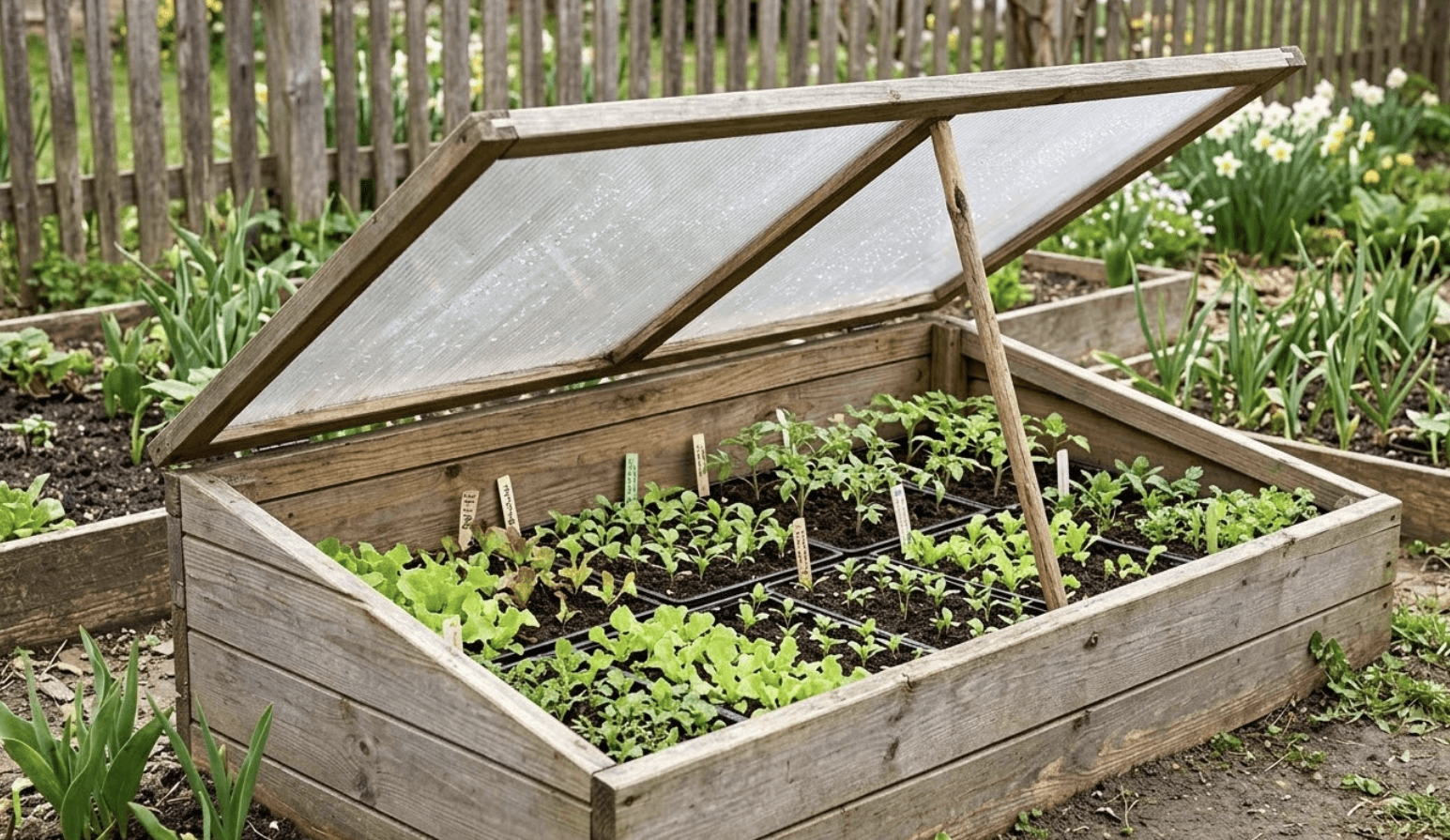
- Hardening Off Transplants: Moving tender seedlings directly from warm indoor grow rooms into the garden shocks plant tissue. The cold frame acts as an intermediate staging area. Seedlings placed inside the frame enjoy natural outdoor sunlight and gentle air movement while remaining shielded from nighttime frosts and cold rain.
- Early Direct Seedings: You can direct-sow cold-tolerant crops—like radishes, arugula, and spring turnips—four to six weeks before your region's last expected frost date. The warmed soil inside the frame triggers rapid germination while outside beds remain frozen solid. When designing your planting beds, companion planting carrots to maximize root growth provides specialized strategies for coordinating early root crops with surface greens.
Summer: The Shade-Cloth Germination Chamber
When summer arrives, remove the glass sash completely and store it in a shady shed out of direct sunlight. Replace the glass with a simple wooden frame wrapped in 40% black knitted agricultural shade cloth.
Use this shaded microclimate to start fall brassicas and winter greens in July and August. Cool-season seeds like spinach and lettuce refuse to germinate when soil temperatures exceed 85°F.
The shade cloth frame blocks harsh summer sunlight, dropping soil temperatures by ten degrees and maintaining the damp, cool conditions needed for uniform late-summer seed germination. For complete seasonal timing on fall cole crops, consult our foundational guide on how to grow cool-weather brassicas.
Autumn: Establishing the Winter Crop Before Persephone
The golden rule of winter gardening is: Winter gardening is about preserving mature crops, not growing new ones.
As winter approaches, the sun drops low and day lengths decline. When day length falls below ten hours per day—known as the Persephone period—plant growth virtually stops regardless of temperature.
To enjoy fresh harvests throughout December and January, your crops must reach 90% of their mature size before the Persephone period begins:
- Sow winter spinach, tatsoi, claytonia (miner's lettuce), and mâche (corn salad) in the cold frame between late August and mid-September.
- Keep the frame well-watered and ventilated through September and October.
- By the time freezing weather locks in during November, your cold frame will be packed with dense, mature, harvest-ready greens. The cold frame now functions as a living, unheated refrigerator, holding crisp, sweet greens in suspended animation until you are ready to cut them for the kitchen. For complementary polyculture ideas, explore our guide to companion planting best plant neighbors for brassicas.
8. Managing Cold Frame Humidity, Pests, and Diseases
The warm, humid, wind-sheltered environment inside a cold frame creates ideal growing conditions for crops, but it also creates an ideal breeding ground for specific pests and fungal blights.
Preventing Fungal Damping-Off and Grey Mold
The most prevalent disease in cold frame production is Grey Mold (Botrytis cinerea). Botrytis attacks decaying leaf tissue and spreads rapidly in cool, stagnant, highly humid air. If a cold frame remains closed for several overcast days, water drops will condense on the underside of the glass and drip onto the plant foliage, creating conditions for fungal infection.
To maintain optimal plant health:
- Water Early and Water at the Soil Level: Never water plants inside a cold frame late in the afternoon. Water strictly in the morning so surface moisture evaporates before the lid is closed for the night. Use a narrow-spout watering can to apply water directly to the soil, keeping the leaf canopies as dry as possible.
- Ventilate Daily: Crack the lid slightly for fifteen minutes even on cold, overcast days to purge stale, humid air and introduce fresh oxygen. Good air circulation prevents fungal spores from establishing on leaf margins.
- Sanitize Plant Canopies: Inspect crops weekly. Pinch off any yellowing, damaged, or decaying lower leaves immediately. A dying leaf is the entry point for Botrytis spores.
+-------------------------------------------------------------------------------+
|                       COLD FRAME TROUBLESHOOTING GUIDE                        |
+-------------------+-----------------------+-----------------------------------+
| Observed Problem  | Underlying Cause      | Corrective Action                 |
+-------------------+-----------------------+-----------------------------------+
| Wilting foliage on| Rapid overheating     | Vent lid immediately; install     |
| sunny winter days | from solar gain       | automatic wax-cylinder vent opener|
+-------------------+-----------------------+-----------------------------------+
| Fluffy grey mold  | Excessive humidity    | Vent frame daily; remove decaying |
| on lower leaves   | and standing water    | foliage; water only at soil line  |
+-------------------+-----------------------+-----------------------------------+
| Leaves chewed down| Slugs hiding in dark, | Apply iron phosphate bait; spread |
| to the midribs    | damp wooden corners   | dry wood ash along interior edges |
+-------------------+-----------------------+-----------------------------------+
| Seedlings heaved  | Freeze-thaw soil      | Bank exterior with straw bales;   |
| out of the ground | cycles in thin frame  | add water jug thermal mass inside |
+-------------------+-----------------------+-----------------------------------+
Rodent and Slug Control
A warm cold frame packed with tender greens in the dead of winter is an irresistible target for voles, field mice, and slugs.
- Slugs: Slugs thrive in the cool, damp microclimate of a cold frame. They hide beneath wooden corner cleats during the day and feed on lettuce leaves at night. Scatter small amounts of organic iron phosphate bait (such as Sluggo) around the interior perimeter of the frame, or place shallow saucers of beer to drown them.
- Rodents: Voles can tunnel under the wooden walls and devour spinach root crowns. When building your cold frame, staple a layer of 1/2-inch galvanized hardware cloth (wire mesh) to the bottom of the box before setting it in place, or bury the wooden walls three to four inches deep into the garden soil to block burrowing pests. For ongoing soil biology maintenance, understanding the C:N ratio in compost ensures that your soil remains healthy and resilient.
Expert Insights & FAQs
What is the ideal angle and orientation for a DIY cold frame lid?
The ideal orientation for a cold frame in the Northern Hemisphere is facing due south to capture maximum solar radiation from the low winter sun. The roof angle should ideally be set to your local latitude plus 10 to 15 degrees (typically a 15-to-25-degree pitch, or roughly one inch of vertical drop for every foot of depth). This slope maximizes perpendicular solar penetration, sheds heavy snow loads naturally, and prevents rainwater from pooling on the glass.
How warm does a cold frame stay at night compared to outdoor air?
A well-constructed, sealed, and weatherstripped cold frame generally stays 5°F to 10°F warmer than the ambient outdoor temperature at night through passive solar collection. When reinforced with thermal mass—such as dark water jugs lining the back wall, masonry borders, or exterior straw bale insulation—interior nighttime temperatures can remain 10°F to 15°F warmer than outdoor conditions, effectively shifting your garden one to two USDA hardiness zones south.
What materials are safest for constructing the wooden box?
Always use untreated, rot-resistant wood like cedar, cypress, redwood, or black locust. If using upcycled shipping pallets, verify that they are stamped with "HT" (Heat Treated) rather than "MB" (Methyl Bromide). Never use pressure-treated lumber (treated with copper preservatives) for structures in direct contact with organic garden soil. If using standard pine on a budget, protect the exterior with non-toxic, food-safe raw linseed oil.
Why is daytime ventilation necessary during cold winter months?
Daytime ventilation is necessary because a sealed cold frame acts as an efficient solar trap. Even when outside temperatures hover in the upper thirties, clear sunlight can drive internal temperatures above 95°F to 100°F within ninety minutes. This intense heat causes cold-hardy greens to transpire water faster than cold roots can absorb it, causing severe wilting, thermal shock, and premature bolting. Propping the lid open on sunny days vents excess heat and purges humidity.
Can I build a cold frame directly on top of an existing raised bed?
Yes, building or placing a cold frame directly on top of an existing raised garden bed is an excellent practice. Raised beds offer superior soil drainage and elevate the work surface to a comfortable ergonomic height. Simply construct the cold frame box to match the exact exterior dimensions of your raised bed rim, and secure it with corner brackets or gravity seals to block wind drafts.
What are the best cold-hardy vegetables to grow in a winter cold frame?
The most reliable crops for winter cold frame production are cold-acclimated leafy greens and root crops, including 'Winter Bloomsdale' spinach, mâche (corn salad), claytonia (miner's lettuce), tatsoi, arugula, Lacinato and curly kales, scallions, winter radishes, and cold-hardy heading lettuces. These varieties withstand freezing cellular temperatures, converting stored starches into sugars that act as natural antifreeze.
How do you convert a cold frame into a biologically heated hotbed?
To convert a cold frame into a hotbed, excavate the soil beneath the frame eighteen to twenty-four inches deep. Fill the bottom twelve to sixteen inches with fresh, nitrogen-rich horse manure mixed with straw bedding, moisten it with water, and tamp it down. Cover the manure layer with eight to ten inches of finished compost and garden soil. As the manure undergoes aerobic decomposition, it generates steady underground soil heat (between 75°F and 90°F) for six to eight weeks.
How do I protect cold frame crops during an extreme polar vortex?
During extreme polar vortex events where temperatures plummet into single digits or below zero, add temporary external insulation over the frame. Cover the closed glass lid with heavy moving blankets, old quilts, sheets of rigid foam insulation, or a deep layer of loose straw in the late afternoon. Be sure to remove these insulating blankets the following morning so the crops can absorb daylight.
Johnnie McCormick
Zone 7b/8a - North Central Alabama
Johnnie McCormick is a gardening hobbyist and the founder of My Garden Spot. Raised in north-central Alabama, his passion for gardening began in his youth. In 2008, he established a large market garden, teaching himself high-yield growing methods. In the years since, he has operated seasonal seedling sales for transplants, specializing in heirloom tomatoes, peppers, eggplants, decorative ground covers like Ajuga (Bugleweed), marigolds, nasturtiums, and fresh kitchen-window herb arrangements (basil, cilantro). Today, he gardens in the hills between Birmingham and Jasper, Alabama (Zone 7b/8a), sharing practical, community-focused gardening resources.
Verified Authoritative Citations & References
In alignment with our strict E-E-A-T research and verification guidelines, this guide cross-references data from the United States Department of Agriculture (USDA) and Cooperative Extension Service programs.
- Rutgers NJAES Cooperative Extension: Greenhouse energy conservation and climate management sheets. horteng.envsci.rutgers.edu
- Cornell Cooperative Extension: High-Yield Greenhouse management and passive climate control resources. cea.cals.cornell.edu
- Penn State Extension: High tunnel design, construction, and microclimate optimization. extension.psu.edu
- Iowa State University Extension: High tunnel production and ventilation guidelines. store.extension.iastate.edu


Please log in to view comments.