Why Are My Early Tomato Leaves Curling Upwards and Turning Leathery?

Why Are My Early Tomato Leaves Curling Upwards and Turning Leathery?
1. The Mid-June Panic: Why Normal Foliage Suddenly Curls and Hardens
Few crops elicit as much obsession, anxiety, and daily inspection from a grower as the tomato. Whether you manage four hundred row feet of heritage beefsteaks for a community market or nurture six treasured indeterminate vines in backyard raised beds, your emotional and labor investment is substantial. You start your seeds in the quiet chill of February, tend them under high-output grow lights, harden them off through unpredictable spring breezes, and bury their stems deep into living compost.
By late May, the rewards seem within grasp. The vines stand four feet tall, anchored to sturdy trellises, loaded with bright yellow blossoms and swelling green fruit. Then, almost overnight during the first punishing hot spell of the season, something appears to go terribly wrong.
You walk down the garden rows in late afternoon and notice that the lower and middle branches have completely transformed. The broad, soft, deeply lobed leaflets have curled tightly upward and inward along the central midrib. Instead of spreading wide to catch the sun, they resemble cupped spoons, rolled canoes, or tight cigars.
When you bend down to touch them, the tactile surprise is even more unsettling. The foliage is no longer soft and pliable. It feels thick, stiff, brittle, and leathery, resembling thick parchment paper or cardboard.
The immediate reaction for nearly every grower is cold panic. Decades of garden folklore and internet forums warn of apocalyptic viral blights, incurable vascular wilts, and airborne herbicide drift. The instinct to grab hand pruners, start snipping off affected branches, or yank the entire vine out of the bed to protect neighboring plants can be overwhelming.
Back during my fourth commercial season in 2011, I experienced this exact shock across an entire block of 'Cherokee Purple' and 'Brandywine' tomatoes in central Alabama. A relentless high-pressure heat dome parked over our valley in early June, pushing ambient temperatures past 96°F after three weeks of steady, cool spring rain. Walking into the field that Monday morning and seeing eighty percent of our prime indeterminate vines curled into rigid green tubes felt like financial ruin.
Yet an old county agent took one look, pinched a leaf between his calloused fingers, and told me to put my shovel away and run my drip irrigation. He was right. Those plants went on to produce some of the heaviest, most flavorful beefsteak harvests of our farm's history.
If your tomato leaves are curling upward into a cup or cylinder, and if that foliage remains deep green without yellow mosaic mottling, bronze spotting, or grotesque stem distortion, your plants do not have a fatal illness. They are executing Physiological Leaf Roll—an ancient, highly effective survival adaptation developed by wild solanaceous plants to endure severe atmospheric and environmental stress.
 A classic example of Physiological Leaf Roll. Notice how the margins of the leaves roll upward and inward, reducing the total surface area exposed to the sun.
2. Plant Anatomy and Cellular Biology: How and Why Leaves Roll
To understand why a tomato curls its leaves, you must look at how the vine functions as a living hydraulic engine and solar collector.
Under normal growing conditions, a tomato leaf is a flat, expansive organ engineered to capture photons and convert carbon dioxide and water into simple sugars via photosynthesis. The underside of each leaflet (the abaxial surface) contains thousands of microscopic breathing pores known as stomata. Each stoma is flanked by specialized guard cells that expand and contract to regulate gas exchange.
When stomata open to absorb atmospheric carbon dioxide, water vapor escapes into the ambient air. This evaporation is transpiration. Transpiration is not waste; it generates the negative hydrostatic pressure (transpiration pull) that draws water and dissolved soil minerals from the root tips all the way up through the vascular xylem to the highest growing shoot. Transpiration also provides evaporative cooling, keeping delicate leaf cells ten to fifteen degrees cooler than the surrounding ambient air during hot afternoons.
Problems arise when the evaporative demand of the atmosphere outpaces the supply capacity of the root zone.
Atmospheric Vapor Pressure Deficit (VPD) Spikes
                       │
                       ▼
      Stomata Expel Moisture at Maximum Speed
                       │
                       ▼
    Soil Roots Cannot Absorb Water Fast Enough
                       │
                       ▼
 Turgor Pressure Collapses in Leaf Margin Cells
                       │
                       ▼
    Mechanical Contraction Rolls Leaf Upward
                       │
                       ▼
 Boundary Layer Traps Humidity & Shields Tissues
When air temperatures exceed 90°F, humidity plunges, or steady summer winds blow across the canopy, the Vapor Pressure Deficit (VPD) between the moist interior of the leaf and the dry atmosphere widens drastically. The air effectively sucks moisture out of the leaf faster than the root system can drink from the soil.
If the vine allowed this imbalance to continue unchecked, cellular water potential would drop to fatal levels, resulting in complete vascular cavitation and permanent tissue death. The plant prevents this collapse by altering cellular turgor pressure.
Specialized bulliform-like epidermal cells located along the upper surface of the leaf lose water and contract faster than the structural cells beneath them. This differential tension forces the outer leaf margins to curl upward and fold inward toward the midrib.
By curling into a tight cylinder, the leaf achieves three vital defensive goals:
- Massive Surface Area Reduction: A fully expanded beefsteak leaf presents a broad target to direct solar rays. By curling inward, the leaf cuts its exposed horizontal surface area by up to fifty percent, drastically reducing thermal heating and protecting photosynthetic machinery from solar damage.
- Boundary Layer Humidity Retention: The curled leaflet creates a protected, stagnant microclimate directly above its stomata. Trapping moisture inside this semi-enclosed pocket increases local relative humidity, lowering the localized vapor pressure deficit and slowing evaporative water loss.
- Internal Energy Redistribution: With less water wasted on canopy cooling, the vine preserves hydraulic pressure to keep its central vascular stem and apical growing tip fully hydrated.
The Origin of the Leathery Texture
Why do these curled leaves feel so stiff and leathery? That physical stiffness is caused by carbohydrate accumulation and cuticle thickening.
When a leaf curls and reduces transpiration, the vascular transport of manufactured sugars (sucrose and starches) through the phloem slows down. Photosynthetic output that cannot be immediately exported into growing fruit or root storage accumulates directly within the leaf mesophyll tissue. Starch grains pack into the spongy parenchyma cells, making the leaf blade physically rigid and heavy.
At the same time, the epidermal cells respond to persistent solar radiation and wind by accelerating the synthesis of cutin and suberin—dense, waxy lipids that coat the exterior leaf cuticle. This waxy shield seals microscopic fissures, preventing moisture escape and giving the leaf its thick, cardboard-like texture.
3. The Four Primary Environmental and Cultural Triggers
Physiological leaf roll rarely happens in isolation. It is typically provoked by a combination of atmospheric shocks and cultural gardening mistakes that throw the plant's root-to-shoot balance into disarray.
1. The Spring-to-Summer Weather Whip-Saw
The single most common timing for leaf roll across temperate growing zones is the volatile transition window between late spring and early summer.
During May, young tomato plants frequently enjoy mild temperatures in the seventies, overcast skies, and frequent spring showers. Under these comfortable conditions, the vine invests heavily in expansive, thin, succulent canopy growth. It builds large leaves because it does not need to guard against desiccation. Because soil surface moisture is plentiful, the root system often remains relatively shallow and compact.
Then June arrives. A sudden continental high-pressure ridge settles over the area. Within forty-eight hours, daytime highs jump from 78°F to 96°F, cloud cover vanishes, and intense ultraviolet radiation bakes the beds.
The plant's expansive spring canopy is suddenly losing moisture at an unsustainable pace. The compact, juvenile root system cannot absorb enough water to keep up with this sudden atmospheric demand. Within forty-eight to seventy-two hours of the heat wave arriving, the lower leaves roll tightly upward to survive.
2. Erratic Soil Moisture and Root Zone Asphyxiation
Water stress triggers leaf roll from both extremes: severe drought and chronic waterlogging.
       Drought Stress Cycle                     Waterlogged Soil Cycle
       ────────────────────                     ──────────────────────
Extended dry spell dries root zone         Heavy rain or over-irrigation floods bed
                 │                                        │
                 ▼                                        ▼
Capillary water drops below root uptake     Pore spaces fill with water, displacing oxygen
                 │                                        │
                 ▼                                        ▼
Root hairs dehydrate and shrink            Roots enter anaerobic stress; root hairs die
                 │                                        │
                 ▼                                        ▼
Upward vascular water flow halts           Damaged roots fail to take up water
                 │                                        │
                 └────────────────► ◄─────────────────────┘
                                    │
                                    ▼
                 Lower leaves roll upward into canoes
- Drought and The Hose-and-Drought Cycle: When a grower waits until the soil is bone-dry and plants begin to sag before drenching the bed with an overhead garden hose, the root system experiences severe osmotic shock. The delicate root hairs responsible for absorbing moisture dry out during the dry interval, temporarily crippling water uptake even after the bed is flooded.
- Saturated Soil and Root Drowning: Many gardeners do not realize that overwatering produces symptoms identical to drought. Tomato roots require oxygen within soil pore spaces to generate cellular energy for nutrient and water absorption. When heavy clay beds stay waterlogged following seasonal downpours or daily manual flooding, oxygen is driven out of the soil. The roots suffocate, microbial pathogens attack root tips, and the root system shuts down. Unable to draw water upward despite sitting in wet mud, the plant rolls its foliage in an emergency effort to stop canopy water loss.
- Mechanical Root Laceration: Running a motorized rotary tiller or slicing deeply with an aggressive draw hoe close to the base of growing tomato plants severs fibrous lateral feeder roots that spread through the top four to six inches of soil. Losing these feeder roots suddenly cuts the plant's water collection capacity, causing lower foliage to curl upward within twenty-four hours.
3. Aggressive Over-Pruning and Sucker Removal
Pruning indeterminate tomatoes can improve airflow and ease trellising, but aggressive pruning often triggers severe physiological shock.
When a gardener removes three or four large suckers (axillary branches) and strips the lower foliage all in a single afternoon, the plant loses thirty to fifty percent of its total photosynthetic volume. This sudden defoliation creates two severe disruptions:
First, it eliminates the natural shade umbrella protecting the central vine and lower branches from intense midday sun. The remaining foliage is exposed to direct ultraviolet radiation that it was not conditioned to handle.
Second, the abrupt removal of active vegetative growing tips destroys major metabolic sinks for carbohydrates. Manufactured sugars produced by remaining lower leaves have nowhere to go. They back up inside the leaf tissue, driving the starch accumulation and cuticle thickening that creates rigid, leathery leaf curling.
4. Excessive Nitrogen Fertility and Imbalanced Nutrition
Pushing tomato vines with high doses of concentrated synthetic nitrogen or uncomposted poultry manure creates unbalanced growth that invites leaf roll.
High nitrogen supplies stimulate explosive vegetative vine development. The plant funnels energy into tall, thick stems and dark green leaves, outgrowing its root system. When high summer temperatures arrive, that undersized root structure cannot supply sufficient moisture to the massive canopy.
High nitrate supplies also shift the physiological balance between leaf development and root expansion. When nitrate levels run too high relative to available phosphorus, potassium, and calcium, cell walls become large and succulent, making them extra sensitive to heat stress. As the vine enters heavy fruit set, the competition for mobile nutrients intensifies, compounding the stress on lower foliage.
4. Differential Diagnosis: Physiological Leaf Roll vs. Lethal Pathogens and Chemical Injury
The primary danger of physiological leaf roll is not the curl itself—it is misdiagnosing the condition and applying harmful chemical treatments or unnecessarily destroying healthy, productive vines.
You must systematically compare the symptoms of physiological leaf roll against the symptoms of viral pathogens, fungal wilts, and airborne herbicide drift.
| Diagnostic Factor | Physiological Leaf Roll | Tomato Yellow Leaf Curl Virus (TYLCV) | Curly Top Virus (CTV) | Synthetic Auxin Herbicide Drift (2,4-D / Dicamba) | Broad Mites or Russet Mites |
|---|---|---|---|---|---|
| Curl Direction | Upward and inward, cupping into canoes or cylinders along the midrib | Upward cupping with distinct crumpled, ruffled margins | Twisting upward and rolling inward, often accompanied by stiff downward nodding | Downward curling, spiral epinasty, twisted petioles and weeping stems | Downward cupping or curling of leaf margins; brittle distortion |
| Location on Plant | Lower and mid-canopy leaves first; new terminal growth remains normal | New apical growth at vine tip is affected first and most severely | Terminal buds and young top foliage show earliest, most severe distortion | Youngest, fastest-growing tips and newly emerged leaves | Under-canopy and young terminal shoots; patchy localized spread |
| Leaf Color & Pattern | Uniform, normal green; healthy pigmentation throughout blade | Severe interveinal chlorosis, pale yellow leaf margins, green veins | Dull yellowing of blades, purple veining along leaf undersides | Normal green initially, followed by bleached veins, mottled chlorosis, or necrotic margins | Bronzed, russeted, or greasy brown undersides; silvery sheen |
| Leaf Texture | Stiff, thick, leathery, and brittle to the touch; snaps cleanly | Leathery, stunted, and severely dwarfed | Thick, stiff, and brittle; leaves break easily when bent | Thin, distorted, strap-like "shoestring" shape with parallel veins | Hard, brittle, glassy, and crinkled; foliage breaks easily |
| Stem & Petiole Appearance | Normal, upright, and straight; no twisting or lesions | Erect, stunted, and bunched ("broom-like" bushy growth) | Stiff, upright, and severely shortened internodes | Extreme twisting (epinasty), split stems, calloused stems, fasciated growth | Fine russeting or brown corky scarring on stems and petioles |
| Blossom & Fruit Set | Normal flowering and fruit set; yields remain heavy | Severe blossom drop; almost total failure to set fruit | Blossom abortion; fruit ripens prematurely while tiny and hard | Misshapen fruit, catfacing, hollow fruit, or blossom abortion | Blossom drop; fruit skin develops rough, scaly, russeted patches |
| Vector / Primary Cause | Abiotic environmental stress (heat, wind, moisture, over-pruning) | Silverleaf Whitefly (Bemisia tabaci) | Beet Leafhopper (Circulifer tenellus) | Airborne vapor or spray drift from lawn or pasture herbicides | Microscopic eriophyid or tarsonemid mites |
| Prognosis & Action | Excellent; non-lethal. Stabilize watering and mulch; do not pull plant | Terminal; incurable. Rogue and destroy infected plants immediately | Terminal; incurable. Rogue and destroy infected plants immediately | Variable depending on dose; severe exposure warrants removal | Manageable; apply micronized sulfur or horticultural oils to undersides |
Distinguishing Herbicide Drift
Herbicide drift deserves special attention because synthetic lawn and pasture herbicides (2,4-D, dicamba, picloram, and aminopyralid) cause devastating damage that mimics some stress symptoms.
However, herbicide damage causes epinasty—the downward bending and spiral twisting of petioles. Leaves affected by herbicide drift develop bizarre, narrow, finger-like shapes with parallel veins running together like a fan, often called "shoestringing." Stems will contort into corkscrews, split open, or develop rough, abnormal calluses.
In contrast, physiological leaf roll never twists the stems, never creates fan-like parallel leaf veins, and never distorts the vine into abnormal corkscrews. The stems remain straight, the petioles remain upright, and the leaflets simply roll upward along their natural midribs.
Outbound research conducted by the Clemson University Cooperative Extension confirms that true physiological leaf roll causes no measurable reduction in total yield or fruit quality, provided that the grower stabilizes root zone moisture and avoids reactionary over-fertilization.
5. Genetic Susceptibility: Which Cultivars Roll Most Readily?
If you grow multiple tomato varieties side by side in the same bed, you will quickly notice that physiological leaf roll does not affect every plant equally. One variety may have its lower leaves rolled into tight green tubes while the variety right next to it remains completely flat and relaxed.
This disparity comes down to genetics. Tomato varieties possess different vascular architectures, root-to-shoot ratios, and hormonal sensitivities to environmental shifts.
Indeterminate Heirlooms vs. Determinate Hybrids
As a general rule, large, indeterminate heirloom varieties are far more prone to physiological leaf roll than compact determinate bush varieties.
Indeterminate vines continuously produce vegetative foliage, floral clusters, and expanding fruit all season long. Because their canopies can reach six to ten feet tall, their hydraulic systems operate under substantial tension during hot summer days. The massive leaf surface area makes them quick to trigger defensive rolling at the first sign of atmospheric stress.
Among heirlooms, potato-leaf varieties show pronounced susceptibility:
- 'Brandywine' (Sudduth's and Pink varieties): The large, unlobed potato-leaf foliage features broad surface areas that lose moisture rapidly in hot sun. 'Brandywine' almost routinely exhibits lower leaf curl during early summer heat waves.
- 'Pruden's Purple': Another classic potato-leaf variety that curls its lower branches as soon as daytime temperatures cross 88°F.
- 'German Queen' and 'Mortgage Lifter': These massive, ribbed pink beefsteaks develop huge individual leaves and heavy fruit loads, frequently rolling their lower canopy while continuing to pump out two-pound tomatoes.
- 'Cherokee Purple': Highly sensitive to moisture fluctuations. When hot weather follows heavy rain, 'Cherokee Purple' almost always rolls its lower third of foliage.
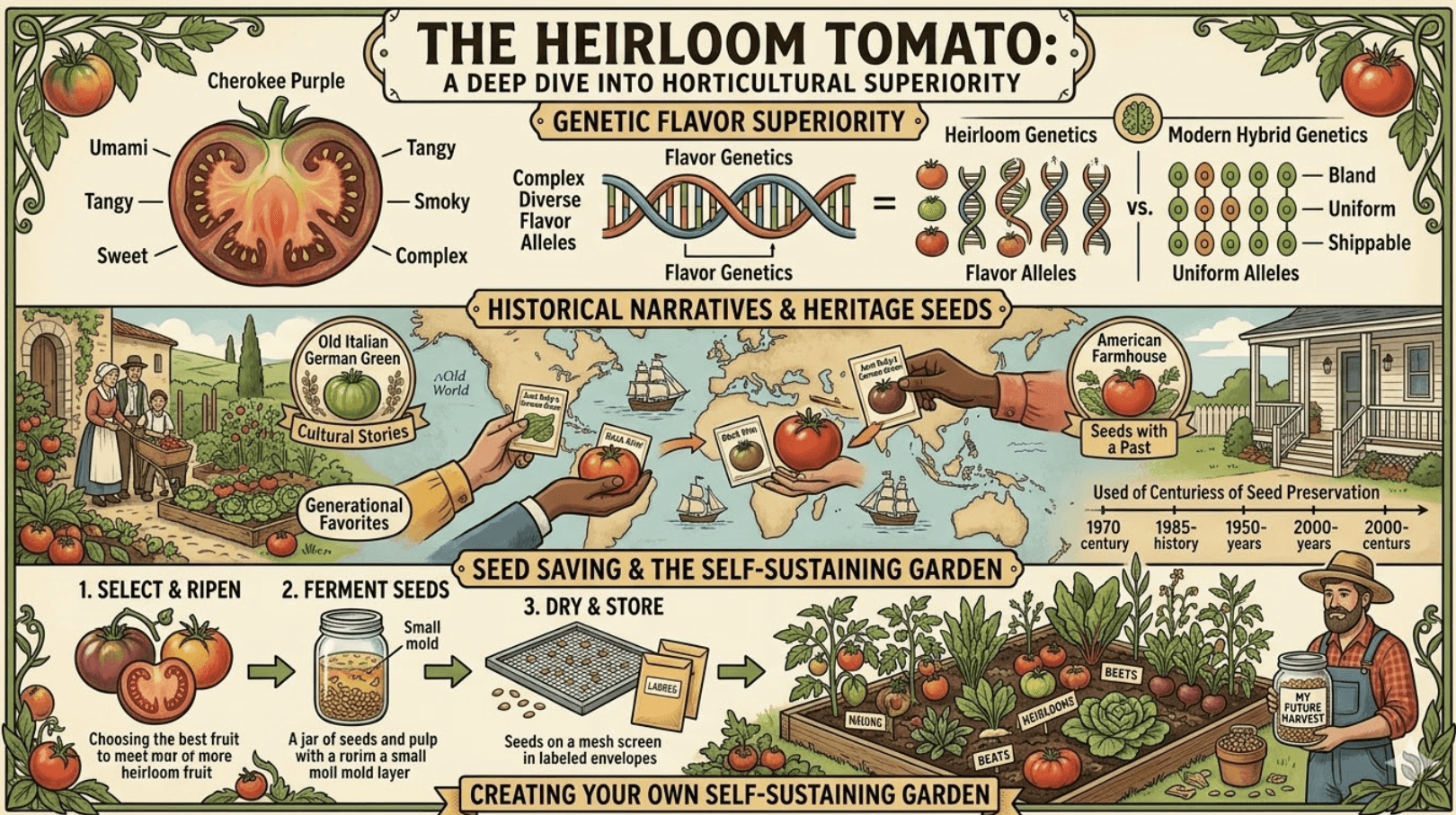
For deeper insights into the genetics, flavor profiles, and management of these heirloom varieties, explore our guide on Why Heirloom Tomatoes Beat Hybrids in Flavor, History, and Seed Saving as well as the specialized history of The Cherokee Purple Tomato and How to Grow It.
The Determinate Sink-Source Dynamic
While determinate processing varieties ('Roma', 'San Marzano', 'Celebrity', 'Amish Paste') roll less frequently during early vegetative stages, they can develop sudden, dramatic leaf roll later in the season.
This happens when a determinate vine sets its entire crop of fruit simultaneously. The demands of dozens of rapidly sizing green tomatoes create an enormous metabolic "sink." The plant redirects every available drop of water and nutrient toward the fruit clusters, starving the lower leaves of moisture and triggering protective upward curling across seventy percent of the canopy.
Commercial greenhouse and field hybrids bred for the American Southeast (such as 'Mountain Fresh Plus', 'BHN 589', and 'Chef's Choice') have been bred with strong root architectures that maintain hydraulic turgor under high temperatures, making them noticeably more resistant to physiological leaf roll.
6. Soil Ecology and Regenerative Root Management
True resilience against abiotic stress begins beneath the soil surface. A tomato vine with an extensive, biologically active root system handles heat waves and moisture swings far better than a plant dependent on shallow roots and synthetic fertilizers.
       Conventional Shallow System               Living Soil Regenerative System
       ───────────────────────────               ───────────────────────────────
Tilled hardpan restricts roots to top 6"   Deep broadfork aeration allows 36"+ root run
                 │                                        │
                 ▼                                        ▼
Frequent shallow watering keeps roots near surface  Deep drip irrigation pulls roots into deep soil
                 │                                        │
                 ▼                                        ▼
Midday sun bakes root zone to 95°F+        4" organic mulch keeps soil cool at 74°F
                 │                                        │
                 ▼                                        ▼
Severe leaf curl, moisture shock           Mycorrhizal hyphae supply steady water; minimal stress
The Mycorrhizal Sponge: Expanding Root Reach by 700%
In a healthy living soil system, tomato roots do not work alone. They establish symbiotic relationships with arbuscular mycorrhizal fungi (AMF), primarily species like Rhizophagus irregularis and Glomus intraradices.
The microscopic fungal hyphae penetrate root cortical cells and extend outward into the surrounding soil matrix, forming an underground network that expands the effective surface area of the root system by up to seven hundred percent.
Hyphae are significantly thinner than the finest plant root hairs, allowing them to penetrate tiny soil micropores that plant roots cannot reach. During peak midday heat, when capillary water in larger soil pores has been depleted, these fungal networks continue harvesting water and dissolved phosphorus, pumping moisture directly into the plant's vascular core. This steady biological hydration prevents the sudden drops in leaf turgor pressure that trigger physiological leaf roll.
To protect this fungal network, never run a mechanical rotary tiller through established garden beds. Power tillers pulverize the soil aggregate structure, shatter fungal hyphae, and create a compacted hardpan six inches down. Instead, use a broadfork to gently fracture subsoil compaction and improve aeration without disturbing soil strata. Review our detailed technique in How to Broadfork Soil for Deep Aeration and Compaction Relief.
Balancing Cation Exchange Capacity (CEC) and Mineral Ratios
Soil mineral chemistry plays a direct role in stomatal regulation and cellular water management:
- Potassium ($K^+$): Potassium acts as the cellular trigger that controls guard cell movement. When a plant senses water stress, potassium ions move out of guard cells, causing them to deflate and close stomatal pores. If soil potassium is deficient or tied up, stomatal regulation becomes sluggish, increasing water loss and forcing the plant to roll its leaves.
- Calcium ($Ca^{2+}$): Calcium forms the structural pectins in the middle lamella that cement plant cell walls together. Adequate calcium strengthens vascular xylem vessels, preventing them from collapsing under high negative transpiration tension. Maintaining steady calcium uptake also protects against blossom-end rot. See our detailed protocol in How to Prevent Blossom-End Rot in Bell Peppers and Eggplants.
- Soil Organic Matter (SOM): Every one percent increase in soil organic matter allows the soil to hold an additional twenty thousand gallons of plant-available water per acre. Increasing organic matter through finished compost and cover crops builds a moisture cushion that protects vines against heat spikes.
Plan your bed preparation well in advance by reviewing our comprehensive Spring Soil Preparation Checklist and learn how to interpret your soil tests in our guide on Understanding Cation Exchange Capacity (CEC).
7. Field Remediation Protocol: Step-by-Step Stress Mitigation
Once physiological leaf roll appears, your goal is simple: stabilize the growing environment and reduce transpiration stress. While existing curled leaves will remain cupped, proper cultural management ensures all new growth emerges flat and productive.
Step 1: Install Precision Drip Irrigation
Overhead watering with sprinklers or hand-held hoses is inefficient and promotes fungal blights like early blight (Alternaria solani) and Septoria leaf spot. It also creates extreme wet-dry moisture swings.
The single best investment you can make is installing a dedicated low-pressure drip irrigation system using drip tape or pressure-compensating emitter tubing.
 Drip irrigation is mandatory for preventing the moisture fluctuations that trigger leaf roll. Water is delivered slowly and deeply directly to the root zone.
- Delivery Rate: Provide 1.5 to 2.5 gallons of water per mature indeterminate plant every forty-eight hours during standard weather. In extreme heat waves (temperatures sustained above 95°F), increase this to 1.5 gallons daily.
- Timing: Always irrigate in the early morning between 5:00 AM and 8:00 AM. Early morning watering charges the soil profile before solar radiation peaks, giving plants the hydration needed to navigate afternoon heat without rolling their leaves.
- Monitoring: Use a manual soil probe or tensiometer to verify moisture depth. Moisture should reach a depth of twelve to eighteen inches beneath the surface, encouraging roots to dive deep where soil temperatures stay cool.
For design specifications, emitter spacing, and timer setups, see our complete installation guide on Drip Irrigation Setup: Commercial Efficiency and Automated Precision Irrigation for Micro-Farms.
Step 2: Apply a Deep Organic Mulch Blanket
Exposed, bare soil is a serious liability in a summer tomato patch. Direct summer sun can heat the top two inches of bare soil past 110°F, cooking delicate feeder roots and vaporizing soil moisture.
Apply a three-to-four-inch layer of clean organic mulch across the entire bed:
- Clean Wheat or Oat Straw: The golden color reflects solar radiation, keeping root zone temperatures ten to fifteen degrees cooler than bare soil while creating a barrier against soil-borne fungal spores.
- Shredded Hardwood or Leaf Mold: Excellent for raised beds and long-term soil fungal development.
- Avoid Fresh Grass Clippings: Green clippings pack down into an anaerobic, slimy mat that heats up as it decomposes and releases excess volatile nitrogen.
For an in-depth comparison of mulching materials, consult Deep Mulch Gardening: Wood Chips vs. Straw in No-Till Systems.
Step 3: Call a Ceasefire on Pruning
When your plants show curled, leathery leaves, step away with the pruning shears.
Removing suckers or stripping foliage from a stressed tomato vine eliminates its self-shading canopy and shocks its vascular system. Allow lateral suckers to grow for two to three weeks. These extra branches will provide valuable shade for the central stem and protect developing tomatoes from sunscald.
Once weather conditions stabilize and the plant resumes vigorous growth with flat new leaves, you can resume gentle pruning to maintain necessary airflow through the inner canopy.
Step 4: Deploy Temporary Overhead Shade Cloth
During intense midsummer heat domes where temperatures hover near 100°F for days, irrigation and mulch alone may not prevent severe leaf roll and blossom drop. High heat causes pollen inside tomato blossoms to become sterile, halting fruit set.
                  Overhead Shade Cloth Deployment

               ┌─────────────────────────────────┐
               │    30% Knitted Shade Cloth      │
               └─────────────────────────────────┘
                         ▲             ▲
                         │ 12-18" Gap  │ (Allows Heat Dissipation)
                         ▼             ▼
               ┌─────────────────────────────────┐
               │     Tomato Canopy Trellis       │
               │                                 │
               │  • Leaf temp drops 8-12°F       │
               │  • Transpiration stress drops   │
               │  • Pollen sterility prevented   │
               └─────────────────────────────────┘
Deploying a temporary thirty-percent knitted agricultural shade cloth over your tomato trellis lowers leaf surface temperatures by eight to twelve degrees, reduces localized vapor pressure deficit, and preserves blossom fertility.
Ensure you leave an open gap of twelve to eighteen inches between the shade cloth and the top of the canopy to allow hot air to escape. Never use shade cloth denser than forty percent for tomatoes, or you will restrict the light needed for photosynthesis.
Learn more about fabric thermodynamics in our technical guide on Reflective vs. Traditional Shade Cloth in Controlled Environments.
Step 5: Apply Foliar Seaweed Extracts
During extreme environmental stress, avoid heavy granular soil fertilizers, especially high-nitrogen formulas. Pushing vegetative growth while roots are struggling will worsen leaf roll.
Instead, apply a gentle foliar spray of cold-water kelp meal extract (Ascophyllum nodosum). Kelp meal contains natural betaines, cytokinins, and trace minerals that act as cellular osmoprotectants. Spray early in the morning when stomata are open. These compounds help plant cells maintain internal osmotic balance and protect enzyme systems from heat damage without stimulating excessive vegetative growth.
8. Long-Term Crop Recovery and Harvest Expectations
One of the most common questions growers ask after correcting their soil moisture and microclimate is: "When will the curled leaves unroll and go back to normal?"
The honest answer: They rarely do.
Once a tomato leaf has curled upward, built up dense starch deposits, and thickened its waxy cuticle with cutin, that cellular structure becomes permanently fixed. The lower leaves will typically remain cupped and leathery for the rest of the growing season.
This permanent shape is not a failure. Think of those curled lower leaves as seasoned battle armor. They have adapted to protect the vine against intense solar radiation, and they will continue photosynthesizing and feeding the root system throughout the summer.
To gauge whether your recovery efforts are working, ignore the old lower leaves and look directly at the top of the vine:
- Inspect the Apical Growing Tip: Within five to ten days after you stabilize drip irrigation, apply mulch, and mitigate heat, the newly emerging leaflets at the top of the vine should unfurl flat, soft, and rich emerald green.
- Examine the Floral Clusters: Healthy, uncurled blossom clusters with bright yellow petals that set green fruit indicate that internal vascular pressure and pollen viability have returned to normal.
- Evaluate Fruit Sizing: Sizing fruit should expand steadily without cracking or sunscald. A vine with curled lower leaves will continue ripening sweet, heavy tomatoes, provided the roots receive consistent moisture.
By responding with steady cultural adjustments rather than panic, you protect your crop and keep your garden on track for an abundant summer harvest.
Related Resources for Tomato Health
- Why Heirloom Tomatoes Beat Hybrids in Flavor, History, and Seed Saving
- The History of the Cherokee Purple Tomato and How to Grow It
- How Do You Prevent Blossom-End Rot in Bell Peppers and Eggplants?
- Drip Irrigation Setup: Commercial Efficiency and Automated Precision Irrigation for Micro-Farms
- How to Broadfork Soil for Deep Aeration and Compaction Relief
- Deep Mulch Gardening: Wood Chips vs. Straw in No-Till Systems
- Reflective vs. Traditional Shade Cloth Thermodynamics in Controlled Environments
- Understanding Cation Exchange Capacity (CEC) for Optimal Mid-Season Fertilizing
- Spring Soil Preparation Checklist: Wake Up Your Garden Beds
Expert Insights & FAQs
Will curled, leathery tomato leaves ever unroll and return to normal?
Curled, leathery leaves rarely flatten out once they have rolled. When a leaflet curls and thickens its waxy cuticle, the cellular structure becomes permanently set. However, once you correct environmental stressors like heat and moisture fluctuations, all new foliage emerging from the top of the vine will grow flat and pliable. The older curled leaves will continue photosynthesizing and supporting the plant without harming your harvest.
Does physiological leaf roll reduce tomato yields or ruin the fruit?
Physiological leaf roll does not reduce fruit yield, flavor, or quality when properly managed. Because it is a benign environmental defense rather than a disease, the plant continues flowering and sizing fruit normally. Yield losses only occur if the underlying stressors—such as severe drought or lack of pollination due to high heat—are left unaddressed, leading to blossom drop or blossom-end rot.
How do I tell the difference between physiological leaf roll and herbicide drift?
Physiological leaf roll causes leaves to curl cleanly upward and inward into a cup or canoe while stems remain straight and upright. Airborne synthetic herbicide drift (such as 2,4-D or dicamba) causes downward curling, severe twisting of leaf stems (petioles), and distorted, strap-like "shoestring" foliage with parallel veins. Herbicides also cause stems to contort into bizarre corkscrews, symptoms never seen with physiological stress.
Why do my potato-leaf heirloom tomatoes curl more than my hybrid varieties?
Potato-leaf heirloom varieties like 'Brandywine' and 'Pruden's Purple' have broad, flat leaflets with large surface areas that lose moisture quickly in hot, dry air. Their large leaf size creates a wider vapor pressure deficit, making them quick to execute protective leaf roll during heat waves. Modern commercial hybrids have been selected for deep, resilient root architectures and smaller leaf architecture, helping them maintain turgor under high temperatures.
Can overwatering cause tomato leaves to curl upward and turn leathery?
Overwatering causes identical leaf curling symptoms to drought. When garden soil stays saturated or waterlogged, oxygen is forced out of the soil pore spaces, suffocating the roots. Drowning roots lose their ability to absorb water and nutrients, cutting off moisture to the foliage. The vine responds by rolling its leaves upward to stop transpiration, mimicking drought stress even when standing in wet soil.
Should I prune off tomato leaves that have curled upward?
Do not prune off curled, leathery leaves if they are still green. Even though they look unusual, these leaves remain functional, photosynthesizing and shading the lower stems and developing fruit. Removing them shocks the plant, exposes inner fruit to direct sunscald, and worsens the stress that triggered leaf roll in the first place. Only prune foliage that turns brown, diseased, or yellow.
How does heavy nitrogen fertilizer cause tomato leaves to curl?
Excessive nitrogen stimulates rapid, lush vegetative growth at the expense of root expansion, creating a top-heavy plant with an undersized root system. When high summer temperatures arrive, the roots cannot supply enough water to support the massive canopy, triggering defensive leaf curling. Excess nitrogen also traps surplus carbohydrates within leaf tissue, causing leaves to thicken and feel leathery.
What is the fastest way to relieve heat stress and stop leaf roll in summer?
The fastest way to relieve heat stress is a three-part approach: lay down a three-to-four-inch layer of clean straw mulch, set drip irrigation to run deeply in the early morning, and suspend a thirty-percent agricultural shade cloth twelve to eighteen inches above the canopy. This combination drops root zone temperatures by ten to fifteen degrees, protects blossom fertility, and reduces transpiration demand so the vine can resume normal growth.
Johnnie McCormick
Zone 7b/8a - North Central Alabama
Johnnie McCormick is a gardening hobbyist and the founder of My Garden Spot. Raised in north-central Alabama, his passion for gardening began in his youth. In 2008, he established a large market garden, teaching himself high-yield growing methods. In the years since, he has operated seasonal seedling sales for transplants, specializing in heirloom tomatoes, peppers, eggplants, decorative ground covers like Ajuga (Bugleweed), marigolds, nasturtiums, and fresh kitchen-window herb arrangements (basil, cilantro). Today, he gardens in the hills between Birmingham and Jasper, Alabama (Zone 7b/8a), sharing practical, community-focused gardening resources.
Verified Authoritative Citations & References
In alignment with our strict E-E-A-T research and verification guidelines, this guide cross-references data from the United States Department of Agriculture (USDA) and Cooperative Extension Service programs.
- Cornell Cooperative Extension: Home Vegetable Gardening Guide and vegetable variety recommendations. gardening.cals.cornell.edu
- Penn State Extension: Master Gardener Manual and companion planting matrices. extension.psu.edu
- Alabama Cooperative Extension System (ACES): Raised bed construction plans and regional seed planting calendars. aces.edu
- USDA NRCS: Cover crops and biological soil health guidelines. nrcs.usda.gov
Please log in to view comments.