How Do You Build Vertical Trellis Systems for Melons and Squash? (Definitive A-Frame Guide)

How Do You Build Vertical Trellis Systems for Melons and Squash? (Definitive A-Frame Guide)
Growing heavy vining crops—such as cantaloupes, sugar baby watermelons, butternut squash, and acorn squash—presents a serious spatial dilemma for market gardeners and intensive backyard growers. Left to their natural growth habits, a single winter squash plant can aggressively sprawl over thirty to forty square feet of prime garden real estate. In a carefully organized 30-inch raised bed system, that horizontal sprawl suffocates walkways, blocks weeding, and swallows neighboring crops.

When we established our Alabama market farm in 2008, I initially planted our cantaloupes and butternut squash directly on flat ground mulched with straw. By midsummer, our 95°F heat combined with Gulf Coast humidity turned the pumpkin patch into a tangled swamp. Ripe watermelons resting on damp soil developed sunken, rotten lesions from soil-borne fungi. Slugs bored holes into the undersides of developing cantaloupes, and powdery mildew rapidly scorched the foliage because air could not circulate through the dense, overlapping leaf canopy.
The practical solution is vertical engineering. By sending massive cucurbit vines upward on heavy-duty structures, you multiply your marketable yield per square foot while protecting your harvest from ground rot and fungal disease. However, standard hardware store tomato cages or flimsy nylon netting will buckle and collapse under the immense weight of a mature squash crop. Successfully trellising heavy fruits requires rigid structural design and sound load-bearing physics.
1. Engineering the Heavy-Duty A-Frame Trellis
When designing a vertical trellis for heavy melons and squashes, you must account for three distinct physical forces:
- Dead Load: The static gravitational weight of dozens of expanding fruits, thick vines, and moisture-laden foliage, easily exceeding 150 to 200 pounds per ten-foot section.
- Wind Load: The sail area created by hundreds of broad squash leaves during severe summer thunderstorms. A flat, vertical wall trellis can act like a solid wall, catching wind shear and pulling straight out of the ground.
- Tensile Pull: The concentrated downward gravitational pull exerted by individual 5-pound fruits pulling on individual wire strands.
A-Frame Structural Mechanics
=============================================================================
                       [ Top Ridge Beam (2x4x10') ]
                               /          \
                              /            \
                             /              \
                            /   Airflow &    \
    Galvanized Wire Mesh   /  Shade Habitat   \  Galvanized Wire Mesh
    (4"x4" Cattle Panel)  /   Beneath Frame    \ (4"x4" Cattle Panel)
                         /                      \
                        /                        \
             [ Bottom Spread: 4.5 to 5.0 Feet Wide ]
=============================================================================
The A-frame design is self-supporting because it resolves downward gravitational weight into diagonal thrust directed straight down the four legs into the ground. Because the base is spread four to five feet wide, wind hitting one side pushes against the opposing leg, which acts as a rigid diagonal brace. You do not need to dig post holes or pour concrete; the sheer geometry of the triangle keeps the trellis firmly grounded.
Materials List for a 10-Foot A-Frame Trellis
Procure the following structural materials before assembly:
- Structural Legs: Four 8-foot 2x4 boards (cedar, redwood, or exterior-rated lumber).
- Ridge Beam: One 10-foot 2x4 board to bridge the top apex.
- Wire Mesh: Two 16-foot by 50-inch galvanized 4-gauge cattle panels or welded hog wire with 4-inch by 4-inch grid openings. (A 4-inch grid is ideal because you can easily reach your hand through to prune and harvest).
- Hardware: Two heavy-duty galvanized strap hinges (6-inch or 8-inch), one box of 3-inch exterior deck screws, and heavy-duty 1.5-inch galvanized fencing staples (U-staples).
- Fruit Support: Stretchy cotton t-shirt strips, old pantyhose, or breathable mesh onion bags for constructing fruit hammocks.
2. Step-by-Step Construction and Cultivation Protocol
Building the structure properly ensures it withstands multiple growing seasons without sagging or shifting.
Step 1: Constructing the A-Frame Foundation

Begin by mitering a 30-degree bevel cut at the top end of each of the four 8-foot legs so they rest flush against the horizontal ridge beam. Lay the 10-foot ridge beam flat on level ground.
Position two legs at opposite ends on one side and fasten them securely with 3-inch exterior deck screws. Mount the galvanized strap hinges across the top joint to connect the opposing pair of legs.
Stand the assembly upright over your permanent 30-inch garden bed. Adjust the spread of the legs so the base measures approximately 4.5 to 5 feet wide across the pathways. Once the angle is established, screw horizontal 2x4 cross-braces across each end to form an "A" shape, locking the legs at the precise angle and preventing the structure from splaying outward under fruit loads.
Step 2: Attaching the Hog Wire Fencing

Position the rigid cattle panel or hog wire fencing across each side of the wooden frame. Starting along the top ridge beam, drive 1.5-inch galvanized U-staples every six inches directly into the wood. Work downward along both legs, pulling the mesh taut and driving staples home.
Make sure the wire mesh remains rigid and flat. Loose, flexing wire can rub against tender vine stems during windy conditions, stripping the vascular cambium and girdling the plant. Leave a six- to eight-inch clearance gap between the bottom edge of the wire and the soil line. This gap permits clear access for hand-weeding, applying compost top-dressings, and running drip irrigation lines without metal obstruction.
Step 3: Training the Vines Vertically

Cucurbit plants produce thin, curling tendrils designed to grip small twigs and grasses. However, they lack the instinctive ability to climb a steep, open vertical wire without initial guidance.
Set your melon or squash transplants along the base of the trellis, spaced 18 inches apart. As the primary vine reaches twelve inches in length, gently lift it and weave the growing tip through the lowest openings of the cattle panel.
Fasten the main vine to the wire using soft cotton twine, strips of knit fabric, or jute garden string. Always tie loops loosely, leaving at least half an inch of slack. As the vine matures, its stem diameter will expand significantly; a tight tie will constrict water-conducting xylem and nutrient-carrying phloem tissues. Inspect the vines twice weekly, tucking new growth upward and securing the leader before summer rains cause the vines to droop toward the soil.
Step 4: Engineering the Fruit Hammock
The stem connecting a melon or winter squash to the main vine is called the pedicel. While the pedicel possesses sufficient tensile strength to nourish fruit resting on the ground, it cannot bear the concentrated suspended weight of a 4- to 8-pound hanging melon in mid-air. Once a fruit reaches the size of an orange, its weight will snap the pedicel, dropping the fruit prematurely.
The Sling Load Distribution
=============================================================================
         [ Welded Steel Cattle Panel Wire ]
              /                         \
             /                           \
   [ Hammock Ties ]                 [ Hammock Ties ]
           \                             /
            \                           /
             [ Flexible Stretchy Sling ]
             (   4 - 6 lb Developing   )
             (      Melon or Squash    )
=============================================================================
To eliminate pedicel failure, engineer a flexible fruit hammock:
- Cut a 12- to 14-inch square of flexible, breathable fabric—such as nylon stockings, old cotton t-shirts, or mesh produce bags.
- Cradle the developing fruit inside the fabric sling.
- Bring the corners of the fabric upward and tie them securely to the steel wire grid directly above the fruit.
- Adjust the tension so the sling bears 100% of the fruit's weight, leaving the pedicel stem completely slack and stress-free.
3. Tensile Strength and Material Durability
A common mistake among home growers is using lightweight materials designed for climbing peas or pole beans. Heavy cucurbits require commercial-grade tensile ratings:
| Trellis Material Type | Tensile Rating (per sq ft) | UV Durability | Lifespan | Suitability for Heavy Cucurbits |
|---|---|---|---|---|
| Extruded Nylon Netting | 40 to 60 lbs | Degrades in 1 season | 3 to 6 months | Unacceptable (Stretches, snaps under weight) |
| Agricultural Jute Twine | 30 to 50 lbs | Rots when wet | 2 to 4 months | Unacceptable (Breaks under wet fruit loads) |
| Plastic Hardware Mesh | 80 to 120 lbs | Becomes brittle | 1 to 2 years | Poor (Cracks at stress points in high winds) |
| 4-Gauge Welded Cattle Panel | 1,000+ lbs | 100% UV Immune | 15 to 25 years | Optimal (Rigid, indestructible, reusable) |
| Concrete Remesh Wire (6-gauge) | 800+ lbs | Rusts slowly | 8 to 12 years | Good (Affordable, strong, rougher surface) |
Galvanized steel cattle panels represent the gold standard for market gardens. The thick 4-gauge steel wire never stretches or sags, and the smooth zinc galvanization protects tender vine rinds from abrasion.
4. Fungal Pathology and Microclimate Aerodynamics
Understanding the microscopic pathogens that threaten cucurbits illustrates why vertical trellising is so effective at preventing disease.
Disease Suppression Mechanisms in Vertical Systems
=============================================================================
Ground-Sprawl Hazard            Vertical Trellis Benefit
-----------------------------------------------------------------------------
Direct soil moisture contact    Elevated 360-degree air circulation
Spore splash-up from rain       Clear separation from soil pathogen zone
Stagnant, high-humidity canopy  Wind sweeps through foliage, dropping RH
Rot-inducing belly lesions      Fruit stays dry, clean, and blemish-free
=============================================================================
Breaking the Soil Inoculum Cycle
The upper half-inch of garden soil contains active populations of soil-borne fungi, including Rhizoctonia solani, Pythium ultimum, and Phytophthora capsici. When melon or squash fruits develop on damp earth, the rind absorbs moisture, softening epidermal cell walls. Fungal hyphae penetrate the rind, producing dark, water-soaked belly rot lesions that quickly liquefy the interior flesh.
Elevating the vines severs this infection pathway completely. During heavy summer downpours, raindrops hitting bare soil create explosive splash droplets that launch fungal spores onto lower leaves. By keeping foliage elevated above a well-mulched bed, splash-driven inoculation drops to near zero.
Canopy Aerodynamics and Powdery Mildew Control
Powdery mildew (Podosphaera xanthii) is the primary foliar disease of squash and melons. Unlike many fungi that require free liquid water to infect, powdery mildew conidia germinate in high relative humidity (above 70%) combined with warm, stagnant air.
When squash vines crawl across flat ground, dense layers of overlapping leaves trap moisture evaporated from the soil, creating a humid microclimate. An open A-frame trellis allows natural wind currents to pass freely through the canopy. This rapid air exchange drops relative humidity within the foliage below the critical threshold required for spore germination, providing mechanical, non-chemical disease suppression.
5. Economic Yield Analysis for Market Gardeners
For small-scale growers and market gardeners, bed square footage is a limited financial asset. Evaluating the return on investment (ROI) of vertical trellising demonstrates its commercial viability:
Production Comparison: Standard 100-Foot Bed
=============================================================================
System Type        In-Row Spacing   Plants per Bed   Total Fruit Harvest
-----------------------------------------------------------------------------
Horizontal Sprawl  36 inches        33 plants        ~132 fruits (4/plant)
Vertical A-Frame   18 inches        132 plants*      ~528 fruits (4/plant)
=============================================================================
*Double-planted along both east and west faces of the A-frame.
By planting transplants every 18 inches along both sides of an A-frame, you can support 132 productive plants in the footprint of a single 100-foot bed. At an average yield of four personal-sized butternut squashes (such as 'Honeynut') per plant, the bed produces 528 marketable squashes.
At a direct-to-consumer farmstand price of $2.50 per pound (averaging 1.5 pounds per fruit), total revenue reaches approximately $1,980 from a single bed. The lumber, cattle panels, and hardware for a 100-foot A-frame installation cost roughly $350 to $450 and last over a decade, paying for themselves in the first half of the very first harvest season.
To explore whole-farm crop planning and profitability modeling, read our guide on Market Garden Crop Planning.
6. Varietal Selection for Vertical Success
Not all melon and squash cultivars adapt well to vertical trellising. Attempting to grow a 35-pound 'Carolina Cross' watermelon or a massive 'Blue Hubbard' squash on an A-frame will overload the structure and make hammocking impractical. Focus on compact, prolific cultivars that produce fruits between two and six pounds:
Exceptional Melons
- 'Sugar Baby' Watermelon: The premier icebox watermelon for vertical culture. Produces uniform, 6- to 8-pound round fruits with sweet red flesh and strong rind integrity.
- 'Minnesota Midget' Cantaloupe: An early-maturing heirloom producing 4-inch, deeply netted, sugary fruits weighing one to two pounds. Its compact vines rarely exceed four feet, making it exceptionally manageable.
- 'Charentais': Classic French heirloom melon with smooth gray-green skin, dark green ribs, and fragrant orange flesh, maturing at two to three pounds.
Premier Winter Squashes
- 'Honeynut' Butternut: A compact, high-yielding variety bred by Cornell University. Produces rich, caramel-sweet fruits weighing one to one-and-a-half pounds that hang effortlessly from cattle panels.
- 'Delicata': Oblong, cream-colored fruits with green stripes, weighing one to two pounds. Its thin skin ripens evenly in elevated sunlight without needing heavy slings.
- 'Table Queen' Acorn: Prolific, deeply ribbed dark green acorn squash weighing two to three pounds with excellent storage characteristics.
For advice on direct-seeding dates and soil temperature targets, review our guide on Direct Sowing Cucumbers and Squash in Summer.
7. Pruning, Training, and Canopy Management
Managing vertical vining crops requires disciplined, bi-weekly canopy maintenance:
Canopy Pruning Protocol
=============================================================================
1. Main Stem:       Identify single vigorous leader; train vertically up mesh.
2. Side Laterals:   Snip secondary shoots emerging from lower 24" leaf axils.
3. Upper Canopy:    Allow 2 - 3 strong secondary vines to run horizontally.
4. Leaf Thinning:   Remove lower yellowing leaves to maximize basal airflow.
5. Terminal Pinch:  Pinch growing tip 30 days before first fall frost.
=============================================================================
- Prune Lower Lateral Shoots: During the first month of growth, prune away all lateral side shoots (suckers) emerging from the leaf axils along the lower two feet of the vine. Directing energy into a single dominant leader ensures rapid vertical climbing.
- Upper Lateral Training: Once the main vine reaches waist height, allow two to three strong lateral shoots to branch out horizontally along the wire grid.
- Terminal Pinching: Approximately thirty to forty days before your region's anticipated first autumn frost, pinch off the growing tips of all vines. This halts new vegetative growth and forces the plant to channel all remaining sugars into ripening existing fruits before freezing temperatures arrive.
8. Hydration and Soil Moisture Management
Elevating plant foliage alters soil thermodynamics beneath the bed. When vines sprawl on the ground, their leaves create a dense living canopy that shades the topsoil, moderating evaporation. Once those vines are lifted skyward, the ground is exposed to direct solar radiation.
To protect the root zone:
- Drip Irrigation: Install a single run of 8-mil drip irrigation tape directly along the planting row at the base of the trellis. Explore complete irrigation design in our manual on Commercial Drip Irrigation Systems.
- Deep Mulching: Cover the drip tape and the bare soil with a 4- to 6-inch layer of clean wheat straw or aged compost. Deep mulching moderates root-zone temperatures, prevents evaporative moisture loss, and eliminates weed competition. Learn more about selecting organic groundcovers in our Deep Mulch Gardening Guide.
- Bed Prep: Ensure the soil beneath the trellis is well-aerated and enriched with finished compost prior to transplanting. Follow our comprehensive Spring Soil Preparation Checklist to establish deep, crumbly soil structure.
For technical research on vertical cucurbit training and commercial yield metrics, consult extension bulletins from the University of Florida IFAS Extension and Oklahoma State University Extension.
9. Diagnostic Troubleshooting Matrix
| Issue Observed | Primary Cause | Agronomic Consequence | Corrective Action |
|---|---|---|---|
| Fruit snaps off vine before ripening | Heavy fruit suspended without a support sling | Pedicel stem fails under fruit dead-weight | Install flexible cloth fruit hammocks when fruits reach baseball size; tie securely to wire. |
| Main vine stem girdled and wilted | Training twine tied too tightly around expanding stem | Vascular cambium constricted, stopping sap flow | Always tie training string loosely with 1/2" slack; use soft cotton or stretchy fabric strips. |
| Yellow spots on leaves with white powdery coating | Powdery mildew (Podosphaera xanthii) | Premature leaf drop; reduced fruit sweetness | Prune dense interior leaves to improve airflow; spray organic potassium bicarbonate or neem oil. |
| Blossoms drop without setting fruit | Incomplete pollination or extreme heat (>95°F) | Unpollinated female blossoms abort | Plant pollinator flowers nearby; hand-pollinate with a small paintbrush in early morning. |
| Developing melons developing sunken, soft black spots | Rind resting on damp ground or touching wet wood | Soil-borne fungal belly rot (Rhizoctonia, Pythium) | Ensure fruit is fully elevated off soil; cradle in breathable mesh sling that dries quickly. |
| Trellis frame leaning or bowing during storms | Insufficient base spread or lack of horizontal cross-bracing | Wind shear destabilizing frame geometry | Spread base legs to at least 4.5 feet; fasten diagonal cross-braces across ends to form rigid A-shape. |
Conclusion: Mastering the Vertical Vegetable Garden
Building a heavy-duty vertical A-frame trellis transforms cucurbit production from a sprawling, disease-prone chore into a tidy, high-yielding system. By utilizing rigid 2x4 framing, long-lasting galvanized cattle panels, and simple fabric fruit hammocks, you protect developing melons from ground rot, suppress foliar fungal diseases, and multiply your usable harvest per square foot.
Construct your frames with care, prune your canopies consistently, and provide strong slings for swelling fruits. Your garden will reward you with clean, sun-ripened, blemish-free melons and squashes throughout the heat of summer.
Step-by-Step Instructions
Constructing the A-Frame Foundation
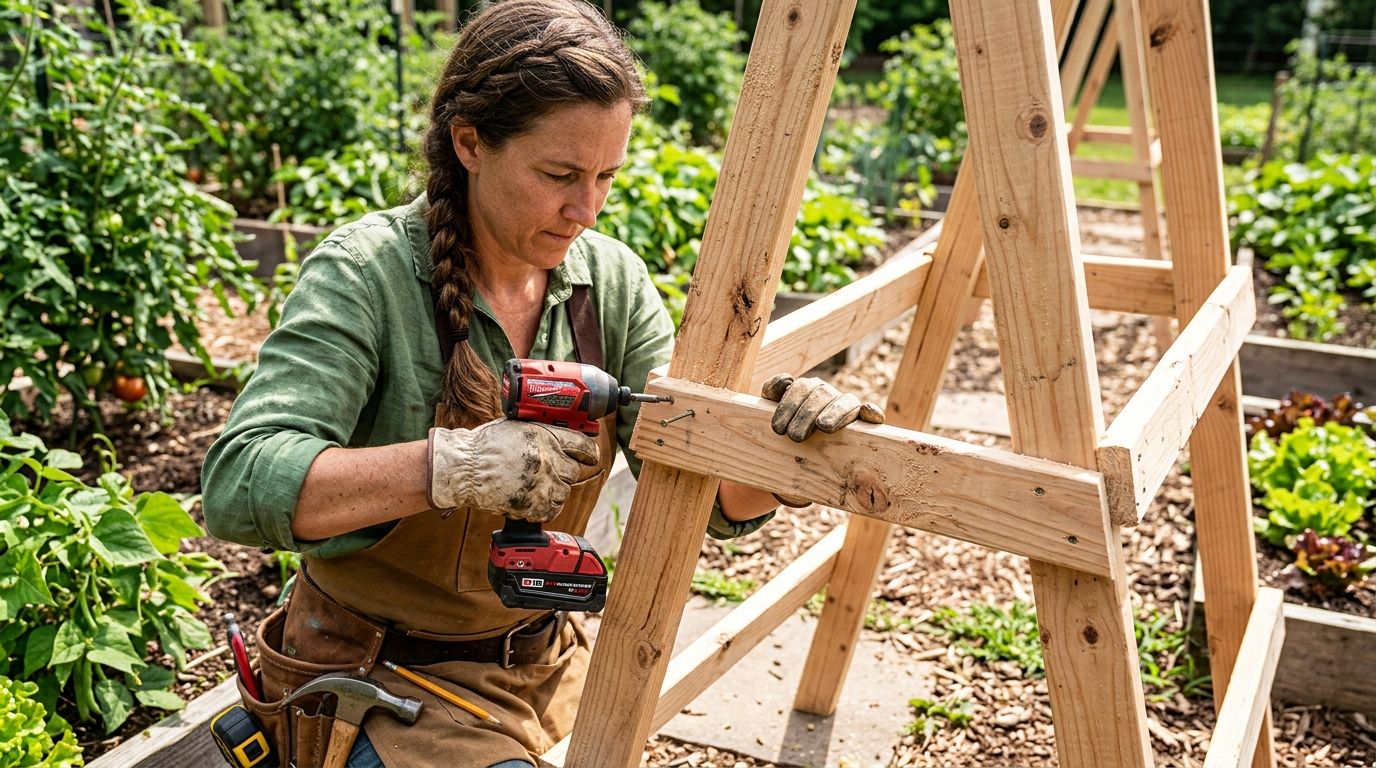
Begin by cutting a 30-degree angle at the top end of each of the four 8-foot legs. This angled cut allows the legs to sit flush against the top ridge beam. Lay the 10-foot ridge beam flat on the ground. Position two of the legs on one side, flush with the ends, and secure them using 3-inch exterior deck screws. Attach the heavy-duty gate hinges directly to the top edge of the ridge beam. Attach the remaining two legs to the other side of the hinges.
Stand the structure up in the garden bed. The hinges allow you to adjust the spread of the legs. For maximum stability against heavy winds, spread the legs so they are approximately 4 to 5 feet apart at the base. Once the angle is set, cut two horizontal cross-braces from scrap lumber and screw them across the sides (forming an 'A' shape) to permanently lock the angle in place and prevent the frame from splaying outward under the weight of the melons.
Attaching the Hog Wire Fencing
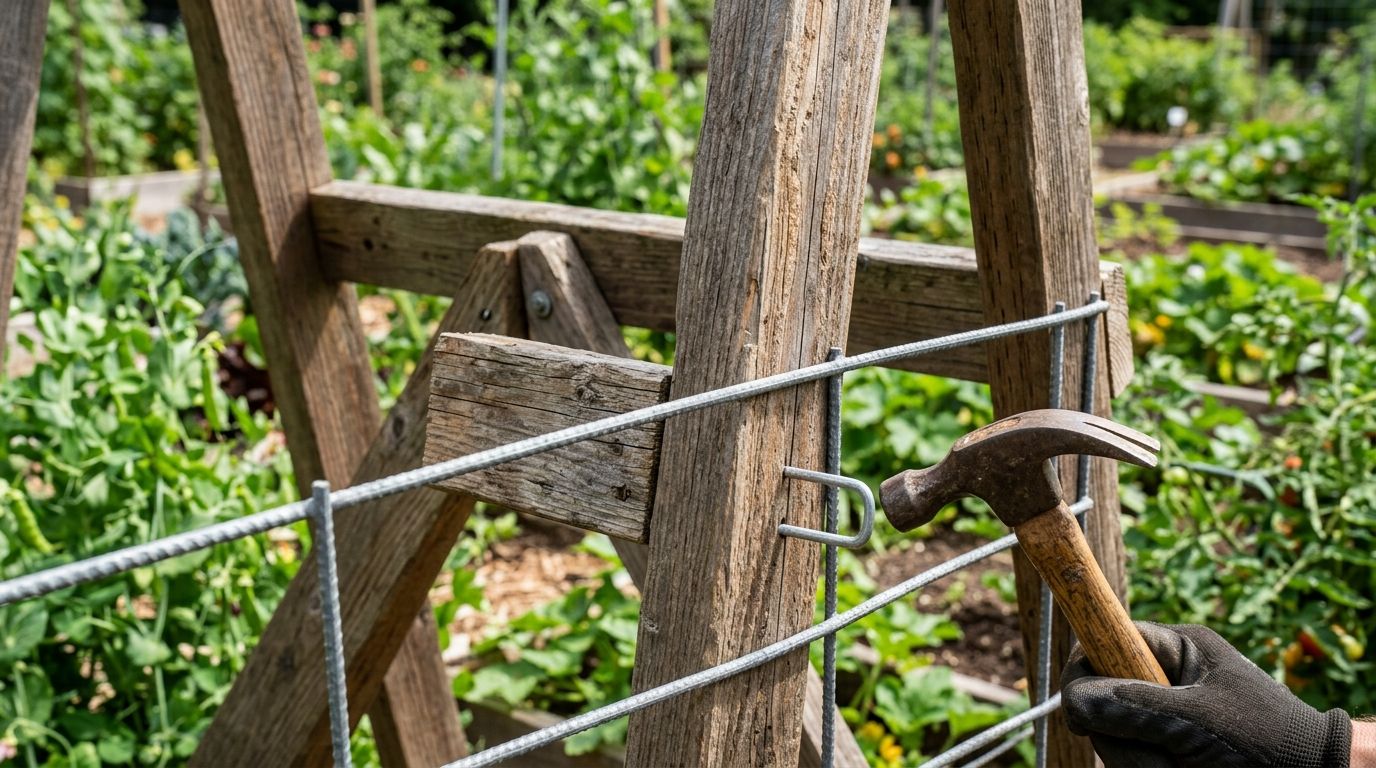
With the wooden skeleton secure, it is time to attach the structural grid. Unroll the heavy-gauge hog wire fencing across the face of the A-frame. Starting at the top ridge beam, drive galvanized U-staples heavily into the wood, securing the thick wire every six inches. Work your way down the legs, pulling the wire mesh as tight and flat as possible before driving the staples home.
It is absolutely critical that the wire mesh is fastened tightly. If the wire sags or bulges, it will shift in the wind, grinding the delicate stems of the squash plants against the rough metal and eventually severing the vines. Leave a 12-inch gap between the bottom edge of the wire and the soil surface. This gap allows you easy access to weed the base of the plants and apply thick layers of compost without the wire getting in the way.
Training the Vines Vertically
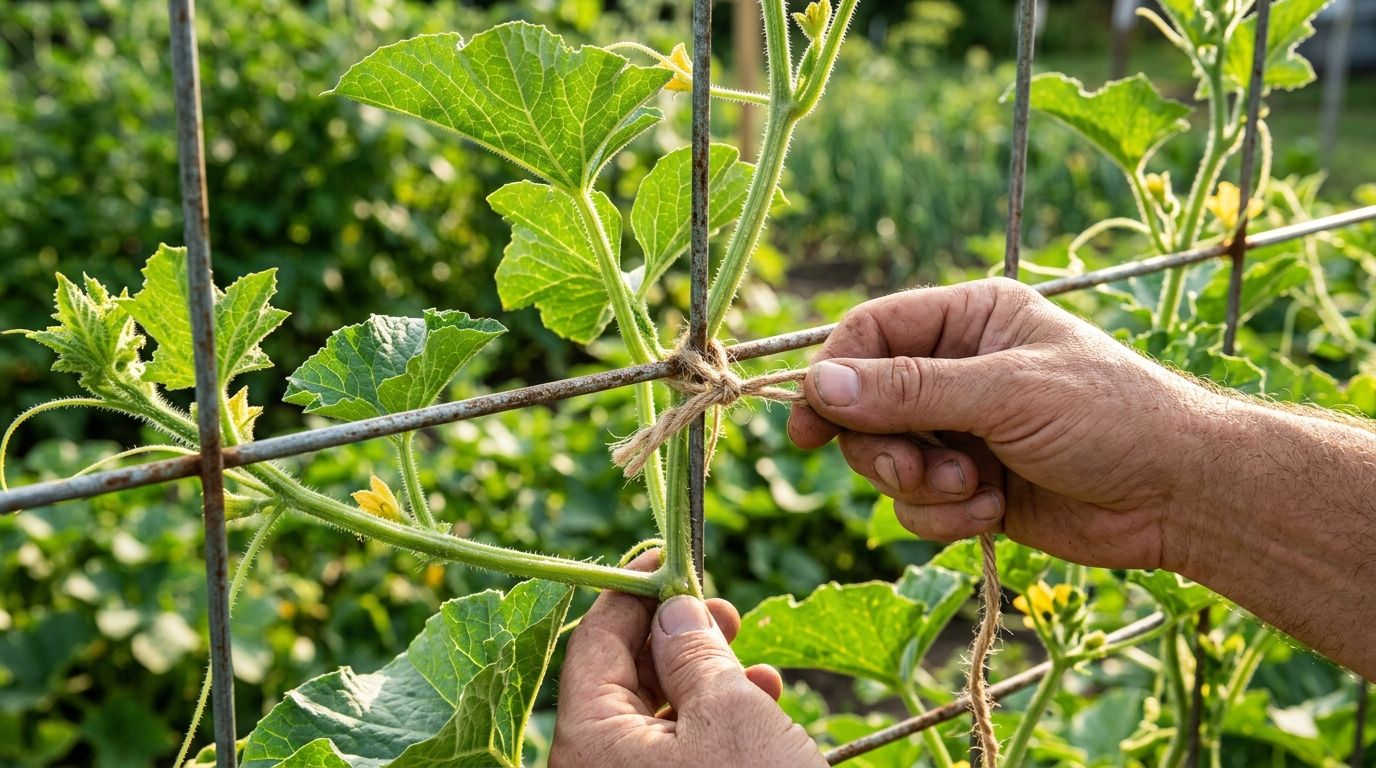
Melons and winter squash possess natural tendrils—thin, curling appendages that reach out and wrap around nearby structures for support. However, these tendrils are biologically adapted to grab onto low-lying vegetation, not necessarily to climb straight up a sheer vertical wall. Therefore, they require intense human intervention during the first month of rapid growth.
Plant your melon or squash transplants at the absolute base of the A-frame, spacing them roughly 18 inches apart. As the primary vine reaches 12 inches in length, gently lift it and weave the growing tip in and out of the lowest squares of the hog wire. Use soft, biodegradable garden twine to tie the main vine to the wire grid. Tie the twine loosely—always leave at least half an inch of slack in the loop. The vine will rapidly expand in girth as it matures; tying it too tightly will choke the vascular tissue and kill the plant. Check the vines every three to four days, continuously weaving the new growth upward and tying it off securely before a heavy rainstorm can knock it down.
Engineering the Fruit Hammock
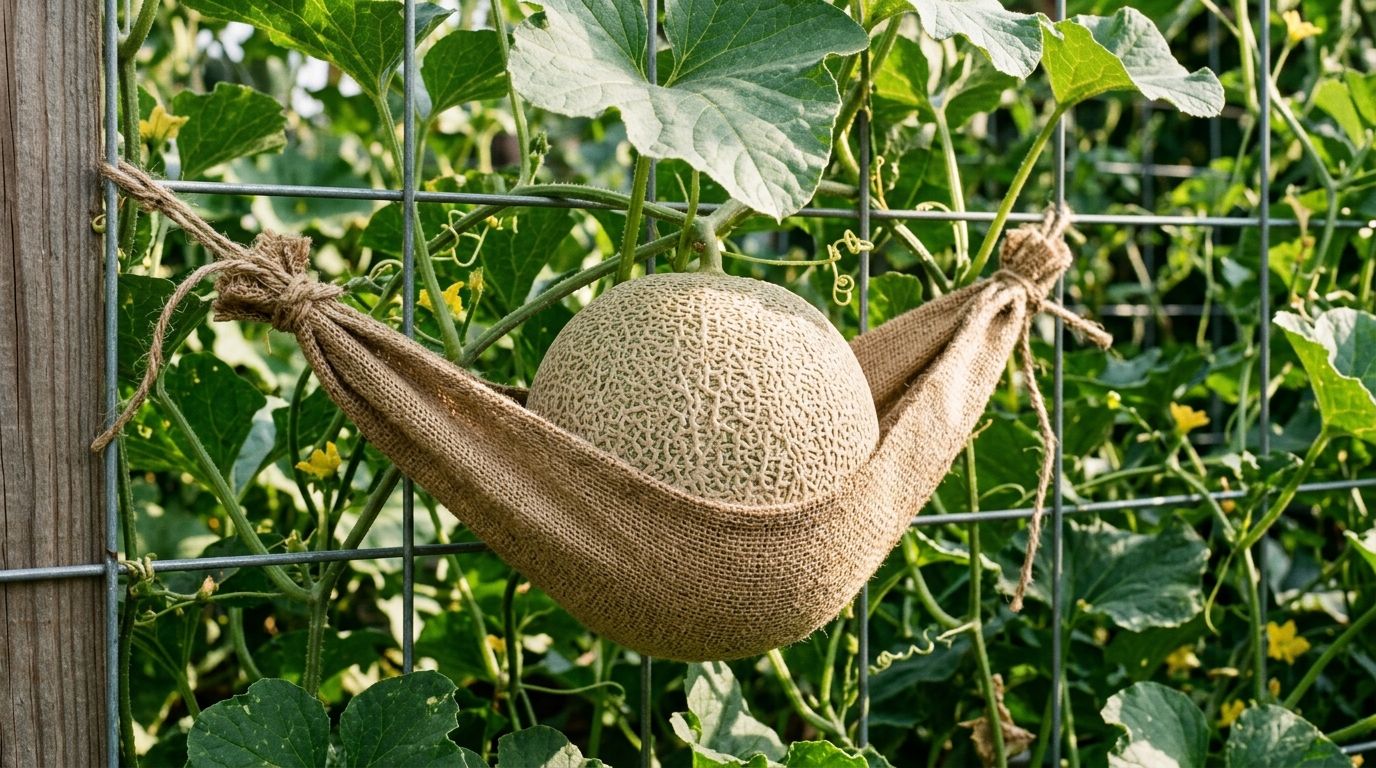
This is the most critical step in the entire vertical growing process. The stem that attaches a heavy cantaloupe or butternut squash to the main vine is known as the pedicel. While the pedicel is strong enough to support the fruit when it is resting on the ground, it is *not* strong enough to support the hanging weight of a 5-pound fruit in mid-air. Once the melon reaches the size of a baseball, gravity will cause the pedicel to snap, dropping your unripe fruit to the ground.
To prevent this, you must engineer a "fruit hammock." The ideal material is old pantyhose, nylon stockings, or mesh onion bags. These materials are incredibly strong, expand dynamically as the fruit grows, and allow rain to drain through instantly. Cut a 12-inch section of the stretchy material. Cradle the young melon inside the fabric. Pull the two ends of the fabric upward, stretching it slightly, and tie it securely to the heavy-gauge hog wire above the fruit. The entire weight of the growing melon is now completely supported by the hammock and the wire trellis, relieving all tension from the delicate plant stem.
Comparative Tensile Strength of Trellising Materials
In structural agricultural design, not all materials are created equal. When designing a trellis for a heavy crop, growers often underestimate the sheer weight of the biomass. A single healthy butternut squash plant can produce 15 to 20 pounds of fruit, combined with another 10 pounds of vegetative foliage and water weight. If you are planting eight squash plants along a 10-foot trellis, that structure must dynamically support over 240 pounds of shifting, swinging weight in a windstorm.
Let's analyze the tensile strength and degradation rates of common materials:
- Nylon Netting: Commonly sold in garden centers for peas and beans, extruded nylon netting has a tensile strength of roughly 40 to 60 pounds per square foot. However, it is highly susceptible to UV degradation. Over a single summer, the sun's ultraviolet rays break down the polymer bonds. By August, the netting becomes brittle. When a 5-pound melon pulls against it, the netting snaps, causing a catastrophic failure that can take down the entire crop. Nylon netting should never be used for heavy fruits.
- Jute Twine (Florida Weave): A Florida weave using agricultural jute twine is excellent for indeterminate tomatoes, but it fails spectacularly for squash. Jute is organic and biodegradable, meaning it rots when exposed to rain and soil microbes. A tight jute line strung in June will snap like a twig by late August under the weight of a heavy cantaloupe harvest.
- Welded Wire Fencing (Hog Wire / Cattle Panel): This is the premier material. Made from 4-gauge or 6-gauge galvanized steel wire welded at every intersection, a standard cattle panel has a tensile strength exceeding 1,000 pounds. It is entirely immune to UV degradation and highly resistant to rust. A hog wire grid will last for 20 years in the field and will never sag or snap under the weight of your heaviest winter squash.
The Physics of A-Frame Load Distribution
The architectural genius of the A-frame trellis lies in its load distribution. A single, straight vertical wall trellis acts like a sail in the wind and requires massive, deep-set concrete footings to prevent it from blowing over. The A-frame, however, is a self-supporting geometric triangle.
When the heavy squash vines pull downward on the wire grid, that gravitational force is transferred diagonally down the 2x4 legs and driven straight into the ground. Because the legs are spread 4 to 5 feet apart at the base, the structure has a massive footprint. Wind shear hitting the broad side of the trellis pushes the structure, but the opposing leg acts as a rigid brace, completely neutralizing the lateral force. This means you do not need to bury the legs or pour concrete; the sheer geometry of the triangle keeps the trellis upright and stable in severe thunderstorms.
Fungal Pathology of Ground-Contact Crops
To truly appreciate the value of vertical trellising, one must understand the microscopic pathogens that exist in the topsoil. The soil surface is a vibrant ecosystem teeming with fungi and bacteria. While many are beneficial, several are aggressive pathogens of the Cucurbitaceae family (which includes all squashes, melons, and cucumbers).
When a melon develops on the ground, the underside of the fruit (the "belly") sits in constant contact with the moist soil. This moisture creates an anaerobic, dark environment that is the perfect breeding ground for *Rhizoctonia solani*, *Phytophthora capsici*, and various *Pythium* species. These fungal pathogens release enzymes that break down the tough rind of the melon, allowing the fungus to penetrate the sweet, watery flesh inside. Within days, a perfectly healthy melon turns into a rotting, liquified mess.
By elevating the crop, you completely break the disease cycle. The fungi cannot travel through the air to reach the fruit. Furthermore, the elevated fruits are exposed to 360-degree airflow, which dries the skin of the melon instantly after a rainstorm, preventing any airborne spores from germinating on the rind.
This airflow also protects the foliage. Powdery mildew (*Podosphaera xanthii*) is the most destructive foliar disease of squash. It thrives in stagnant, humid air. When squash vines sprawl on the ground, the dense layers of overlapping leaves trap moisture. By training the vines up a vertical wire grid, the wind can pass directly through the canopy. This drops the relative humidity within the leaf zone below the critical threshold required for powdery mildew spores to germinate, effectively providing mechanical, chemical-free disease control.
Economic Yield Analysis for Market Gardeners
For the commercial market gardener operating on limited acreage, spatial efficiency dictates profitability. Let us analyze the economic impact of vertical trellising on a standard 100-foot by 30-inch garden bed.
If you allow butternut squash to sprawl horizontally, you can plant approximately one squash plant every 3 feet down the center of the bed (yielding roughly 33 plants per 100-foot bed). These plants will immediately spill over the edges into the pathways, blocking tractor access and making harvesting a logistical nightmare. Assuming a yield of 4 squash per plant, that 100-foot bed yields 132 squash.
Now, deploy a 100-foot long vertical A-frame trellis system down the center of that same bed. Because the vines are trained vertically, you can decrease your plant spacing to 18 inches. Furthermore, the A-frame has two sides! You can plant a row of squash on the east-facing side, and a row of shade-tolerant crops (like lettuce or spinach) on the west-facing side, or double-plant the squash on both sides.
By double-planting the squash at 18-inch spacing on both sides of the A-frame, you can fit 132 plants into the exact same 100-foot bed footprint. Assuming the same yield of 4 squash per plant, your total harvest jumps to 528 squash. You have quadrupled your yield per square foot without expanding the physical footprint of the farm. When butternut squash sells for $2.50 per pound, the return on investment for the lumber and hog wire is realized in the very first harvest of the season. To learn more about organizing a commercial plot, check out our guide on market gardening 101.
Varietal Selection for Vertical Success
While the A-frame trellis is incredibly strong, it is still subject to the laws of physics. Not every variety of melon or squash is appropriate for vertical cultivation. Attempting to grow a 30-pound 'Georgia Rattlesnake' watermelon or a massive 'Blue Hubbard' squash on a vertical trellis is a recipe for disaster; the sheer mass of a single fruit is too difficult to hammock effectively, and the vines are simply too aggressive to contain.
Instead, focus on small-fruited, highly prolific varieties known as "icebox" melons or personal-sized squash. These varieties typically produce fruits weighing between 2 and 6 pounds, which is the exact sweet spot for vertical hammocking.
- Melons: 'Sugar Baby' is the undisputed king of vertical watermelons, producing perfect 6-pound dark green globes. 'Minnesota Midget' is an exceptional heirloom cantaloupe that produces copious amounts of 4-inch, deeply ribbed, sugary fruits.
- Winter Squash: 'Honeynut' squash is a miniaturized butternut variety that is intensely sweet and perfectly sized for a trellis. 'Delicata' squash is another prime candidate, offering thin-skinned, boat-shaped fruits that rarely exceed two pounds and require very little hammocking.
- Cucumbers: While technically a different category, cucumbers thrive on this heavy-duty setup. Varieties like 'Marketmore 76' or 'Lemon Cucumber' will climb the hog wire effortlessly and require absolutely no hammocking, as their pedicels are strong enough to support their light weight.
Pruning the Vertical Canopy
When you compress a sprawling vining crop into a vertical two-dimensional plane, canopy management becomes paramount. Left unpruned, a squash plant will produce dozens of lateral side shoots (suckers) that will quickly turn your trellis into a tangled, impenetrable jungle of foliage. This defeats the primary purpose of the trellis, which is to increase airflow and sunlight penetration.
To manage the canopy, you must ruthlessly prune the plant. Identify the primary, thickest vine emerging from the soil. As it climbs the trellis, snip off the secondary lateral shoots that emerge from the leaf axils (the 'armpit' where the leaf stem meets the main vine). Allow only one or two strong secondary vines to develop, and train these horizontally along the wire grid. By limiting the vegetative growth, you force the plant to redirect its photosynthetic energy entirely into flowering and fruiting. Furthermore, you should proactively prune away any lower leaves that turn yellow or show the first signs of powdery mildew spots, instantly removing the pathogenic spores from the microclimate.
Hydrological Management of Elevated Crops
It is important to understand that elevating the foliage of a plant changes its hydrological dynamics. When vines sprawl on the ground, the large canopy of leaves acts as a living mulch, shading the soil completely and drastically reducing evaporation. When you lift the entire plant onto a vertical trellis, the soil at the base is suddenly exposed to the blazing summer sun.
Therefore, vertical trellising must be paired with aggressive deep mulching and precision drip irrigation. Lay a single line of drip tape directly across the root zone of the transplants. Cover the drip tape and the exposed soil with a minimum of four inches of clean wheat straw, untreated wood chips, or shredded leaves. This deep mulch layer will suppress weed competition, regulate massive soil temperature swings, and lock in the moisture delivered by the drip tape. Without this mulch layer, the exposed soil will bake dry in July, causing the vertically suspended fruits to crack from inconsistent hydration. For more on soil moisture dynamics, read our comprehensive deep mulch gardening guide.
Conclusion
The implementation of heavy-duty vertical trellising represents a quantum leap in the efficiency of a small-scale garden. By utilizing structural materials like 2x4 lumber and hog wire, and employing the biological hack of the custom fruit hammock, growers can successfully cultivate massive yields of melons, butternut squash, and cantaloupes in a fraction of the traditional footprint. This architectural approach not only eliminates the devastating effects of ground-rot and powdery mildew but also transforms the chaotic sprawl of a squash patch into a highly managed, visually stunning vertical orchard.
Expert Insights & FAQs
Can I use string or nylon netting instead of metal cattle panels?
For cucumbers or lightweight peas, nylon netting is acceptable. However, for heavy melons and winter squash, string netting is inadequate. The concentrated weight of mature fruit and wet foliage will stretch nylon severely, causing the trellis to sag and potentially collapse in a thunderstorm. Heavy-gauge welded steel cattle panels are necessary for heavy loads.
Do I need to hand-pollinate the flowers on a vertical trellis?
Usually, no. Vertical trellises often experience higher pollination rates because the bright yellow male and female blossoms are elevated and highly visible to passing bumblebees and honeybees. However, if you are growing inside a greenhouse or high tunnel with limited pollinator access, you can easily hand-pollinate the accessible elevated flowers using a small paintbrush.
How many fruits can a single 10-foot A-frame trellis support?
A properly constructed 10-foot long A-frame, built with 2x4 lumber and anchored securely, can support over 150 to 200 pounds of hanging fruit. If you are growing 'Sugar Baby' watermelons or 'Honeynut' squashes, the structure can hold 20 to 30 mature fruits across both faces of the frame.
What is the best material for tying young vines to the wire?
Always use soft, natural materials like jute twine, cotton string, or strips of old cotton t-shirts. Never use plastic zip ties or thin wire twist-ties directly around plant stems, as these will cut into expanding stems and constrict the vascular flow of water and nutrients.
How do I know when a hammocked melon is ripe?
Because the melon is fully supported, it will not snap off the vine naturally when ripe (a process called the 'full slip'). Instead, inspect the small, curly tendril located on the main vine exactly where the melon's stem attaches. When that specific tendril turns completely brown and dries like a dead twig, the melon is fully ripe and ready to harvest.
Will raccoons, deer, or rodents damage elevated melons?
While a vertical trellis removes fruit from ground-dwelling pests like slugs and pillbugs, it places fruit at eye level for deer. In areas with high deer pressure, vertical trellises should be located inside an 8-foot perimeter fence. Raccoons can climb cattle panels easily, so exclusion fencing or live traps may be necessary in rural areas.
Should I prune off male flowers to conserve plant energy?
Never prune off male flowers. Cucurbit plants produce male flowers for several weeks before female blossoms emerge to attract and train local bee populations to visit the patch. Without the pollen from male flowers, female flowers will abort and drop off the vine without forming fruit.
What size fruit can be safely grown on a vertical trellis?
Focus on personal-sized melons and squashes weighing between 2 and 6 pounds, such as 'Sugar Baby' watermelon, 'Minnesota Midget' cantaloupe, 'Honeynut' butternut, and 'Delicata' squash. Avoid giant cultivars weighing over 15 pounds, as their sheer bulk makes hammocking difficult and can strain the trellis joints.
Johnnie McCormick
Zone 7b/8a - North Central Alabama
Johnnie McCormick is a gardening hobbyist and the founder of My Garden Spot. Raised in north-central Alabama, his passion for gardening began in his youth. In 2008, he established a large market garden, teaching himself high-yield growing methods. In the years since, he has operated seasonal seedling sales for transplants, specializing in heirloom tomatoes, peppers, eggplants, decorative ground covers like Ajuga (Bugleweed), marigolds, nasturtiums, and fresh kitchen-window herb arrangements (basil, cilantro). Today, he gardens in the hills between Birmingham and Jasper, Alabama (Zone 7b/8a), sharing practical, community-focused gardening resources.
Verified Authoritative Citations & References
In alignment with our strict E-E-A-T research and verification guidelines, this guide cross-references data from the United States Department of Agriculture (USDA) and Cooperative Extension Service programs.
- Cornell Cooperative Extension: Home Vegetable Gardening Guide and vegetable variety recommendations. gardening.cals.cornell.edu
- Penn State Extension: Master Gardener Manual and companion planting matrices. extension.psu.edu
- Alabama Cooperative Extension System (ACES): Raised bed construction plans and regional seed planting calendars. aces.edu
- USDA NRCS: Cover crops and biological soil health guidelines. nrcs.usda.gov
Please log in to view comments.