What are the Best Farm Pricing Strategies for Small Farms?


1. Introduction: The Evolution of Agricultural Economics
Navigating the financial landscape of modern agriculture requires the acumen of a seasoned economist and the strategic foresight of a business manager. The concept of cultivating the land for financial gain is deeply rooted in history. Eighteenth-century garden manuals—and earlier texts such as Thomas Tusser's 1557 handbook—shaped the cultural meaning of cultivation, demonstrating how bringing a harvest to market could turn a profitable margin even on a small scale. The tools have changed; the arithmetic has not.
Today, whether you are a bootstrap urban farmer managing a quarter-acre of intensive market beds or the operations manager of an investor-backed enterprise, establishing a rigorous farm pricing strategy is the absolute baseline of your viability. Volatile input costs, unpredictable weather, and shifting consumer demands create an environment where arbitrary pricing guarantees insolvency. When I first established my market garden in 2008, I made the classic beginner's mistake: I looked at the prices at the local supermarket, added fifty cents, and assumed I was running a profitable business. It wasn't until the end of the season, when I calculated the hundreds of hours I spent washing greens and dealing with pest pressure, that I realized my effective hourly wage was less than three dollars.
Pricing remains the most neglected skill on small farms: too many growers set prices by glancing at the stall next door, effectively outsourcing their business model to a competitor whose costs they know nothing about. That competitor might own their land outright, rely on unpaid family labor, or have an off-farm income subsidizing their operation. If you copy their prices, you import their flawed economics into your business, leading directly to burnout and financial failure.
This comprehensive guide provides an authoritative blueprint for structuring your prices, evaluating market channels, and scaling your agricultural business. We will begin with the math that underpins everything—your true Cost of Production—then work outward through pricing models, retail psychology, wholesale negotiation, and the ecological efficiencies that quietly determine your margins.
2. The Foundation: Calculating Your True Cost of Production (COP)
Before a single radish or heirloom tomato is priced, you must intimately understand your Cost of Production (COP). If your prices fall below your COP, you are not running a business—you are subsidizing your customers with your own capital and labor. Every sound pricing decision, from a farmers market bunch of kale to a palletized wholesale contract, begins here.
Enterprise Budgets and Cost Allocation
An enterprise budget isolates a single crop or operation to track all associated costs and revenues. This granularity matters: a farm-level profit-and-loss statement can hide the fact that your high-margin salad mix is quietly subsidizing your labor-intensive, low-yield heirloom tomatoes every single season. Costs are divided into two distinct categories:
- Variable (Operating) Costs: Expenses that fluctuate in proportion to production volume. This includes biological inputs (seeds, transplants, inoculants), soil amendments (compost, rock phosphate, organic fertilizers), direct labor (hours spent prepping beds, cultivating, harvesting, and washing), and post-harvest supplies (packaging, clam-shells, standard wax boxes, labels). Post-harvest handling is routinely underestimated; if your packing workflow is inefficient, it silently inflates the variable cost of every unit you sell. Designing an efficient wash and pack station is crucial because layout directly affects labor minutes per case.
- Fixed Costs (Overhead): Expenses required to keep the farm operational regardless of harvest volume. This encompasses infrastructure and depreciation (high tunnels, wash-pack roofing, tractors, delivery vehicles, irrigation timers), administrative expenses (software subscriptions, e-commerce platforms, lease payments, insurance), and—critically—the owner's baseline management draw. Omitting your own labor and management compensation is the single most common COP error on small farms. If you don't pay yourself on paper, you won't get paid in reality.

The COP Formula and Row-Foot Margins
Advanced market gardeners evaluate profitability by the square foot or row-foot of bed space. This spatial metric allows accurate comparison between a 30-day radish crop and a 110-day storage onion crop occupying the same ground. Time is money, and bed space is your most limited asset.
Total Crop Cost = (Total Fixed Overhead / Number of Active Growing Beds) + (Variable Costs for that Specific Bed)
Unit Cost = Total Crop Cost / Total Sellable Units Harvested
A worked example: Suppose your season's total overhead is $24,000 and you run 60 active beds; each bed therefore carries $400 of allocated overhead. A bed of lettuce requires $90 in seed, compost, and packaging plus $110 in direct labor—$600 total cost for the bed. If the bed yields 120 marketable heads, your unit COP is $5.00 per head. Any retail price above $5.00 is margin; any wholesale offer below it is a slow leak. For a deeper treatment of whole-farm return metrics, see our Market Gardening 101 Guide.
The Shrinkage Factor
It is absolutely crucial to build a "shrink allowance" into every calculation. Shrink represents produce lost to pest damage, aesthetic imperfections, transit bruising, or post-harvest rot. If you harvest 1,000 heads of lettuce but historical records show a 20% shrinkage rate (which is entirely common for organic operations dealing with cabbage loopers or tip burn), your COP must be divided across 800 marketable heads—not the 1,000 you planted. Ignoring shrink makes your spreadsheet profitable while your bank account disagrees.
3. Farm Pricing Models Evaluated
Different crops, sales channels, and customer demographics call for different pricing logic. Robust farm businesses do not marry a single model; they deploy a deliberate combination depending on the context.
Cost-Plus Pricing
In Cost-Plus pricing, the farmer calculates the exact COP per unit and adds a predetermined percentage markup—commonly 30% to 60% depending on the channel. The virtue of this model is mathematical security: every sale is provably profitable.
However, the vice of Cost-Plus pricing is a complete blindness to demand. Cost-plus ignores what the market will bear. This means it leaves money on the table during scarcity (such as the first week of ripe field tomatoes in July, when customers will happily pay a massive premium) and can price you out of the market during peak-season gluts when supply outstrips demand. Use Cost-Plus pricing as your strict floor-setting tool, not your ceiling.
Value-Based Pricing
Here, the price is set by the perceived value to the customer rather than by your internal costs. This model thrives on product differentiation and brand equity. Certified organic status, hyper-local provenance, unique heirloom varieties, impeccable post-harvest handling, and a compelling farm story all increase perceived value.
Value-based pricing supports the highest margins in agriculture, but it demands exceptional marketing overhead. It requires beautiful signage, social proof, consistent top-tier quality, and the discipline to never train your customers to expect discounts. Our guide to pricing early spring greens demonstrates how seasonal scarcity and freshness amplify perceived value, allowing you to charge significantly more than the grocery store equivalent.
Competitive (Market-Oriented) Pricing
Setting prices against external benchmarks—competitor stalls at the farmers market, organic grocery averages, or USDA terminal market reports—ensures a high velocity of sales and keeps you relevant in price-sensitive venues.
The primary risk here is a margin squeeze. If your competitors operate with a lower COP (unpaid family labor, inherited land) or are simply ignorant of their own numbers, matching their prices imports their unsustainable economics into your business. Benchmark constantly to understand the local market, but never let a competitor's chalk sign override your own mathematically determined COP floor. If you cannot produce a crop profitably at the prevailing market price, you must stop growing that crop.
Dynamic and Seasonal Pricing
Sophisticated growers overlay all three models with a seasonal dimension. Early-season scarcity supports value-based premiums. Peak-season abundance shifts you toward competitive pricing and volume bundling to move massive amounts of perishable inventory quickly. Shoulder seasons reward the strict cost-plus discipline that keeps late-fall plantings profitable despite slower growth rates.
CSA pricing is its own specialized case. Because CSA shares are sold months before production begins, they must be priced against projected costs with a deliberate risk margin built in, as detailed in our profitability guide for CSA shares.
4. Wholesale vs. Retail: A Structural Comparison
The most profound strategic divergence a farm faces is whether to sell direct-to-consumer (retail) or business-to-business (wholesale). These are not merely two different prices for the same carrot; they are two fundamentally different businesses that happen to share a field. The most resilient farms run a deliberate, hybridized model of both.
Pricing Matrix Comparison
| Feature | Retail (Farmers Market / CSA) | Wholesale (Contractors, Distributors, Chefs) |
|---|---|---|
| Price Level / Margin | Highest (50% - 70%+ Gross Margin) | Lowest (15% - 40% Gross Margin) |
| Sales Volume | Low (Individual units/bunches) | High (Cases, Pallets, Bulk Bins) |
| Marketing / Labor | High (Signage, individual sales, setup/breakdown) | Low (B2B relationships, palletized drop-offs) |
| Packaging Costs | High (Consumer branding, clam-shells, bags) | Low to Moderate (Standardized boxes, returnable crates) |
| Payment Terms | Immediate (Cash, POS credit, Venmo) | Delayed (Net-15, Net-30, COD) |
| Price Stability | Variable week to week based on supply | Fixed by seasonal contract or weekly price sheet |
| Quality Tolerance | Flexible (a good story sells "ugly" produce) | Strict (standardized specs, culls rejected) |
Why the Hybrid Model Wins
Retail margins look intoxicating on paper until you honestly account for the labor of a farmers market day: loading the truck, driving in traffic, five hours of active selling, breakdown, and the shrink on whatever comes home unsold. Conversely, wholesale margins look thin until you price the alternative—trying to move 400 pounds of peak-season zucchini one three-dollar basket at a time.
Blending the channels lets each cover the other's weakness. Wholesale contracts absorb your high-volume, lower-value surplus at a predictable floor price, protecting your weekly cash flow. Retail channels capture the premium consumer dollar on your highest-quality, most differentiated crops. The CSA sits uniquely between the two, providing retail margins but with wholesale-like predictability and upfront capital.
5. Tactical Retail and Farmers Market Strategies
For direct-to-consumer sales, blending rigorous cost accounting with consumer psychology is highly effective. The following tactics consistently raise your Average Order Value (AOV) and revenue per market hour.
- Psychological Pricing: Whole numbers ($5.00) speed up cash transactions and simplify mental math at a busy stand, but modern digital point-of-sale systems make "charm pricing" (like $4.95) entirely frictionless. Charm pricing creates a subconscious perception of value on premium items. Test both approaches on different products and let your POS data decide the winner.
- Bundle Pricing: Increase AOV by bundling. Offering heirloom tomatoes at $5.00 per pound or a 10-pound "canning box" for $40.00 moves peak-season gluts rapidly before quality degrades, and customers leave feeling they secured a fantastic deal. The discount is real but mathematically bounded—and it is always cheaper than composting unsold inventory.
- Tiered Pricing and Grades: Never sell all produce at one single grade. Flawless "Number 1" produce commands the full premium retail price. Cosmetically imperfect "Number 2" or utility-grade produce sells in bulk to home canners, sauce-makers, and budget-conscious families. Tiering converts what would have been shrink into a legitimate second revenue stream. Structured price tiers for accessibility can go further still—such as sliding-scale payment models or accepting SNAP/EBT, which opens an entirely new customer base while ensuring food equity.
- Loss Leaders: Price a fast-growing, popular crop—like radishes, early snap peas, or sweet corn—at or near break-even to pull foot traffic to your stand. Once the customer is there, convert that traffic into buyers of high-margin items like value-added preserves, salad mixes, or cut flowers.
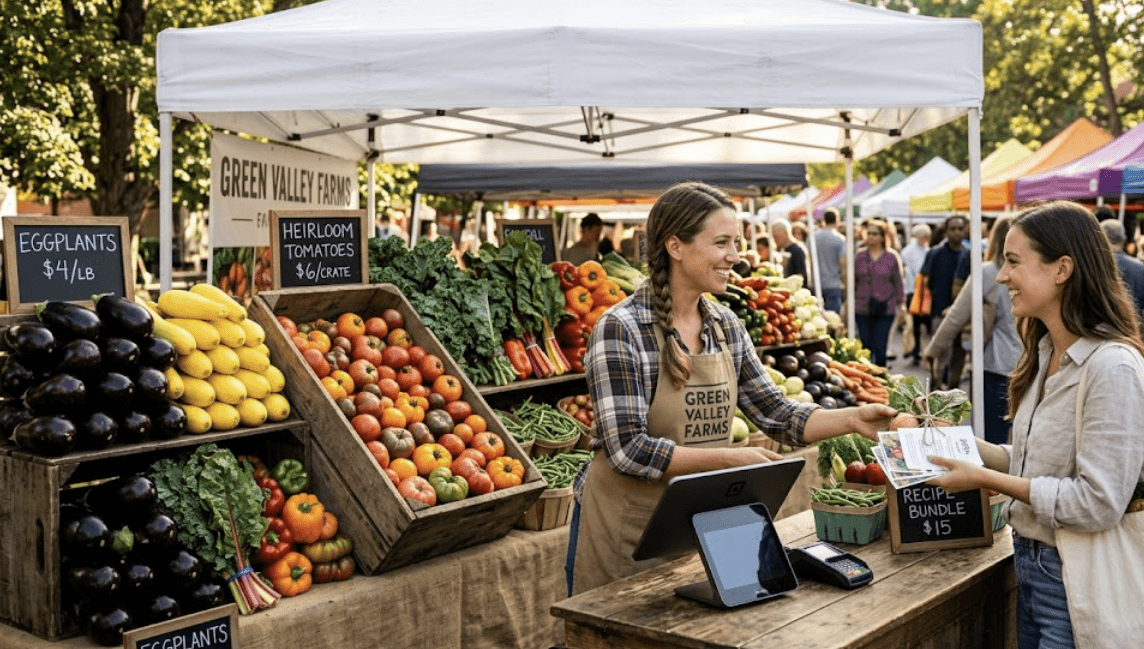
- Presentation as Pricing Power: Crisp, abundant displays, clear signage with variety names, and visible pricing reduce buyer hesitation and support value-based prices. A sparse table looks picked over and sad; an overflowing table signals freshness and quality.

6. Scaling Wholesale and Negotiating Contracts
When transitioning to wholesale, your customer changes fundamentally. You are no longer selling to a person choosing dinner; you are selling to executive chefs, produce buyers, and B2B contractors who prioritize reliability, standardized specifications, and consistent case counts above all else. This channel is about velocity and scale—and it rewards farms that behave like professional suppliers.
Establish Your Floor Price and Defend It
Use your COP formula to establish the absolute lowest price you can accept while preserving a baseline margin—20% is a sound minimum for wholesale accounts. This is your floor, and it is strictly non-negotiable. Publish a written wholesale price sheet (a "Fresh Sheet") and update it weekly or seasonally. When a buyer pushes below your floor, the correct answer is a courteous no. A contract that loses money on every case cannot be saved by volume; it will simply bankrupt you faster.
Volume Discounts and Commitment Tiers
Offer discounts strictly in exchange for something concrete: volume or consistency. A contractor purchasing ten cases per week earns a deeper discount than one purchasing two. A chef who signs a six-month purchasing commitment earns a better tier than one who orders opportunistically when their broadline distributor shorts them.
What you should never discount against is vague promises of "loyalty" or "exposure." Structure tiers explicitly on your price sheet—for example, a 25% discount off retail for standing weekly restaurant orders, scaling toward 40% only for regional distributors moving pallet volume—so every buyer understands the rules are based on arithmetic, not favoritism.
Managing Specifications, Invoicing, and Revisions
Wholesale buyers will reject cases that miss specification: wrong count, wrong size grade, wilted greens, or mixed varieties in a single-SKU box. Build the cost of meeting these strict specs—extra grading labor, standardized wax packaging, earlier harvest timing—into your wholesale price from the start.
Invoice upon delivery with clear terms (Net-15 or Net-30), and follow up on late payments promptly. A profitable account that pays in 90 days is a massive cash-flow liability for a small farm. Equally important is operational flexibility. When market saturation collapses a wholesale price mid-season, revise your committed volumes downward in writing, redirect that inventory to your higher-margin retail channel, and update your production plan. The farms that survive wholesale are the ones that treat contracts as living agreements anchored to a defended floor price.
7. Ecological Efficiency, Seasonality, and Risk Management
To truly master farm economics, look beyond the spreadsheet to the ecology of the field. Your margin is decided as much by agronomy as by arithmetic. By focusing on regenerative practices, you can lower your variable costs and increase your overall profitability.
Maximizing Yield Through Ecological Design
Historical texts and modern soil science agree: deep soil preparation, no-till practices, and generous compost applications build the friable, biologically active, moisture-retentive tilth that drives massive yields per square foot. Biological synergies amplify this effect.
Companion planting—stacking crops with mutually beneficial relationships—naturally deters pests, improves space utilization, and reduces the need for purchased synthetic inputs. This suppresses your variable COP and creates room for aggressive, competitive pricing without sacrificing your profit margin. When you rely on beneficial insects rather than expensive organic pesticides, your margins widen automatically.
Buffer Margins for Crop Failure
Agriculture is uniquely exposed to chaos: hail in July, an early September frost, an unforeseen aphid outbreak the week before a major wholesale contract begins. A resilient pricing strategy therefore carries an explicit risk premium.
Standardize a 10% to 15% risk buffer into your base pricing across all crops, so that your successful harvests systematically subsidize your inevitable failures. Farms that price their produce assuming a perfect, flawless season are profitable exactly one year in five.
Seasonality as a Pricing Lever
Scarcity is the farmer's oldest pricing ally. The first field tomatoes of June and the last robust greens of November command premiums that mid-season abundance never will. Extending your production window—using coldframes, low tunnels, caterpillar tunnels, and aggressive succession sowing—moves more of your harvest calendar into those highly profitable shoulder seasons.
Value-Added Processing: The Glut Escape Valve
When seasonal gluts collapse fresh-market prices below your COP, smart farms pivot rather than dump. Transforming a perishable commodity—excess tomatoes, basil, berries—into a shelf-stable premium product like artisanal marinara, pesto, or jam protects your margin and eliminates spoilage risk entirely.
The same principle applies inside a CSA, where value-added add-ons raise per-member revenue without adding a single bed of production. Model your processing labor honestly before committing: a value-added product is only an escape valve if its unit COP plus the kitchen labor clears a retail margin.
8. Record-Keeping and Annual Price Iteration
Pricing is not a decision you make once; it is a loop you close every season. The farms with the strongest margins share one distinct habit: they measure everything and adjust without sentiment.
- Track labor by crop. A simple harvest log—noting the crop, bed number, minutes spent, yield, and cull rate—converts your COP from a wild estimate into an exact measurement after just one season.
- Record sales by channel. Note what sold, at what price, how fast it moved, and what came home unsold. Velocity data reveals which products deserve more bed space next spring and which deserve a quiet retirement.
- Review prices annually against data. Each winter, recompute your COP per crop with the year's actual numbers, compare against realized prices by channel, and adjust accordingly. Raise prices where velocity stayed high at premium levels; drop or re-engineer crops whose margins never materialized.
- Raise prices deliberately. Annual price increases of 3% to 5% keep pace with inflation, fuel costs, and rising input prices. These small increments are rarely noticed by retail customers, whereas a single panicked 20% jump after three flat years will cause massive customer churn.
A farm that cannot say what a bunch of carrots costs to produce is not pricing—it is guessing, and guessing is a slow-motion exit from agriculture. The complete strategy is a closed loop: calculate your true Cost of Production, set channel-specific floors you refuse to breach, deploy Value-Based pricing as a ceiling, blend wholesale velocity with retail margin, and exploit regenerative ecological efficiency to widen every spread. Master the arithmetic, and the harvest will take care of the rest.
Related Guides & Agronomic References
- To explore connected soil and crop strategies, see our deep-dive on supermarket prices.
- For complete infrastructure setup and management, consult our guide on market garden enterprise.
- To maintain season-long health and pest suppression, explore our analysis of farmers market sales.
Expert Insights & FAQs
What is the biggest mistake small farms make when setting their prices?
The most common mistake is failing to calculate their true Cost of Production (COP)—specifically omitting the cost of the owner's direct labor and capital depreciation—and instead simply matching competitor prices, which imports someone else's economics into your business.
How do I determine my cost of production if I grow dozens of different crops?
Group crops into categories based on labor intensity—fast-growing greens, heavy root crops, fruiting vines. Track labor and inputs for one representative crop per category for a month to establish a baseline cost per row-foot, then apply that benchmark across the category.
What is the typical wholesale discount I should offer a restaurant or contractor?
Wholesale buyers generally expect 25% to 50% off your direct-to-consumer retail price. Restaurants typically receive 25% to 30% for smaller standing orders, while broadline distributors and contractors require 40% to 50% for pallet-sized volume commitments.
How does companion planting affect my farm's pricing strategy?
Companion planting naturally deters pests and maximizes space utilization, reducing the need for costly inputs and increasing marketable yield per square foot. That lowers your variable Cost of Production, creating room for more competitive pricing without sacrificing margin.
How much of a shrink allowance should I factor into my pricing?
For highly perishable items like washed salad greens, a shrink allowance of 15% to 20% is standard to cover cull rates and post-harvest rot. For robust storage crops like potatoes and winter squash, 5% to 10% is a safe benchmark.
What is a loss leader and should a small farm use one?
A loss leader is a product sold at or near cost to attract customers to your stand—sweet corn and radishes are classics. It works well if you stock a robust selection of high-margin items, such as value-added preserves or cut flowers, that the attracted traffic subsequently buys.
How do I handle chefs who ask for discounts based on loyalty?
Publish a standardized wholesale price sheet and offer discounts strictly in exchange for volume or consistency—for example, a signed six-month purchasing commitment or a guaranteed weekly case count—rather than vague loyalty. Arithmetic, not favoritism, should set every tier.
Is it better to lower prices at the end of a farmers market to sell out?
Generally no. Repeatedly slashing prices late in the market trains customers to wait for the final hour, cannibalizing your full-price early sales. Donating unsold produce to a food bank for a tax deduction, or composting it, protects your brand's perceived value.
Johnnie McCormick
Zone 7b/8a - North Central Alabama
Johnnie McCormick is a gardening hobbyist and the founder of My Garden Spot. Raised in north-central Alabama, his passion for gardening began in his youth. In 2008, he established a large market garden, teaching himself high-yield growing methods. In the years since, he has operated seasonal seedling sales for transplants, specializing in heirloom tomatoes, peppers, eggplants, decorative ground covers like Ajuga (Bugleweed), marigolds, nasturtiums, and fresh kitchen-window herb arrangements (basil, cilantro). Today, he gardens in the hills between Birmingham and Jasper, Alabama (Zone 7b/8a), sharing practical, community-focused gardening resources.
Verified Authoritative Citations & References
In alignment with our strict E-E-A-T research and verification guidelines, this guide cross-references data from the United States Department of Agriculture (USDA) and Cooperative Extension Service programs.
- USDA Agricultural Marketing Service (AMS): Community Supported Agriculture (CSA) standards and local market surveys. ams.usda.gov
- Penn State Extension: Small Farm Economics, financial planning, and crop pricing research documents. extension.psu.edu
- Cornell Cooperative Extension: Market gardening business planning and local sales guidelines. smallfarms.cornell.edu
- Alabama Cooperative Extension System (ACES): Local food regulations, CSA legal permits, and farm safety standards. aces.edu

Please log in to view comments.