
Why Are Ants Farming Aphids on Young Apple Trees and How Do You Stop Them?
You’ve done everything right. You’ve picked the perfect sunny spot, amended the soil, and planted your shiny new apple trees with dreams of future pies and ciders dancing in your head. Then, one morning, you notice it: a disturbingly organized line of ants marching up the slender trunk, a veritable six-legged superhighway with a sinister purpose. You follow the trail to find the tender new leaves are… sticky? And covered in tiny green bugs? What in the name of Granny Smith is going on here?
Congratulations, you haven’t just planted a tree; you’ve unwittingly become the landlord for a sophisticated, miniature livestock operation. Those ants aren't just visiting; they're ranchers, and those little green bugs are their prized herd of cattle. This isn't a random infestation; it's a calculated business partnership, a perfect example of symbiosis playing out on your prized fruit tree. But don't despair! Understanding this bizarre relationship is the first step to dismantling their operation and taking back your orchard. We're about to dive deep into the entomological espionage, the sweet, sticky currency, and the organic warfare you'll need to wage to protect your future harvest.
What is the secret business deal between ants and aphids on your apple tree?
The Aphid's Role: The Sap-Sucking Sugar Factory
Aphids are essentially tiny, living juice boxes. They belong to the insect order Hemiptera, characterized by their piercing-sucking mouthparts called stylets. They use these needle-like appendages to tap directly into the phloem of your apple tree. The phloem is the plant's vascular tissue that transports sugars (produced during photosynthesis in the leaves) to other parts of the plant for energy and growth. This sap is incredibly rich in sugars but relatively low in amino acids, which aphids need to grow and reproduce.
To get enough amino acids, an aphid has to process a massive volume of sap. This is like trying to get your daily protein intake by drinking nothing but soda. The aphid's digestive system is highly specialized to filter out the amino acids it needs while quickly expelling the excess sugar and water. This sugary, sticky waste product is what we call honeydew.
The Ant's Role: The Rancher and Bodyguard
For an ant, honeydew is liquid gold. It's a readily available, high-energy food source that fuels the entire colony. So, certain species of ants, like the common Black Garden Ant (Lasius niger), have evolved to actively farm these aphids. Their behavior is remarkably deliberate:
- Milking: Ants will gently stroke the aphids with their antennae. This action stimulates the aphids to excrete a droplet of honeydew, which the ant immediately consumes. It's a controlled, on-demand process.
- Herd Management: Ants are not passive collectors. They will move their aphid 'livestock' to the most succulent parts of the plant—the tender new shoots and undersides of young leaves where the phloem is easiest to access. They've been known to carry aphid eggs into their nests to overwinter, bringing them back out in the spring to start a new 'herd'.
- Protection: This is the most critical part of the deal. The ants provide a 24/7 security detail for their precious honeydew producers, which brings us to our next point.
This type of complex interaction is a cornerstone of building a resilient garden. You can learn more about how different species interact by exploring The Science of Companion Planting for Natural Pest Deterrence which shows how to use these relationships to your advantage.
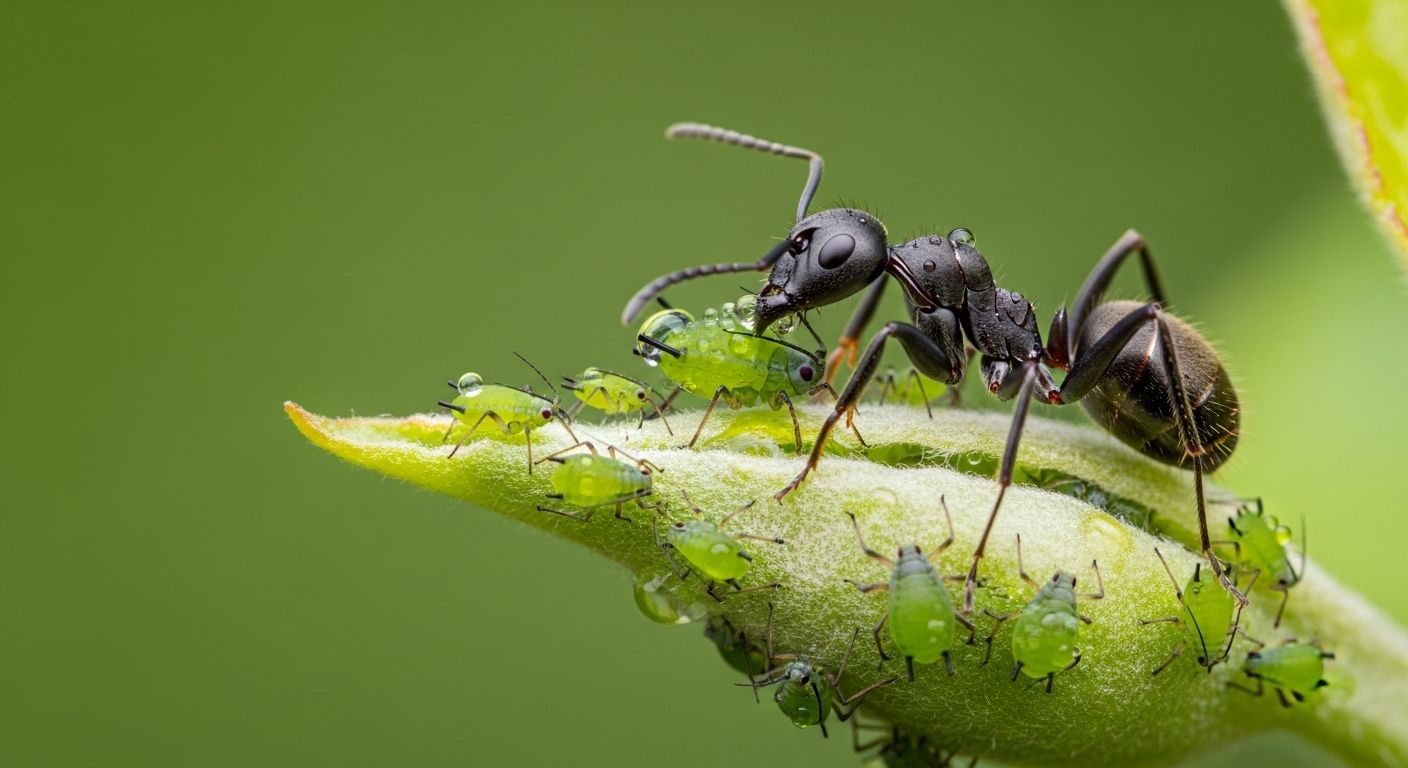
How do ants defend their aphid 'cows' from natural predators?
Here’s a look at the cast of characters—the heroes who want to eat your aphids and the ant thugs that stop them:
| Predator (The Good Guys) | Method of Attack on Aphids | How Ants Interfere (The Thugs) |
|---|---|---|
| Ladybug (Adult & Larva) | A single ladybug can eat up to 5,000 aphids in its lifetime. The larvae are even more voracious. | Ants swarm the ladybugs, biting at their legs and antennae. While they often can't pierce the ladybug's hard shell, the harassment is usually enough to drive them away. |
| Lacewing Larva | Nicknamed "aphid lions," these tiny alligator-like larvae grab aphids with their sickle-shaped jaws and suck them dry. | Ants will aggressively attack and kill lacewing larvae. Their soft bodies make them much more vulnerable than adult ladybugs. Ants will physically pick them up and drop them off the plant. |
| Parasitic Wasp (Aphidius spp.) | These tiny, non-stinging wasps lay a single egg inside an aphid. The larva hatches and eats the aphid from the inside out, turning it into a papery, bronze-colored shell called a "mummy." | Ants recognize the threat and will actively chase away the wasps, preventing them from laying their eggs. They disrupt the entire parasitic cycle. |
| Hoverfly Larva | These small, maggot-like larvae crawl through aphid colonies, consuming dozens per day. | Similar to lacewing larvae, hoverfly larvae are soft-bodied and easily dispatched by a coordinated group of ants. |
Ants use a combination of chemical signals (alarm pheromones) and physical aggression to protect their herd. A single ant might not be a match for a ladybug, but a dozen of them working in concert are a formidable defense force. By eliminating these natural predators, the ants ensure their food supply remains stable and abundant, which allows the aphid population to explode, causing significant damage to your young apple tree.
Why are young apple trees particularly vulnerable to aphid farming operations?
Succulent, Tender Growth: A young tree is in a state of rapid expansion. Its new shoots, stems, and leaves are soft, lush, and un-lignified (not yet woody). This tender tissue is incredibly easy for an aphid's stylet to pierce, requiring less energy to get to the phloem. An older, established tree has thick, protective bark that is much harder to penetrate, except on the newest growth at the very tips of branches.
Nutrient-Dense Sap: The sap flowing through this new growth is the richest in the entire tree. It's packed with the sugars and amino acids needed to build new leaves, stems, and eventually, fruit. This is a five-star meal for an aphid, allowing it to reproduce at an astonishing rate. Aphids reproduce parthenogenetically (without mating) during the summer, with females giving birth to live, pregnant female clones. A single aphid can produce dozens of offspring in her short life, and on a nutrient-rich young tree, this population growth is exponential.
Physical Proximity: Young trees are smaller, meaning the journey from the ground-level ant nest to the prime feeding grounds is short. The entire 'farm' is compact and easier for the ants to patrol and defend from predators. There's less territory to cover, so the security detail is more concentrated and effective.
Stress and Establishment: A newly planted tree is under a certain amount of transplant shock and stress as it works to establish its root system. This stress can make it more susceptible to pests. The heavy feeding from a large aphid colony can further weaken the tree, stunting its growth and making it even more vulnerable to other diseases and pests. It's a vicious cycle. If you're planning a new orchard, using
[our interactive Garden Planning Tool](/garden-calculator)can help you think through placement and spacing for healthier, more resilient trees from the start.
Understanding this vulnerability is key. When you plant a new fruit tree, you should be on high alert for the first signs of this partnership forming. For more detailed information on getting your trees started right, check out [The Ultimate Guide to Growing Fruit Trees](/articles/ultimate-guide-growing-fruit-trees).
What are the warning signs of a full-scale ant-aphid infestation on your fruit trees?
- The Ant Superhighway: This is often the first and most obvious sign. You'll see a distinct, busy trail of ants moving purposefully up and down the trunk of your apple tree. They aren't just wandering; they are commuting to work. If you see this, you can be almost certain there is an aphid herd at the end of the trail.
- Visible Aphid Colonies: Gently turn over the newest, most tender leaves. Aphids love to hide on the undersides of leaves and along soft green stems. They can be green (Green Apple Aphid), pink, black, or even fuzzy (Woolly Apple Aphid). They are tiny, pear-shaped insects, often clustered in dense colonies.
- Distorted or Curled Leaves: As aphids feed, they inject saliva into the plant tissue which can cause the leaves to pucker, curl, and yellow. This deformation is a clear sign of distress and a heavy feeding operation. Stunted shoot growth is another common symptom.
- The Sticky Test: Touch the leaves on the tree. If they feel sticky or look unusually glossy, you're feeling the honeydew. This residue will often drip onto lower leaves or even the ground beneath the tree, giving everything a shiny, tacky coating.
- Sooty Mold Development: If the infestation has been going on for a while, you'll see a black, soot-like fungus growing on the surfaces coated with honeydew. This is a secondary problem but a very clear indicator of a long-standing honeydew-producing pest problem.
- Absence of Beneficials: A healthy garden has predators. If you see a massive aphid colony but no ladybugs, lacewing larvae, or other predators nearby, it's a huge red flag that ants are actively running them off.
Keeping a garden journal and tracking pest activity on a calendar can be a massive help. You can cross-reference your observations with our [MyGardenSpot Planting Calendar](/planting-calendar) to anticipate when pest pressure for your region will be highest.
How does honeydew excretion lead to secondary complications like sooty mold?
Think of a leaf as a tiny solar panel. Its primary job is to capture sunlight and use that energy to convert carbon dioxide and water into glucose (sugar) for the plant to live on. This process is called photosynthesis.
The Photosynthesis Problem
The chemical equation for photosynthesis is, at its simplest:
6CO2 (Carbon Dioxide) + 6H2O (Water) + Light Energy → C6H12O6 (Glucose) + 6O2 (Oxygen)
When a thick layer of black sooty mold covers the leaf's surface, it physically blocks the "Light Energy" component from reaching the chlorophyll within the leaf cells. This has several cascading effects on a young apple tree:
- Reduced Energy Production: Less light means less photosynthesis, which means less glucose. The tree has less energy to fuel its own growth. For a young tree trying to establish a strong root system and sturdy framework, this is a major setback.
- Stunted Growth: With less energy, the tree's overall growth will be stunted. New shoots will be shorter, leaf development will slow, and the tree will be noticeably less vigorous than a healthy one.
- Weakened Defenses: A tree running on an energy deficit is a stressed tree. This makes it more susceptible to other pests and actual diseases that do infect plant tissue.
- Poor Fruit Development: On a slightly more mature tree, a severe sooty mold problem can lead to smaller, lower-quality fruit, as the tree doesn't have the energy reserves to properly size them up.
Effectively, the aphids drain the tree's energy by drinking its sap, and the resulting sooty mold further strangles the tree's ability to create new energy. It's a devastating one-two punch. The first step to fixing this is always to address the root cause: the insects producing the honeydew. A strong foundation of healthy soil can help trees resist these pressures. For a refresher, see our guide on [The Ultimate Guide to Spring Soil Preparation and Amending](/articles/ultimate-guide-spring-soil-preparation-amending).
What is the most effective way to physically block ants from climbing your trees?
Applying a sticky barrier is the single most effective way to do this. Here is the proper, safe method for your young trees:
Step-by-Step Guide to Creating an Ant-Proof Barrier:
- Gather Your Materials: You will need a roll of tree wrap, heavy paper, or even duct tape, and a tub of a sticky horticultural product like Tanglefoot. You'll also want a putty knife or disposable stick for application.
- Select the Location: Choose a smooth spot on the trunk, at least a foot or two off the ground and below the lowest branches.
- IMPORTANT: Apply the Protective Wrap: Never apply a sticky product like Tanglefoot directly to the bark of a tree, especially a young one with thin bark. It can cause discoloration, damage, or even girdle the tree. Wrap a 4-5 inch wide band of your chosen material tightly around the trunk. If using duct tape, some people prefer to wrap it sticky-side-out to create a less-messy barrier, though Tanglefoot is more durable.
- Apply the Sticky Barrier: Using your putty knife, apply a 1-2 inch wide band of the Tanglefoot over the center of your protective wrap. Apply it in a consistent, unbroken circle around the entire trunk.
- Prune Any Bridges: Your barrier is useless if the ants can bypass it. Prune off any low-hanging branches that touch the ground. Make sure the tree isn't touching any fences, stakes, or tall weeds that could serve as an alternate route for the ants to climb.
- Monitor and Maintain: Check the band every week or so. It can become clogged with dead ants, debris, or dirt, which can form a bridge for other ants to cross. If needed, use a stick to stir the Tanglefoot to expose a fresh sticky surface, or reapply a thin new layer.
Once this barrier is in place, you will have effectively fired the aphid's security team. Now, you can move on to dealing with the aphids themselves.
How do you eradicate the aphids without harming beneficial orchard insects?
Here are the top three organic, predator-friendly methods:
The High-Pressure Water Blast: This is your first line of attack. Use a hose-end sprayer with a 'jet' or 'flat' setting to deliver a strong stream of water to the aphid colonies, especially on the undersides of leaves. This won't kill all of them, but it will physically knock a huge percentage of them off the tree. Aphids are clumsy and often can't find their way back. Do this in the morning on a sunny day so the foliage has time to dry, reducing the risk of fungal diseases.
Insecticidal Soap: This is not the same as dish soap. While a DIY solution can work in a pinch, commercially available insecticidal soaps are specifically formulated from potassium salts of fatty acids. They work by dissolving the waxy outer cuticle of soft-bodied insects like aphids, causing them to dehydrate and die. They must be sprayed directly on the aphids to be effective and have no residual effect, meaning they are safe for beneficial insects that arrive after the spray has dried. Always follow the label directions and test on a small area first.
Neem Oil: A fantastic tool in the organic arsenal. Cold-pressed neem oil acts in multiple ways: it can smother insects on contact, and when they ingest it, a compound called azadirachtin acts as a hormone disruptor, messing up their molting and reproduction cycles. It's also an antifeedant. Mix it according to the directions (it requires an emulsifier, like a drop of pure castile soap, to mix with water) and spray thoroughly, again focusing on the undersides of leaves. Avoid spraying in direct, hot sun, as it can cause leaf burn.
| Method | How it Works | Pros | Cons |
|---|---|---|---|
| Water Blast | Physical removal | Free, easy, no chemicals | Temporary, may not get all aphids |
| Insecticidal Soap | Dissolves waxy cuticle | Fast-acting, safe for beneficials | Requires direct contact, can burn leaves if mixed too strong |
| Neem Oil | Smothers, repels, disrupts hormones | Multiple modes of action, some residual repellent effect | Slower to act, can burn leaves in sun, distinct odor |
Often, a combination of these methods is most effective. Start with a water blast, then follow up a day or two later with a targeted spray of insecticidal soap or neem oil on the remaining colonies. You can find more strategies in our comprehensive guide to [Organic Pest Control for Aphids Naturally](/articles/organic-pest-control-aphids-naturally).
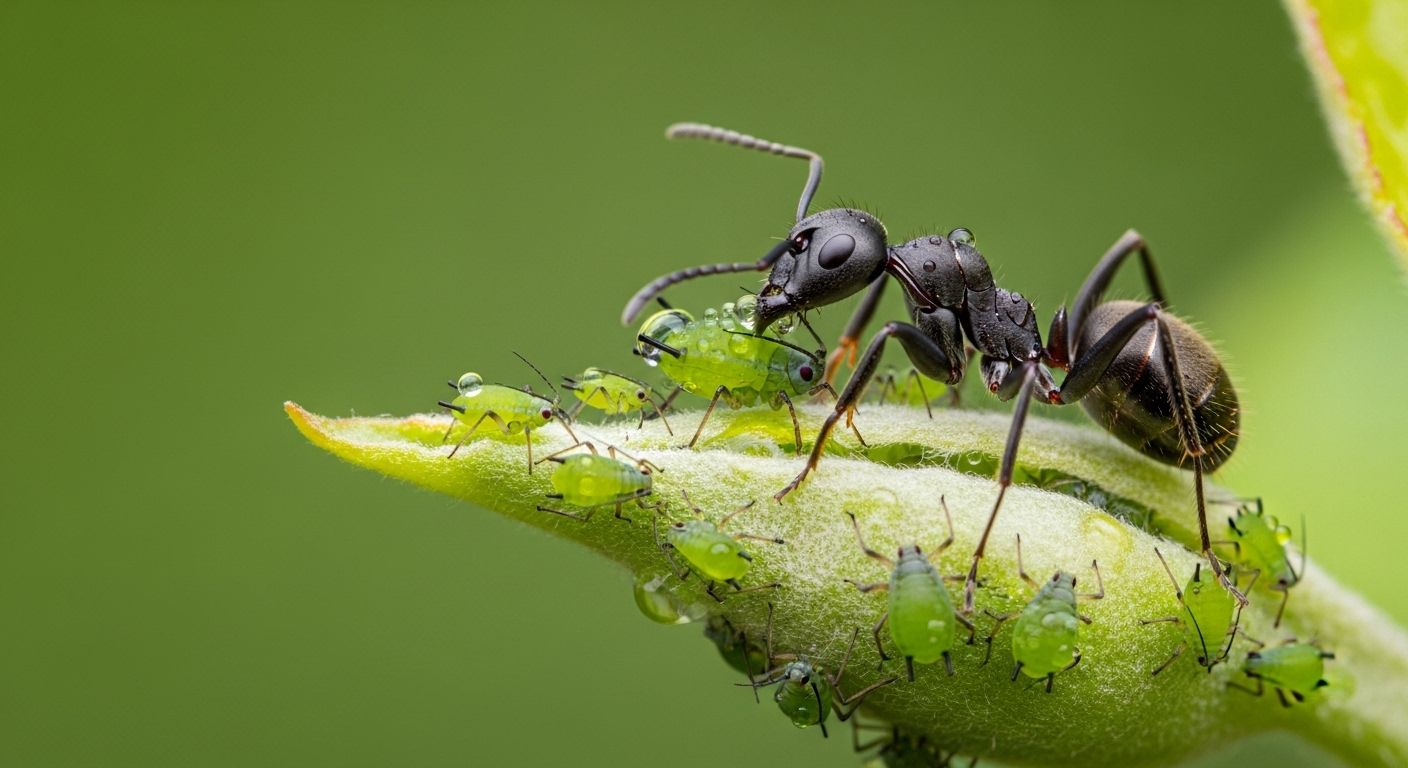
What long-term organic strategies can prevent ants from establishing farms next season?
1. Build an Army of Beneficials: Don't just avoid killing the good bugs; actively invite them in and give them a reason to stay. This is done by planting a wide variety of flowering plants (insectaries) that provide nectar and pollen, which are essential food sources for the adult stages of many predators.
- Plant a "Beneficial Bug Buffet": Create a diverse understory around your apple trees.
- Sweet Alyssum: A fantastic living mulch that provides a carpet of tiny flowers, perfect for attracting hoverflies.
- Umbelliferous Flowers (Dill, Fennel, Cilantro, Queen Anne's Lace): The tiny, accessible flowers of this family are particularly attractive to parasitic wasps.
- Composite Flowers (Yarrow, Cosmos, Sunflowers): These provide excellent landing pads and food for ladybugs and lacewings.
- Provide Water: A shallow dish of water with some stones for insects to land on can make a big difference in the hot summer months.
- Use our Tools: Plan your predator-attracting plant guilds with
[our Companion Visualizer tool](/tools/companion-planting-visualizer)to see what works best together.
2. Focus on Soil and Tree Health: A strong, healthy plant is a less appealing target for pests. Aphids are often drawn to plants that are stressed or have imbalances in their nutrient levels.
- Compost is King: Healthy soil rich in organic matter and microbial life leads to healthy trees. Top-dress around your apple trees with high-quality compost each spring. This provides a slow-release source of balanced nutrients. Learn more about making your own black gold by reading
[The Science of Composting: Mastering the Carbon-to-Nitrogen Balance](/articles/science-of-composting-carbon-nitrogen-balance). - Avoid Synthetic Nitrogen: Quick-release synthetic nitrogen fertilizers can cause a flush of weak, sappy growth that is an absolute magnet for aphids. Stick to organic, slow-release sources of fertility.
- Mulch: A 3-4 inch layer of wood chips or straw around the base of the tree (but not touching the trunk) helps retain moisture, suppress weeds, and build healthy soil over time.
3. Proactive Monitoring and Early Intervention: Make a habit of walking through your orchard regularly. Turn over leaves, check for ant trails, and inspect new growth. By catching the very first signs of an ant-aphid partnership, you can intervene with a simple water spray or by rubbing them off with your fingers before the population has a chance to explode. A little vigilance goes a long way in preventing a small problem from becoming a full-blown infestation.
Expert Insights & FAQs
What is the secret business deal between ants and aphids on your apple tree?
Ants and aphids share a symbiotic relationship called mutualism. Aphids feed on the tree's sugary sap and excrete a waste product called honeydew. Ants consume this energy-rich honeydew, effectively “milking” the aphids like cattle, and in return, they protect the aphids from predators and even move them to better feeding spots.
How do ants defend their aphid 'cows' from natural predators?
Ants act as aggressive bodyguards for their aphid herds. They use their powerful mandibles and superior numbers to attack, kill, or drive away beneficial predators like ladybugs, lacewing larvae, and parasitic wasps. This interference prevents natural pest control and allows the aphid population to grow unchecked on your tree.
Why are young apple trees particularly vulnerable to aphid farming operations?
Young apple trees have tender, succulent new growth with thin bark and high concentrations of nitrogen-rich sap in their phloem. This makes them an irresistible, high-quality food source for aphids, and consequently, a prime, easily-accessible location for ants to establish their lucrative farms and tend their herds.
What are the warning signs of a full-scale ant-aphid infestation on your fruit trees?
Look for dedicated “highways” of ants marching up and down the trunk. Other clear signs include clusters of tiny green, black, or woolly aphids on the undersides of new leaves, curled or yellowing foliage, and a tell-tale sticky, shiny residue (honeydew) on leaves and branches below the infestation.
How does honeydew excretion lead to secondary complications like sooty mold?
The sticky, sugary honeydew excreted by aphids provides a perfect growth medium for airborne fungi, primarily from the genus Capnodium. This results in a black, powdery coating called sooty mold. While it doesn't infect the tree, it blocks sunlight, significantly reducing the leaf's ability to perform photosynthesis and create energy.
What is the most effective way to physically block ants from climbing your trees?
The most effective physical barrier is a non-drying, sticky band like Tanglefoot, applied over a protective wrap of paper or tape around the tree trunk. This creates an impassable “moat” that traps ants, severing their connection to the aphid colony above and allowing beneficial predators to regain control.
How do you eradicate the aphids without harming beneficial orchard insects?
Once ants are blocked, use a strong jet of water from a hose to physically dislodge most aphids. For remaining clusters, apply insecticidal soap or neem oil directly onto the colonies, focusing on the undersides of leaves. These organic options kill soft-bodied aphids on contact but spare hard-bodied beneficial insects.
What long-term organic strategies can prevent ants from establishing farms next season?
For long-term prevention, focus on building a resilient orchard ecosystem. Attract and support beneficial predator insects by planting a diverse understory of flowers like alyssum, dill, and yarrow. Improve soil health with high-quality compost and mulch to grow stronger, less susceptible trees that can better resist pest attacks.
Johnnie McCormick
Zone 7b/8a - North Central Alabama
Johnnie McCormick is a gardening hobbyist and the founder of My Garden Spot. Raised in north-central Alabama, his passion for gardening began in his youth. In 2008, he established a large market garden, teaching himself high-yield growing methods. In the years since, he has operated seasonal seedling sales for transplants, specializing in heirloom tomatoes, peppers, eggplants, decorative ground covers like Ajuga (Bugleweed), marigolds, nasturtiums, and fresh kitchen-window herb arrangements (basil, cilantro). Today, he gardens in the hills between Birmingham and Jasper, Alabama (Zone 7b/8a), sharing practical, community-focused gardening resources.
Verified Authoritative Citations & References
In alignment with our strict E-E-A-T research and verification guidelines, this guide cross-references data from the United States Department of Agriculture (USDA) and Cooperative Extension Service programs.
- University of California Fruit & Nut Research Center: Backyard orchard culture and tree spacing guidelines. homeorchard.ucanr.edu
- Cornell Cooperative Extension (Pomology): High-density planting, rootstock selection, and summer pruning manuals. ecommons.cornell.edu
- Oregon State University Extension Service: Training and pruning backyard fruit trees guide. catalog.extension.oregonstate.edu
- Penn State Extension: Small-scale fruit production and pest monitoring guides. extension.psu.edu


Please log in to view comments.