
High Tunnel Aerodynamics: Maximizing the Natural Chimney Effect
1. Introduction: The Importance of Airflow in Controlled Environments
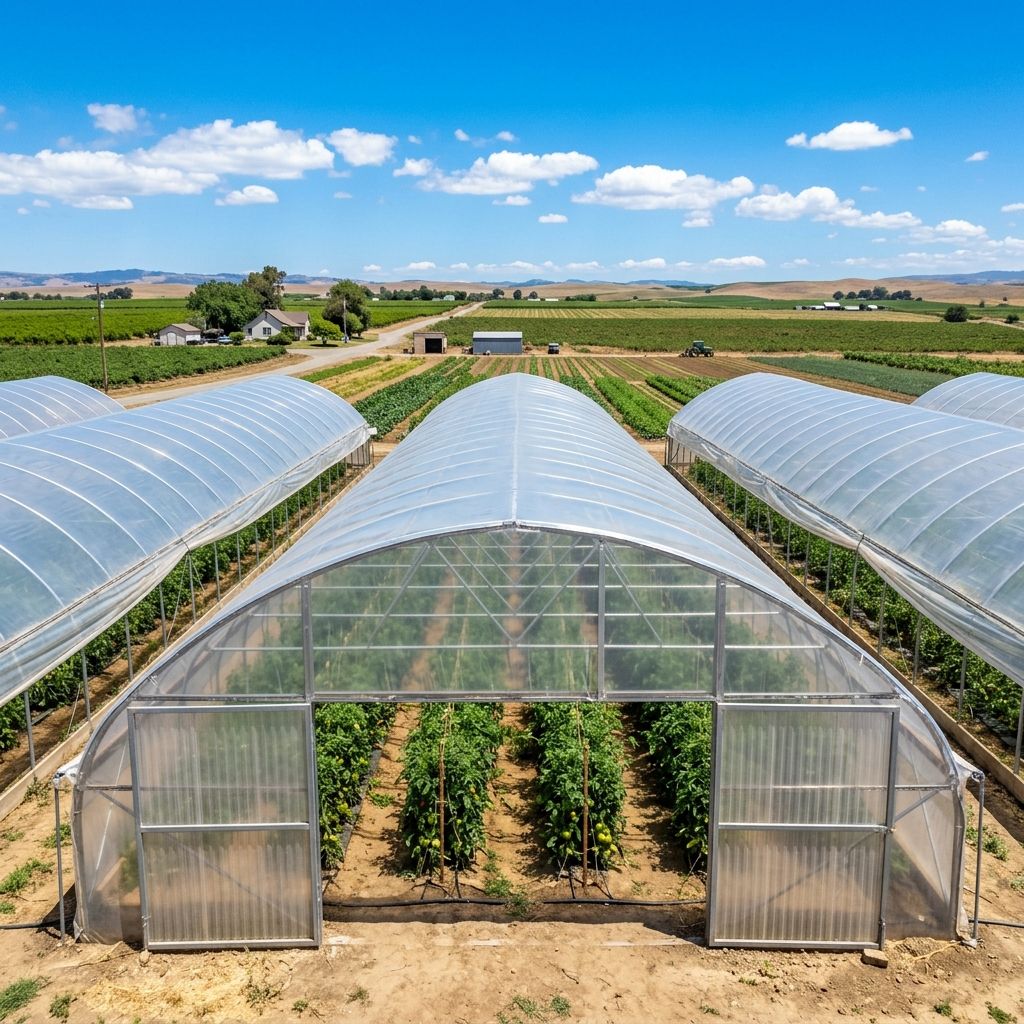
High tunnels (or hoop houses) are essential structures for extending the growing season and protecting crops from extreme weather. However, because they are covered in transparent plastic, they trap large amounts of solar radiation. During hot summer days, temperatures inside a high tunnel can quickly rise above 110°F (43°C), stunting crop growth and sterilizing flowers. Managing this heat requires effective ventilation. While active cooling systems (fans and wet pads) are common in greenhouses, high tunnels are typically unheated and rely entirely on passive cooling. To ventilate a high tunnel passively, you must understand the principles of aerodynamics and learn how to maximize the natural chimney effect.
1.1 The Role of Ventilation in High Tunnels
Ventilation does more than lower temperatures; it regulates humidity, provides carbon dioxide, and strengthens plant stems. Without adequate airflow, transpiration causes relative humidity to rise above 90%, creating a stagnant, wet environment where fungal pathogens like powdery mildew and Botrytis thrive. High humidity also slows down transpiration, preventing plants from absorbing calcium, which leads to physiological disorders like blossom end rot. Furthermore, plants absorb carbon dioxide during the day for photosynthesis; if the air is stagnant, the carbon dioxide around the leaves is quickly depleted, halting growth. Constant airflow replaces this depleted air with fresh carbon dioxide, supporting photosynthesis.
1.2 Passive vs. Active Air Exchange
Active ventilation relies on electricity to run exhaust fans and motorized louvers. While effective, active ventilation increases utility bills and is vulnerable to power outages. If the power grid fails during a hot day, a sealed greenhouse can overheat in minutes, destroying the crops. Passive ventilation, on the other hand, utilizes natural physical forces—thermal buoyancy and wind pressure—to exchange air without electricity. By designing the structure to maximize these natural forces, you build a resilient, low-cost growing system that keeps crops cool and healthy under all weather conditions.
1.3 The Goal of Aerodynamic Design
The goal of aerodynamic design is to maximize the rate of passive air exchange inside the high tunnel, ensuring that hot, humid air is exhausted from the top of the structure while cool, fresh air is drawn in through the bottom. This vertical airflow loop creates a comfortable microclimate for the crops, preventing heat stress and disease outbreaks. In this guide, we will analyze the physics of thermal buoyancy, explore the aerodynamic benefits of different hoop shapes, and detail the vent placements and dimensions required to maximize the natural chimney effect.
2. The Physics of the Chimney Effect (Thermal Buoyancy)
The natural chimney effect (or stack effect) is driven by the physical principle of thermal buoyancy, where warm air rises because it is less dense than cold air.
2.1 Density and Buoyancy Forces
When air is heated by solar radiation, the air molecules absorb energy, move faster, and spread apart. This expansion makes the warm air less dense than the surrounding cooler air. Just as a hot air balloon rises through the atmosphere, the warm, light air inside the high tunnel rises toward the highest point of the ceiling. As this hot air escapes through high vents, it creates a lower pressure zone inside the structure. This vacuum pulls cooler, denser air in through lower sidewall vents or doors, creating a continuous, natural airflow loop.
2.2 Thermodynamic Equations of Stack Flow
The volume of air moved by the stack effect depends on the height difference between the lower inlet vents and the upper outlet vents, and the temperature difference between the inside and outside air. The physics of stack ventilation flow rate ($Q$) can be calculated using the equation: $$Q = C_d A \sqrt{2 g H \frac{\Delta T}{T_i}}$$ where $C_d$ is the discharge coefficient (reflecting the aerodynamic resistance of the vents), $A$ is the vent area, $g$ is the acceleration of gravity, $H$ is the height difference between the inlet and outlet vents, $\Delta T$ is the temperature difference, and $T_i$ is the indoor temperature. As this equation shows, maximizing the height difference ($H$) increases the natural passive airflow rate, improving cooling without fans.
2.3 The Role of Height in Stack Pressure
The height difference ($H$) between the air inlets and outlets is the primary driver of stack pressure. A tall high tunnel with high ridge vents will ventilate much more efficiently than a short structure, even if they have the same floor area. By increasing the height of the roof and placing ridge vents at the absolute peak, you increase the stack pressure, forcing hot air out of the tunnel at a faster rate. When building a high tunnel, always select a design with a high ceiling (12 to 15 feet) to maximize this passive cooling capacity.
3. Designing for Stack Effect: Gothic Arch vs. Quonset Shapes
The physical shape of the high tunnel hoops has a significant impact on its aerodynamic properties and passive cooling efficiency.
3.1 The Quonset Hoop Shape
The Quonset shape is the traditional hoop design, featuring a semi-circular curved frame.
- Pros: Easy and cheap to construct, offering excellent resistance to wind loads.
- Cons: Poor aerodynamics for passive cooling. The rounded ceiling has no steep peak, causing warm air to pool along the entire upper curve rather than channeling to a ridge vent. This pooling creates a stagnant, hot air pocket at the top of the tunnel, raising overall temperatures.
3.2 The Gothic Arch Shape
The Gothic arch shape features straight sidewalls that meet at a sharp, peaked ridge.
- Pros: Superior aerodynamics for passive cooling. The steep pitch of the roof acts as a natural funnel, directing the rising warm air straight to the ridge vents at the peak. This peak prevents hot air from pooling, ensuring rapid exhaust. The Gothic shape also sheds snow and wind loads more efficiently than the Quonset design.
- Cons: Slightly more complex to build and requires more steel framing.
3.3 Comparative Aerodynamic Analysis
In a Quonset high tunnel, warm air rises and hits the flat upper curve, where it slows down and circulates in pockets. In a Gothic arch high tunnel, the rising air hits the sloped walls and is channeled smoothly toward the peak. This smooth, vertical flow reduces aerodynamic drag, allowing for a faster rate of air exchange. CFD (Computational Fluid Dynamics) models show that Gothic structures achieve up to 30% higher passive ventilation rates than Quonset structures under the same weather conditions, making them the superior choice for hot climates.
4. Optimizing Vent Placement and Sizing
To maximize the chimney effect, you must size and place your air inlets and outlets precisely.
4.1 Inlet Vent Placement (Roll-Up Sidewalls)
The air inlets are the vents that allow cool, fresh air to enter the high tunnel. In a standard hoop house, this is achieved using roll-up sidewalls. These are plastic walls that can be rolled up manually using a hand crank, exposing the lower 4 to 6 feet of the structure. Sidewall roll-ups should be placed at crop canopy level. This placement ensures that the incoming cool air sweeps across the plants, removing heat and humidity from the root and leaf zones.
4.2 Outlet Vent Placement (Ridge and End-Wall Vents)
The air outlets are the vents that allow hot, humid air to escape. To maximize the chimney effect, these vents must be placed at the highest point of the structure.
- Ridge Vents: Continuous vents running along the peak of the roof. They are highly efficient, allowing hot air to escape along the entire length of the tunnel.
- End-Wall Vents: Louvered vents placed high on the end-walls. While less efficient than ridge vents, they are easier to install and help ventilate the ends of the tunnel.
4.3 Vent Sizing Ratios
To prevent air flow bottlenecks, the total vent area must be sized correctly. The total vent area (inlets and outlets combined) should equal at least 15% to 20% of the greenhouse floor area. Additionally, the area of the inlets should equal or exceed the area of the outlets. If your inlets are too small, they will restrict the volume of incoming air, slowing down the ventilation rate. A 1:1 or 1.2:1 inlet-to-outlet area ratio is recommended for optimal passive cooling.
When calculating vent sizes, you must also consider the aerodynamic blockage created by structural supports, purlins, and louvers. The net free ventilating area is always smaller than the physical dimensions of the vent frame. For example, a louvered vent with overlapping slats has a net free area of only 60% to 70% of the frame opening. Always use the net free area rather than the frame area when performing your calculations. Sizing the vents conservatively ensures that your high tunnel has sufficient ventilation capacity even during calm, hot summer days.
When calculating vent sizes, you must also consider the aerodynamic blockage created by structural supports, purlins, and louvers. The net free ventilating area is always smaller than the physical dimensions of the vent frame. For example, a louvered vent with overlapping slats has a net free area of only 60% to 70% of the frame opening. Always use the net free area rather than the frame area when performing your calculations. Sizing the vents conservatively ensures that your high tunnel has sufficient ventilation capacity even during calm, hot summer days.
5. Wind Dynamics and Cross-Ventilation
While the chimney effect is driven by temperature differences, wind pressure is the primary driver of passive ventilation on breezy days.
5.1 Windward and Leeward Pressure Zones
When wind blows against a high tunnel, it creates a high-pressure zone on the windward (facing the wind) side and a low-pressure zone on the leeward (sheltered) side. Opening vents on both sides forces air to sweep across the plants, driven by this pressure difference. This is known as cross-ventilation.
- Windward Inlets: Air enters through the windward vents, pushed by the positive wind pressure.
- Leeward Outlets: Air escapes through the leeward vents, pulled by the negative suction pressure. This cross-flow removes heat and humidity rapidly.
5.2 Orienting the High Tunnel
To maximize cross-ventilation, orient the high tunnel perpendicular to the prevailing summer winds. If your summer winds blow from the southwest, align the length of the tunnel from northwest to southeast. This alignment ensures the wind hits the side of the tunnel at a steep angle, maximizing the pressure difference and cross-ventilation rate.
5.3 Managing Wind Turbulence and Buffers
Strong, turbulent winds can damage crops and tear plastic films. To protect the structure, plant a semi-permeable windbreak (such as a hedge of deciduous trees or a wood slat fence) on the windward side of the garden. A semi-permeable windbreak slows the wind without blocking it completely, reducing turbulence and preventing the wind from pooling cold air and forming a frost pocket.
6. Vapor Pressure Deficit (VPD) and Humidity Exhaust
Ventilation does more than cool the air; it removes moisture, allowing plants to transpire water normally.
6.1 Understanding VPD in High Tunnels
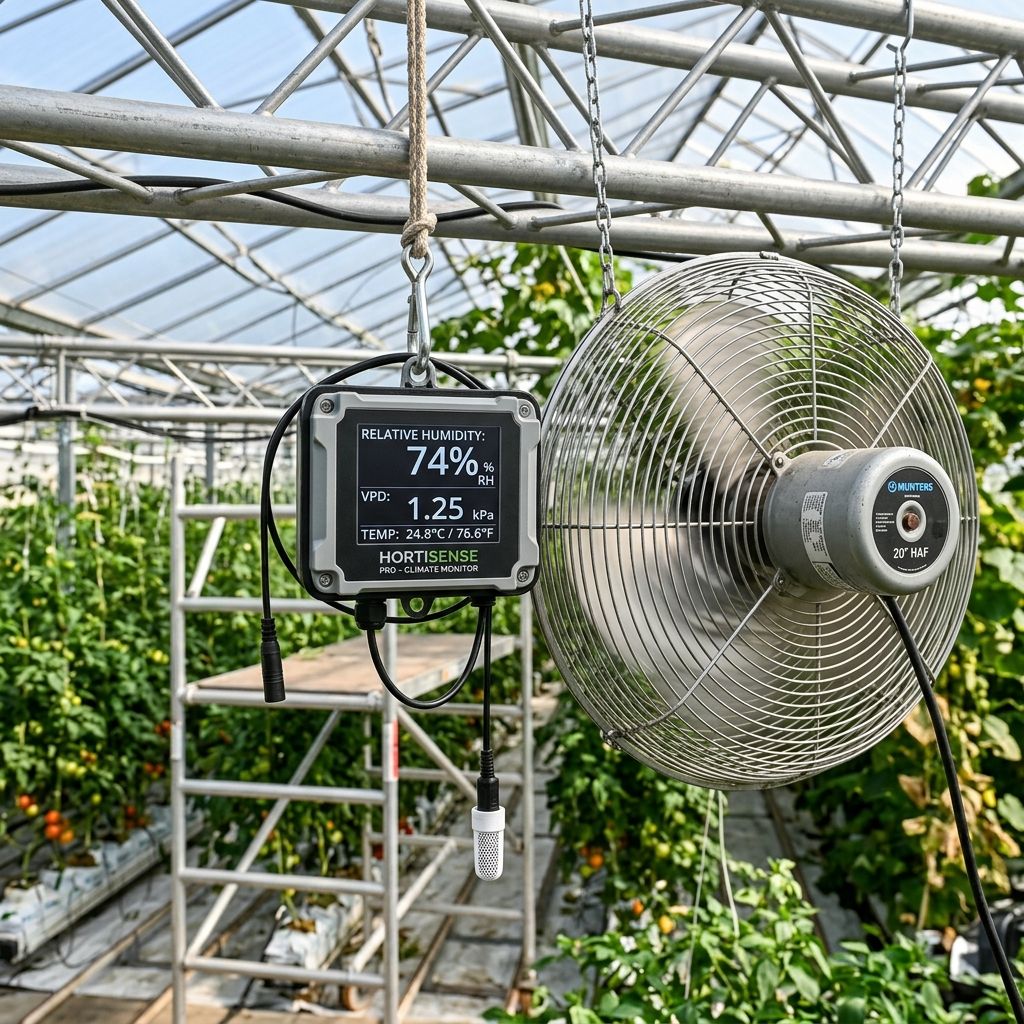
Vapor Pressure Deficit (VPD) is the difference between the moisture level inside the leaf and the dry air outside. The optimal VPD for most crops is 0.8 to 1.2 kPa. If the VPD is too low (high humidity), the plants cannot transpire water, limiting calcium uptake and causing tipburn in lettuce or blossom end rot in tomatoes. If the VPD is too high (dry air), the plants close their stomata, stopping growth. High-efficiency ridge vents exhaust this humid air, keeping the VPD in the sweet spot.
6.2 Preventing Foliar Condensation
Condensation forms on leaves when the leaf temperature drops below the dew point. Wet leaves encourage fungal pathogens like Botrytis. HAF (Horizontal Air Flow) fans and ridge vents help keep the canopy dry by circulating air and exhausting moisture, preventing condensation and reducing the need for chemical fungicides.
7. Automated Passive Systems and Louvers
While manual roll-up sides are common, installing automated passive systems can save labor and improve climate stability.
7.1 Motorized Vent Openers
Motorized vent openers use small electric motors or solar-powered pistons to open and close vents based on the temperature. These systems can be retrofitted onto ridge vents and end-wall louvers. The controller can be programmed to open the vents gradually as the temperature rises, maintaining a stable environment without manual labor.
7.2 Wax-Piston Solar Vents
For off-grid setups, use wax-piston solar vents. These openers contain a sealed cylinder filled with a mineral wax that expands when heated. As the temperature rises, the expanding wax pushes a piston that opens the vent. When the weather cools, the wax contracts, and a spring pulls the vent shut. This mechanical system requires no electricity, making it highly reliable and cheap to run.
8. Troubleshooting Airflow Dead Zones
Even with ridge vents and roll-up sides, high tunnels can develop stagnant areas where air does not circulate.
8.1 Identifying Dead Zones
Dead zones typically form in the center of the tunnel, low to the ground, or near the end-walls. In these areas, temperatures and humidity will be higher than the rest of the structure. Monitor these zones using digital sensors, and look for signs of crop stress, such as yellowing leaves or mold growth.
To diagnose dead zones, perform a smoke test. Use a handheld smoke pen, a theatrical fog generator, or a simple incense stick to release a stream of smoke in different areas of the high tunnel. Watch the movement of the smoke: in well-ventilated zones, the smoke will drift steadily toward the ridge vents; in dead zones, the smoke will hang in the air, swirling lazily or remaining stagnant. This visual diagnostic helps you identify exactly where circulation is failing, allowing you to reposition your HAF fans to clear the stagnant air.
8.2 Boundary Layer Resistance
In still air, a thin layer of humid air (boundary layer) wraps around the plant leaves, restricting water and gas exchange. Breaking this boundary layer requires a wind velocity of at least 50 feet per minute (FPM). If the air inside the high tunnel is stagnant, the plants cannot transpire water, limiting calcium transport. HAF fans should be positioned to blow air directly across the crop canopy, breaking the boundary layer and supporting healthy transpiration.
To diagnose dead zones, perform a smoke test. Use a handheld smoke pen, a theatrical fog generator, or a simple incense stick to release a stream of smoke in different areas of the high tunnel. Watch the movement of the smoke: in well-ventilated zones, the smoke will drift steadily toward the ridge vents; in dead zones, the smoke will hang in the air, swirling lazily or remaining stagnant. This visual diagnostic helps you identify exactly where circulation is failing, allowing you to reposition your HAF fans to clear the stagnant air.
8.2 Boundary Layer Resistance
In still air, a thin layer of humid air (boundary layer) wraps around the plant leaves, restricting water and gas exchange. Breaking this boundary layer requires a wind velocity of at least 50 feet per minute (FPM). If the air inside the high tunnel is stagnant, the plants cannot transpire water, limiting calcium transport. HAF fans should be positioned to blow air directly across the crop canopy, breaking the boundary layer and supporting healthy transpiration.
8.2 Using HAF Fans to Clear Dead Zones
To eliminate dead zones, install Horizontal Air Flow (HAF) fans. These fans circulate the air horizontally, mixing stagnant pockets with the main airflow loop and ensuring a uniform temperature and humidity throughout the high tunnel, resulting in consistent crop growth.
9. Frequently Asked Questions
1. What is the natural chimney effect and how does it cool a high tunnel?
The natural chimney effect (or stack effect) is driven by thermal buoyancy. Warm air is less dense than cold air, causing it to rise and escape through high ridge vents. This creates a low-pressure area that draws cooler, fresh air in through lower sidewall vents.
2. Why is a Gothic arch shape superior to a Quonset shape for passive cooling?
The Gothic arch shape features a steep, peaked ridge that acts as a natural funnel, directing warm air straight to the ridge vents. The Quonset shape is rounded, causing warm air to pool along the ceiling and create stagnant, hot air pockets.
3. How large should the vent area be in a high tunnel?
The total vent area (inlets and outlets combined) should equal at least 15% to 20% of the greenhouse floor area. The inlet area (roll-up sides) should equal or exceed the outlet area (ridge vents) to prevent airflow bottlenecks.
4. What is Vapor Pressure Deficit (VPD) and why does it matter?
VPD is the difference between the moisture level inside the leaf and the dry air outside. It dictates transpiration rates. If VPD is too low (high humidity), plants cannot take up calcium; if it is too high (dry air), plants close their stomata, stopping growth.
5. How does wind direction affect high tunnel ventilation?
Wind creates a high-pressure zone on the windward side and a low-pressure zone on the leeward side. Orienting the tunnel perpendicular to prevailing winds forces air to sweep across the beds, maximizing cross-ventilation.
6. What are wax-piston solar vents and how do they work?
Wax-piston vents are non-electric openers that contain mineral wax. As the temperature rises, the wax expands, pushing a piston that opens the vent. When it cools, the wax contracts and a spring pulls the vent shut.
7. How do Horizontal Air Flow (HAF) fans help inside a high tunnel?
HAF fans circulate air horizontally, breaking the stagnant boundary layer around leaves, preventing cold/hot spots, and ensuring uniform temperature and humidity throughout the structure.
8. What causes condensation inside a high tunnel and how do I prevent it?
Condensation forms when leaf or wall temperatures drop below the dew point. Prevent it by running circulation fans to keep the air moving, opening vents to exhaust moisture, or applying anti-condensation sprays to the plastic.
Related Guides & Agronomic References
- To explore connected soil and crop strategies, see our deep-dive on climate control in greenhouses.
- For complete infrastructure setup and management, consult our guide on shade cloth systems.
- To maintain season-long health and pest suppression, explore our analysis of tomato blossom drop in heatwaves.
Expert Insights & FAQs
What is the natural chimney effect and how does it cool a high tunnel?
The natural chimney effect (or stack effect) is driven by thermal buoyancy. Warm air is less dense than cold air, causing it to rise and escape through high ridge vents. This creates a low-pressure area that draws cooler, fresh air in through lower sidewall vents.
Why is a Gothic arch shape superior to a Quonset shape for passive cooling?
The Gothic arch shape features a steep, peaked ridge that acts as a natural funnel, directing warm air straight to the ridge vents. The Quonset shape is rounded, causing warm air to pool along the ceiling and create stagnant, hot air pockets.
How large should the vent area be in a high tunnel?
The total vent area (inlets and outlets combined) should equal at least 15% to 20% of the greenhouse floor area. The inlet area (roll-up sides) should equal or exceed the outlet area (ridge vents) to prevent airflow bottlenecks.
What is Vapor Pressure Deficit (VPD) and why does it matter?
VPD is the difference between the moisture level inside the leaf and the dry air outside. It dictates transpiration rates. If VPD is too low (high humidity), plants cannot take up calcium; if it is too high (dry air), plants close their stomata, stopping growth.
How does wind direction affect high tunnel ventilation?
Wind creates a high-pressure zone on the windward side and a low-pressure zone on the leeward side. Orienting the tunnel perpendicular to prevailing winds forces air to sweep across the beds, maximizing cross-ventilation.
What are wax-piston solar vents and how do they work?
Wax-piston vents are non-electric openers that contain mineral wax. As the temperature rises, the wax expands, pushing a piston that opens the vent. When it cools, the wax contracts and a spring pulls the vent shut.
How do Horizontal Air Flow (HAF) fans help inside a high tunnel?
HAF fans circulate air horizontally, breaking the stagnant boundary layer around leaves, preventing cold/hot spots, and ensuring uniform temperature and humidity throughout the structure.
What causes condensation inside a high tunnel and how do I prevent it?
Condensation forms when leaf or wall temperatures drop below the dew point. Prevent it by running circulation fans to keep the air moving, opening vents to exhaust moisture, or applying anti-condensation sprays to the plastic.
Johnnie McCormick
Zone 7b/8a - North Central Alabama
Johnnie McCormick is a gardening hobbyist and the founder of My Garden Spot. Raised in north-central Alabama, his passion for gardening began in his youth. In 2008, he established a large market garden, teaching himself high-yield growing methods. In the years since, he has operated seasonal seedling sales for transplants, specializing in heirloom tomatoes, peppers, eggplants, decorative ground covers like Ajuga (Bugleweed), marigolds, nasturtiums, and fresh kitchen-window herb arrangements (basil, cilantro). Today, he gardens in the hills between Birmingham and Jasper, Alabama (Zone 7b/8a), sharing practical, community-focused gardening resources.
Verified Authoritative Citations & References
In alignment with our strict E-E-A-T research and verification guidelines, this guide cross-references data from the United States Department of Agriculture (USDA) and Cooperative Extension Service programs.
- Rutgers NJAES Cooperative Extension: Greenhouse energy conservation and climate management sheets. horteng.envsci.rutgers.edu
- Cornell Cooperative Extension: High-Yield Greenhouse management and passive climate control resources. cea.cals.cornell.edu
- Penn State Extension: High tunnel design, construction, and microclimate optimization. extension.psu.edu
- Iowa State University Extension: High tunnel production and ventilation guidelines. store.extension.iastate.edu


Please log in to view comments.