The Definitive Guide to Evaporative Cooling: Fan and Pad vs. Misting Systems

The Definitive Guide to Evaporative Cooling: Fan and Pad vs. Misting Systems
In the world of modern agriculture, controlling the climate is not a luxury; it is the cornerstone of productivity and profitability. From the sprawling greenhouses that nurture our food supply to the barns that shelter valuable livestock, the relentless pressure of summer heat poses a significant threat. Heat stress can decimate crop yields, stunt animal growth, reduce milk and egg production, and in severe cases, lead to mortality. To combat this, producers require cooling solutions that are not only effective but also economically viable. While traditional air conditioning is prohibitively expensive for large agricultural spaces, the elegant principle of evaporative cooling offers a powerful and energy-efficient alternative.
This guide delves into the two leading technologies in agricultural evaporative cooling: the robust fan and pad system, often called a 'wet wall,' and the versatile misting system. Each harnesses the natural cooling power of water evaporation, yet they do so through distinct mechanisms, resulting in different strengths, weaknesses, and ideal applications. Choosing between them is a critical decision that impacts initial investment, ongoing operational costs, and ultimately, the health and productivity of your operation. We will dissect the science, compare the mechanics, analyze the economics, and provide the detailed insights you need to make an informed choice for your specific agricultural environment.
What is the fundamental principle behind evaporative cooling?
Evaporative cooling operates on the thermodynamic principle of phase transition. When liquid water evaporates into a gaseous state (water vapor), it requires energy to break its molecular bonds. This energy is drawn from the surrounding air in the form of sensible heat, resulting in a measurable drop in the air's temperature.
This process is the same reason you feel a chill after stepping out of a swimming pool; the water evaporating from your skin is pulling heat from your body. In a controlled agricultural setting, we are simply engineering this natural phenomenon on a massive scale. The effectiveness of evaporative cooling is fundamentally tied to the concept of wet-bulb depression, which is the difference between the dry-bulb temperature (the ambient air temperature we typically measure) and the wet-bulb temperature (the lowest temperature that can be reached by the evaporation of water only).
A larger wet-bulb depression, which occurs in conditions of lower relative humidity, indicates a greater potential for cooling. For instance, if the air is 95°F with 20% relative humidity, the wet-bulb temperature is approximately 65°F, offering a theoretical cooling potential of 30°F. However, if the air is 95°F with 80% relative humidity, the wet-bulb temperature is around 89°F, leaving only a 6°F cooling potential. This is why evaporative cooling systems are superstars in arid and semi-arid climates but have limited efficacy in persistently humid regions.
The core formula governing this energy exchange is the latent heat of vaporization. For water, this is approximately 2,260 kilojoules per kilogram (or about 970 BTU per pound). Every pound of water that a cooling system successfully evaporates into the air removes roughly 970 BTUs of heat energy from that environment.
How does a fan and pad evaporative cooling system operate?
A fan and pad system, also known as a wet wall, functions by creating negative pressure within a structure. Large exhaust fans are installed on one wall, while the opposite wall is fitted with porous, water-saturated cellulose pads. The fans pull air out, forcing fresh, hot outside air to be drawn in through the wet pads.
As the hot, dry air passes through the intricate, water-soaked structure of the pads, a massive surface area for evaporation is created. This triggers a rapid phase change of the water, which absorbs a significant amount of heat from the air. The result is a continuous flow of cool, humidified air entering the structure. This system effectively turns an entire building into a large-scale evaporative cooler.
Key Components and Design
A successful fan and pad system is more than just fans and pads; it's an integrated system where each component must be properly sized and maintained.
- Exhaust Fans: These are the engines of the system. They must be sized to achieve a specific air exchange rate, typically one complete air exchange per minute for a commercial greenhouse. The capacity of a fan is measured in Cubic Feet per Minute (CFM).
- Cellulose Pads: Modern pads are typically made of corrugated cellulose paper treated with anti-rot and stiffening resins. They are designed to maximize air-to-water contact while minimizing resistance to airflow. Standard thicknesses are 4 inches or 6 inches, with 6-inch pads offering higher efficiency.
- Water Distribution System: This includes a water sump or reservoir, a pump, and a distribution pipe (gutter) that runs along the top of the pads. The pump circulates water from the sump to the distribution pipe, which has holes that allow water to trickle down and saturate the pads.
- Water Collection Gutter: A gutter at the bottom of the pads collects the excess water and returns it to the sump for recirculation, conserving water.
- Controls: Thermostats and humidistats automate the system, activating the fans and water pump only when cooling is needed, which conserves energy and water.
Sizing and Formulas
Properly sizing a fan and pad system is critical for its performance. The calculations involve determining the required airflow (CFM) and the necessary pad area.
Calculate the Volume of the Structure:
Volume (cubic feet) = Length x Width x Average HeightDetermine Required Airflow (CFM): For most greenhouses, the target is one air exchange per minute.
Required CFM = Volume (cubic feet)Example: For a greenhouse 30' wide x 100' long with an average height of 12':Volume = 30 x 100 x 12 = 36,000 cubic feetRequired CFM = 36,000You would then select a combination of fans whose total CFM rating meets or slightly exceeds this number (e.g., three 12,000 CFM fans).Calculate Required Pad Area: The pad area must be sized to ensure the velocity of air passing through it is within the optimal range.
Pad Area (square feet) = Required CFM / Target Air Velocity (FPM)- For 4-inch pads, target velocity is ~250 Feet per Minute (FPM).
- For 6-inch pads, target velocity is ~400 FPM.
Continuing the example, using 4-inch pads:
Pad Area = 36,000 CFM / 250 FPM = 144 square feetThis means you would need a continuous pad wall that is, for instance, 4 feet high and 36 feet long.
| Component | Function | Key Consideration | Maintenance Task |
|---|---|---|---|
| Exhaust Fans | Create negative pressure and pull air through the structure. | Total CFM rating must match building volume. | Clean blades, check belt tension. |
| Cellulose Pads | Provide a wet surface for evaporation to occur. | Proper thickness and total surface area. | Clean mineral deposits, replace every 2-5 years. |
| Water Pump | Circulates water from the sump to the top of the pads. | GPM rating must be sufficient for pad length. | Clean intake filter, check for proper operation. |
| Sump / Reservoir | Holds the recirculating water for the system. | Sized to prevent pump from running dry. | Drain and clean periodically to remove sediment. |
| Distribution Pipe | Delivers water evenly across the top of the pads. | Holes must be clean and free of debris. | Flush regularly to prevent algae/mineral blockage. |
How do misting and fogging systems achieve cooling?
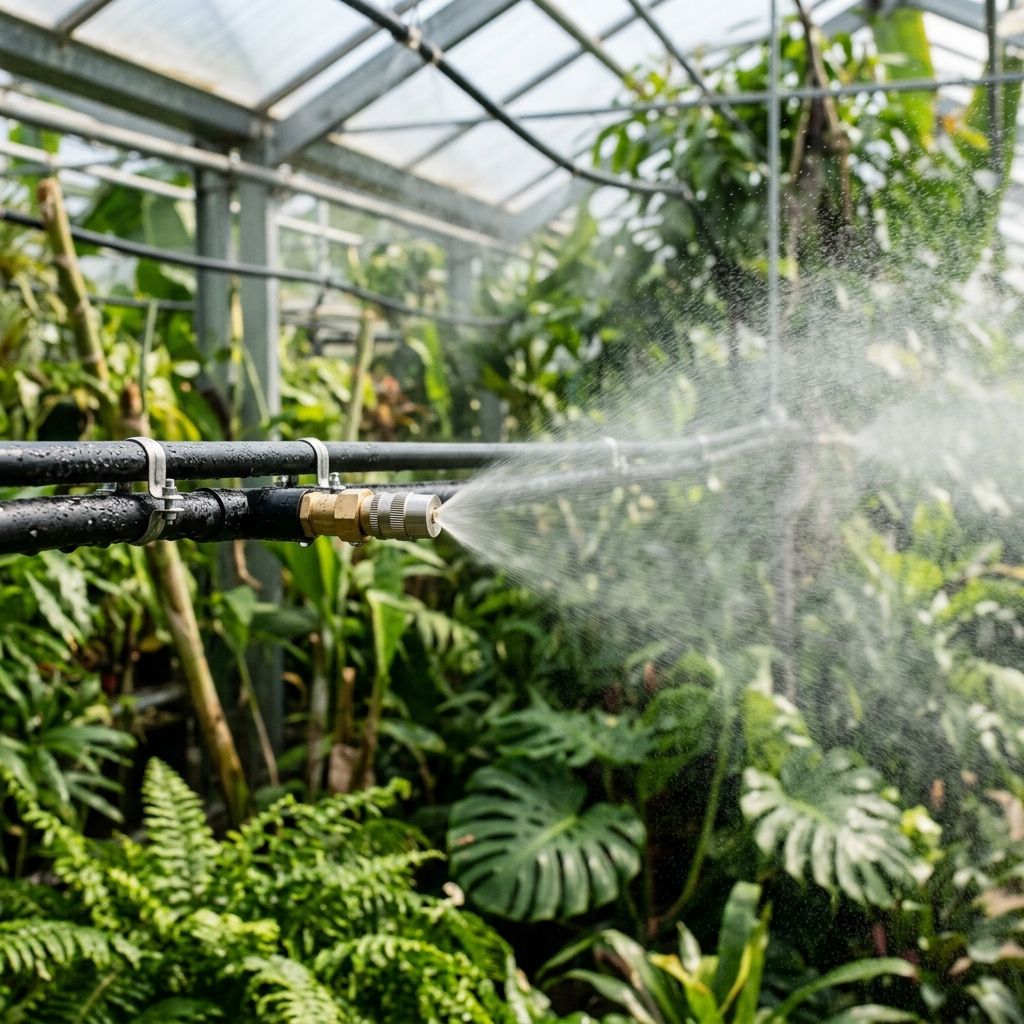
Misting and fogging systems cool the air by atomizing water into millions of microscopic droplets that are introduced directly into the environment. These tiny droplets have an enormous collective surface area and evaporate very quickly in mid-air, a process known as 'flash evaporation.' This process absorbs heat directly from the surrounding air, lowering the ambient temperature.
The key distinction between misting and fogging lies in the droplet size, which is determined by the system's operating pressure. Misting systems produce larger droplets that can sometimes lead to surface wetting, while high-pressure fogging systems create ultra-fine droplets that evaporate almost instantly, providing powerful cooling with minimal residual moisture. The goal is for the water to cool the air, not to wet the plants, animals, or surfaces below.
Types of Misting/Fogging Systems
- Low-Pressure Systems (40-100 PSI): These often connect directly to a standard garden hose. They produce the largest droplets (around 100-200 microns) and are best suited for residential patios or applications where some surface wetting is acceptable. Their cooling effect is limited.
- Mid-Pressure Systems (100-250 PSI): These use a booster pump to increase pressure and create smaller droplets than low-pressure systems. They represent a middle ground in cost and performance, suitable for some hobby greenhouses or small-scale livestock applications.
- High-Pressure Systems (800-1200+ PSI): These are the professional standard for agricultural cooling. They utilize specialized high-pressure pumps and nozzles to atomize water into ultra-fine droplets (5-15 microns), creating a true 'fog.' This fog remains suspended in the air longer, ensuring complete evaporation and maximizing the cooling effect without wetting surfaces. This is often referred to as 'adiabatic cooling.'
System Components
A high-pressure fogging system is comprised of several critical parts:
- High-Pressure Pump: The heart of the system, this pump (typically a piston or diaphragm pump) pressurizes the water to the required level (800+ PSI).
- Filtration: Because the nozzle orifices are microscopic, water filtration is non-negotiable. Multi-stage filtration systems are used to remove sediment and minerals that would otherwise cause clogging.
- Tubing and Fittings: High-pressure rated tubing, often stainless steel or specialized flexible nylon, transports the pressurized water to the nozzles.
- Nozzles: Precision-engineered nozzles, often with anti-drip features, are responsible for atomizing the water into a fine fog.
- Controls: Humidistats, thermostats, and timers are used to cycle the system on and off, preventing over-saturation of the air and conserving water and energy.
| System Type | Operating Pressure (PSI) | Droplet Size (Microns) | Cooling Effect | Cost | Common Application |
|---|---|---|---|---|---|
| Low-Pressure | 40 - 100 | 100 - 200+ | Modest | Low | Patios, hobby gardens |
| Mid-Pressure | 100 - 250 | 50 - 100 | Good | Moderate | Hobby greenhouses, small livestock pens |
| High-Pressure Fog | 800 - 1200+ | 5 - 15 | Excellent | High | Commercial greenhouses, livestock barns, propagation |
Which system is more effective at reducing temperature?
Fan and pad systems are generally more effective at achieving a significant, uniform temperature drop across an entire enclosed structure. Their cooling efficiency, defined as the percentage of the wet-bulb depression they achieve, can reach 85-95% with well-maintained 6-inch pads. Misting systems offer more versatile, targeted cooling but their overall efficiency can be lower.
Fan and pad systems process 100% of the incoming air, cooling it in a single pass at the pad wall. This creates a predictable temperature gradient, with the coolest air near the pads and the warmest air near the exhaust fans. While this gradient can be a disadvantage in some long greenhouses (e.g., a 5-10°F difference from end to end), the overall temperature reduction is powerful and reliable.
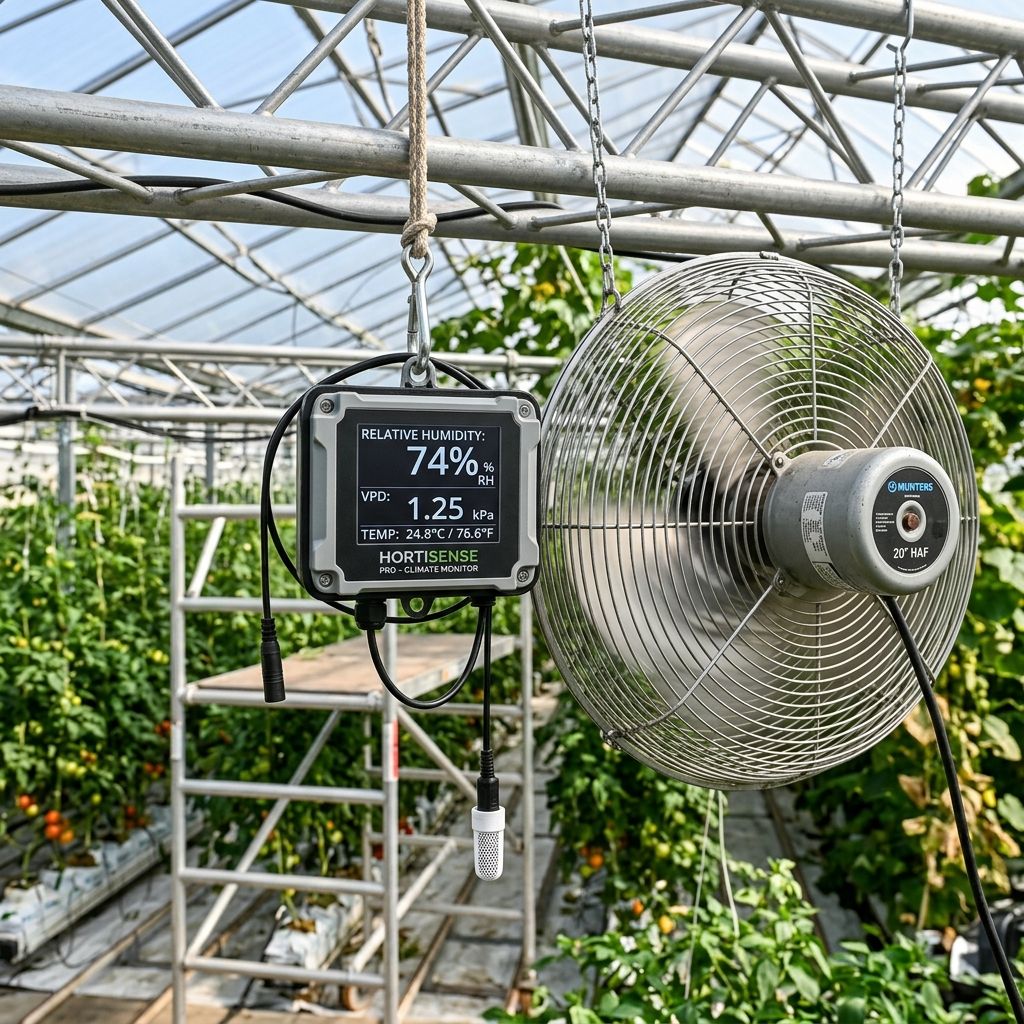
Misting and fogging systems cool the air in situ. Their effectiveness depends heavily on factors like nozzle placement, air circulation within the structure, and the system's cycle timing. A well-designed high-pressure fog system, often used in conjunction with Horizontal Air Flow (HAF) fans, can achieve very uniform cooling. However, if air circulation is poor, you can get pockets of cool, overly humid air while other areas remain hot.
The efficiency of a fan and pad system can be calculated with the following formula:
Efficiency (%) = ((T_in_dry - T_out_dry) / (T_in_dry - T_in_wet)) x 100
Where:
T_in_dry= Dry-bulb temperature of incoming outside airT_out_dry= Dry-bulb temperature of air after passing through the padT_in_wet= Wet-bulb temperature of incoming outside air
Example: If outside air is 95°F (dry-bulb) and 65°F (wet-bulb), and the air exiting the pad is 71°F:
Efficiency = ((95 - 71) / (95 - 65)) x 100 = (24 / 30) x 100 = 80%
It is more difficult to assign a single efficiency number to a misting system, as its performance is distributed throughout a space. However, for a given amount of water evaporated, the total BTUs of heat removed from the environment will be the same regardless of the system. The key difference is in how and where that cooling is delivered.
What are the key differences in water and energy consumption?
Fan and pad systems are typically high water consumers but can be more energy-efficient per unit of cooling delivered. Conversely, high-pressure misting systems are exceptionally water-efficient, using only what is evaporated, but require a powerful, energy-intensive pump to create the necessary pressure for atomization.
The primary energy draw for a fan and pad system comes from the large exhaust fans. The water pump is generally a smaller, fractional horsepower motor. The system's water consumption is high because the pads must be kept constantly saturated, and a portion of the water is intentionally 'bled off' to flush away mineral deposits, preventing scaling on the pads.
For a high-pressure misting system, the main energy consumer is the high-pressure pump motor, which can be substantial (e.g., 2 to 5 horsepower). However, water usage is minimal because there is no recirculation or bleed-off; nearly 100% of the water released through the nozzles is intended for evaporation. This makes them an excellent choice in water-scarce regions.
Consumption Formulas and Comparison
Water Consumption:
Fan and Pad: A general rule of thumb for water evaporation is approximately 1 gallon per minute (GPM) for every 100,000 BTUs of cooling. A more practical formula is:
Evaporation (GPM) ≈ (Total CFM / 1000) * 0.8(This is a simplified estimate for a hot, dry day) For our 36,000 CFM example:(36,000 / 1000) * 0.8 = 28.8 GPH (Gallons per Hour). Note this doesn't include bleed-off, which can add another 5-10%.Misting System: Water consumption is a simple calculation:
Consumption (GPH) = Number of Nozzles x Nozzle Flow Rate (GPH)Example: A system with 50 nozzles, each rated at 1.5 GPH:50 x 1.5 = 75 GPH. While this number seems higher, misting systems are cycled on and off (e.g., 10 seconds on, 50 seconds off), so the actual hourly consumption is much lower. If this system runs 1/6th of the time, the actual usage is75 / 6 = 12.5 GPH.
| Metric | Fan and Pad System | High-Pressure Misting System |
|---|---|---|
| Primary Energy Use | Large exhaust fans (e.g., 3 x 1 HP motors) | High-pressure pump (e.g., 1 x 3 HP motor) |
| Primary Water Use | Evaporation + Bleed-off for mineral control | Flash evaporation only; no recirculation or waste |
| Typical Energy Profile | Constant energy draw when fans are on. | Intermittent high energy draw when pump cycles. |
| Typical Water Profile | High, continuous flow. | Low, intermittent bursts. |
| Efficiency Focus | High energy efficiency per BTU of cooling. | High water efficiency. |
How do installation and maintenance requirements compare?
Fan and pad systems involve a more intensive and structural installation but feature relatively straightforward, albeit laborious, maintenance. Misting systems offer a more flexible and less structurally invasive installation but demand meticulous and frequent maintenance of their precision components, especially the nozzles and filters.
Installation
- Fan and Pad: This is a significant construction project. It requires cutting large openings in the building's end walls for both the pad wall and the exhaust fans. Framing, plumbing for water distribution and drainage, and heavy-duty electrical wiring for the fans must be professionally installed. It is best integrated into the initial design of a new structure.
- Misting System: Installation is generally simpler. It involves mounting the pump station and running lines of tubing (stainless steel or nylon) overhead throughout the structure. Nozzles are inserted into the lines at desired intervals. While it requires careful planning for proper coverage, it does not require major structural modifications, making it easier to retrofit into existing buildings.
Maintenance
Maintenance is the single most critical factor in the long-term performance of either system.
Fan and Pad Maintenance: The primary challenge is managing water quality. Hard water leads to mineral deposits (scale) on the pads, which clogs them, reduces airflow, and lowers efficiency. Algae growth is also a common problem.
- Daily: Check for dry streaks on pads, indicating clogged distribution holes.
- Weekly: Clean the sump and water filters.
- Monthly: Gently brush the exterior of the pads to remove dust and debris. Check fan belts for proper tension.
- Annually: At the end of the season, drain the entire system. Thoroughly clean and descale the pads using approved mild acid or cleaning solutions. Cover the pads and fans to protect them during the winter.
Misting System Maintenance: The enemy of a misting system is clogging. The microscopic orifices in the nozzles are easily blocked by even the smallest particles of sediment or mineral scale.
- Weekly: Inspect nozzles for uniform spray patterns. A dripping or jetting nozzle is clogged.
- Monthly: Check and clean or replace the primary water filter cartridges. This is the most important preventative task.
- Quarterly/Annually: Depending on water quality and usage, nozzles may need to be removed and soaked in a descaling solution. Check the oil level in the high-pressure pump (if applicable).
Neglecting maintenance on a fan and pad system leads to a gradual decline in performance. Neglecting maintenance on a high-pressure misting system leads to system failure—clogged nozzles, dripping lines, and potential pump damage.
What are the ideal applications for each system in agriculture?
Fan and pad systems are the undisputed champions for cooling large, enclosed structures that benefit from a high rate of air exchange, like commercial greenhouses and modern poultry barns. Misting systems excel in applications requiring targeted cooling, humidity control, or use in open-air environments where containing airflow is impossible.
Prime Applications for Fan and Pad Systems:
- Commercial Greenhouses: For crops like tomatoes, peppers, and cucumbers grown in long rows, the linear airflow of a fan and pad system is perfect. It provides a constant stream of fresh, cool, CO2-rich air that moves from one end to the other.
- Poultry Houses: Modern broiler and layer houses are long, enclosed buildings where maintaining a consistent environment and removing ammonia is critical. The high air exchange rate of a wet wall system achieves both cooling and ventilation simultaneously.
- Swine and Dairy Barns: In enclosed barns, fan and pad systems can dramatically reduce heat stress, which is known to improve feed conversion, milk production, and reproductive rates.
Prime Applications for Misting/Fogging Systems:
- Propagation and Germination: In these early stages of plant life, high humidity is just as important as temperature control. High-pressure fogging systems can create the ideal cool, moist microclimate without over-saturating the delicate seedlings.
- Livestock Spot Cooling: In open-sided dairy barns or outdoor holding pens, a fan and pad system is not feasible. Misting lines can be installed directly over feed bunks or resting areas to provide targeted cooling relief to animals where they congregate.
- Dust and Odor Suppression: The fine fog produced by these systems can help capture airborne dust particles and suppress odors in environments like horse arenas or livestock transfer alleys.
- Open-Air Retail Nurseries: Misting can make outdoor shopping areas more comfortable for customers and reduce heat stress on plants displayed for sale.
In some cases, a hybrid approach is optimal. For example, a greenhouse might use a fan and pad system as its primary cooling source, but add a high-pressure fogging line to provide an extra burst of cooling or humidity on the hottest days.
How does ambient humidity affect the performance of each system?
Both systems are fundamentally dependent on the evaporation of water, making their performance inversely proportional to the relative humidity (RH) of the ambient air. As RH increases, the air's capacity to absorb more water vapor decreases, severely limiting the cooling potential of either system. They are most effective in dry climates.
This limitation is rooted in the physics of wet-bulb depression. When relative humidity is low, there is a large gap between the dry-bulb and wet-bulb temperatures, meaning there is significant potential for evaporation and thus cooling. As RH climbs towards 100%, the wet-bulb temperature approaches the dry-bulb temperature, and the potential for evaporative cooling diminishes to nearly zero.
- At 30% RH, a 95°F day offers a massive cooling potential of over 25°F.
- At 60% RH, that potential on a 95°F day drops to about 15°F.
- At 90% RH, the cooling potential on a 95°F day is less than 5°F, and the system will add a great deal of moisture to the air for very little temperature benefit.
This is why it's crucial for operators in regions with variable humidity to use a humidistat in their control system. The controller should be set to disable the evaporative cooling system when the RH exceeds a certain threshold (typically 80-85%), as running it beyond this point is ineffective, wastes energy and water, and can promote fungal diseases in crops or respiratory issues in livestock.
Impact on Fan and Pad vs. Misting: While both are affected, the perceived impact can differ. A fan and pad system will still move air for ventilation even when the water is turned off in high humidity. A misting system in high humidity can quickly lead to dripping and overly damp conditions if not managed carefully by a reliable controller, as it adds moisture without providing significant cooling.
| Relative Humidity | Dry-Bulb Temp | Wet-Bulb Temp | Cooling Potential | System Effectiveness |
|---|---|---|---|---|
| 20% | 95°F (35°C) | 65°F (18°C) | 30°F (17°C) | Excellent - Maximum performance for both systems. |
| 50% | 95°F (35°C) | 79°F (26°C) | 16°F (9°C) | Good - Still highly effective. |
| 80% | 95°F (35°C) | 89°F (32°C) | 6°F (3°C) | Poor - Limited cooling, adds significant humidity. |
| 95% | 95°F (35°C) | 94°F (34°C) | 1°F (0.5°C) | Negligible - System should be turned off. |
What is the comparative cost of fan and pad vs. misting systems?
Generally, fan and pad systems carry a higher initial capital cost due to their larger components and the need for structural modifications. High-pressure misting systems can have a more variable initial cost, but their long-term operational costs can be higher due to the energy consumption of the pump and meticulous maintenance needs.
Capital Expenditure (CAPEX)
The initial investment is a major deciding factor for many operations.
- Fan and Pad System: The cost is driven by the price of large-diameter fans, the linear feet of cellulose pads, pumps, plumbing, and the significant labor for installation. For a new build, this can be integrated efficiently, but retrofitting an existing structure can be expensive.
- Misting System: The cost of a low or mid-pressure system is quite low, but their performance is limited. A high-pressure fogging system's cost is dominated by the high-pressure pump unit, which can be thousands of dollars. The cost of tubing and nozzles is secondary. The overall cost can be lower than a fan and pad system for smaller or oddly shaped areas.
Hypothetical 5,000 sq. ft. Greenhouse Cost Comparison:
| Cost Component | Fan and Pad System (Estimate) | High-Pressure Misting System (Estimate) |
|---|---|---|
| Primary Equipment | $7,000 - $12,000 (Fans, Pads) | $5,000 - $9,000 (Pump, Filters) |
| Distribution | $1,500 - $3,000 (Plumbing) | $2,000 - $4,000 (Tubing, Nozzles) |
| Installation Labor | $4,000 - $8,000 | $2,500 - $5,000 |
| Total Initial Cost | $12,500 - $23,000 | $9,500 - $18,000 |
Operational Expenditure (OPEX)
Long-term costs can sometimes outweigh the initial investment.
- Fan and Pad: The primary costs are electricity for the fans and makeup water. The largest recurring replacement cost is the cellulose pads, which typically need to be replaced every 2-5 years depending on water quality and maintenance, at a cost of several thousand dollars.
- Misting System: The main cost is electricity for the high-pressure pump. While water usage is lower, the cost of replacement filter cartridges and periodically replacing worn or clogged nozzles adds up. A pump failure can be a very expensive repair.
Ultimately, the most cost-effective system depends on local utility rates, water availability, the specific application, and the operator's commitment to routine maintenance. A full Return on Investment (ROI) calculation should consider not just the system costs, but the economic gains from preventing heat-related losses in crop yield or animal productivity.
Related Guides & Agronomic References
- To explore connected soil and crop strategies, see our deep-dive on greenhouse climate control.
- For complete infrastructure setup and management, consult our guide on high tunnel aerodynamics and ventilation.
- To maintain season-long health and pest suppression, explore our analysis of reflective vs traditional shade cloth.
Expert Insights & FAQs
What is the fundamental principle behind evaporative cooling?
Evaporative cooling operates on the thermodynamic principle of phase transition. When liquid water evaporates into a gaseous state (water vapor), it requires energy to break its molecular bonds. This energy is drawn from the surrounding air in the form of sensible heat, resulting in a measurable drop in the air's temperature.
How does a fan and pad evaporative cooling system operate?
A fan and pad system, also known as a wet wall, functions by creating negative pressure within a structure. Large exhaust fans are installed on one wall, while the opposite wall is fitted with porous, water-saturated cellulose pads. The fans pull air out, forcing fresh, hot outside air to be drawn in through the wet pads.
How do misting and fogging systems achieve cooling?
Misting and fogging systems cool the air by atomizing water into millions of microscopic droplets that are introduced directly into the environment. These tiny droplets have an enormous collective surface area and evaporate very quickly in mid-air, a process known as 'flash evaporation.' This process absorbs heat directly from the surrounding air, lowering the ambient temperature.
Which system is more effective at reducing temperature?
Fan and pad systems are generally more effective at achieving a significant, uniform temperature drop across an entire enclosed structure. Their cooling efficiency, defined as the percentage of the wet-bulb depression they achieve, can reach 85-95% with well-maintained 6-inch pads. Misting systems offer more versatile, targeted cooling but their overall efficiency can be lower.
What are the key differences in water and energy consumption?
Fan and pad systems are typically high water consumers but can be more energy-efficient per unit of cooling delivered. Conversely, high-pressure misting systems are exceptionally water-efficient, using only what is evaporated, but require a powerful, energy-intensive pump to create the necessary pressure for atomization.
How do installation and maintenance requirements compare?
Fan and pad systems involve a more intensive and structural installation but feature relatively straightforward, albeit laborious, maintenance. Misting systems offer a more flexible and less structurally invasive installation but demand meticulous and frequent maintenance of their precision components, especially the nozzles and filters.
What are the ideal applications for each system in agriculture?
Fan and pad systems are the undisputed champions for cooling large, enclosed structures that benefit from a high rate of air exchange, like commercial greenhouses and modern poultry barns. Misting systems excel in applications requiring targeted cooling, humidity control, or use in open-air environments where containing airflow is impossible.
How does ambient humidity affect the performance of each system?
Both systems are fundamentally dependent on the evaporation of water, making their performance inversely proportional to the relative humidity (RH) of the ambient air. As RH increases, the air's capacity to absorb more water vapor decreases, severely limiting the cooling potential of either system. They are most effective in dry climates.
What is the comparative cost of fan and pad vs. misting systems?
Generally, fan and pad systems carry a higher initial capital cost due to their larger components and the need for structural modifications. High-pressure misting systems can have a more variable initial cost, but their long-term operational costs can be higher due to the energy consumption of the pump and meticulous maintenance needs.
Johnnie McCormick
Zone 7b/8a - North Central Alabama
Johnnie McCormick is a gardening hobbyist and the founder of My Garden Spot. Raised in north-central Alabama, his passion for gardening began in his youth. In 2008, he established a large market garden, teaching himself high-yield growing methods. In the years since, he has operated seasonal seedling sales for transplants, specializing in heirloom tomatoes, peppers, eggplants, decorative ground covers like Ajuga (Bugleweed), marigolds, nasturtiums, and fresh kitchen-window herb arrangements (basil, cilantro). Today, he gardens in the hills between Birmingham and Jasper, Alabama (Zone 7b/8a), sharing practical, community-focused gardening resources.
Verified Authoritative Citations & References
In alignment with our strict E-E-A-T research and verification guidelines, this guide cross-references data from the United States Department of Agriculture (USDA) and Cooperative Extension Service programs.
- Rutgers NJAES Cooperative Extension: Greenhouse energy conservation and climate management sheets. horteng.envsci.rutgers.edu
- Cornell Cooperative Extension: High-Yield Greenhouse management and passive climate control resources. cea.cals.cornell.edu
- Penn State Extension: High tunnel design, construction, and microclimate optimization. extension.psu.edu
- Iowa State University Extension: High tunnel production and ventilation guidelines. store.extension.iastate.edu



Please log in to view comments.