
Does Misting Outdoor Patio Plants Help Reduce Heat Stress?
Yes, misting outdoor patio plants can help reduce heat stress by lowering the surrounding ambient temperature by 5°F to 15°F through evaporative cooling and raising relative humidity, which lowers the local Vapor Pressure Deficit (VPD). However, to prevent root rot from soil saturation and fatal fungal or bacterial diseases (such as powdery mildew, botrytis, or leaf spot) triggered by prolonged leaf wetness, misting must be scheduled strictly during peak heat hours (12:00 PM to 4:00 PM) using automated short pulse intervals (e.g., 30 seconds of misting every 10 minutes) rather than continuous spray, and must never be applied in the evening.
1. Introduction: The Summer Patio Microclimate and Container Vulnerability
As summer solar radiation intensifies, concrete, brick, and wooden patios transform into significant thermal sinks. These hard surfaces absorb shortwave solar energy and radiate it back into the surrounding air as longwave thermal energy, elevating local patio temperatures by 10°F to 20°F above the ambient forecast. For container gardens, hanging baskets, and potted ornamentals placed on these patios, this creates a harsh, high-stress microclimate.
Unlike plants in the native ground—where deep root systems are insulated by the soil's thermal mass—potted plants have their roots confined to small volumes of potting mix. The walls of containers (especially plastic and dark ceramic pots) absorb solar heat, raising soil temperatures to over 95°F. This thermal stress impairs root respiration, limits water absorption, and damages the plant's vascular system.
To mitigate this heat, gardeners often turn to micro-misting systems or manual misting. However, while misting is a powerful tool for microclimate modification, it is a double-edged sword. If applied without an understanding of plant biology and atmospheric physics, it can lead to root rot, disease outbreaks, and physiological decline. This guide explores the science of misting, analyzing how water droplets interact with leaf surfaces, humidity, and the Vapor Pressure Deficit (VPD) to help you protect your patio garden safely.

1.1. Pot Thermodynamics: Soil Heat and Root Cell Biology
To understand the severity of patio heat stress, we must look at the biochemistry of container root zones. Ground soil maintains a stable temperature profile, rarely rising above 75°F at a depth of 6 inches, even during hot summer afternoons. However, in containers, the soil temperature fluctuates rapidly, closely following the surrounding air temperature and solar exposure.
Leaf vs. Root Heat Limits
While leaves possess specialized mechanisms to tolerate high temperatures (such as producing heat-shock proteins and cooling themselves through transpiration), root cells have no such defenses. They are evolved to function in cool, dark environments:
- Optimal Root Temp (65°F to 75°F): Root cells actively respire, absorbing water and nutrients at peak efficiency.
- Stress Threshold (85°F): Root metabolic activity slows down. The rate of nutrient absorption (especially phosphorus and potassium) drops.
- Vascular Failure (95°F and above): High heat fluidizes the lipid bilayer of root cell membranes. This fluidization causes cellular structure loss, leading to electrolyte leakage. The roots lose their osmotic control, making them unable to pull up water even if the soil is wet.
Pot Materials and Heat Retention
The material of your container also determines how much heat is passed to the roots:
| Pot Material | Heat Absorption Rate | Moisture Evaporation | Root Health Impact |
|---|---|---|---|
| Dark Plastic | Very High | Very Low | Retains heat; high risk of root scald. |
| Glazed Ceramic | High | Low | Conducts heat; holds water but gets very hot. |
| Terracotta / Clay | Low | High | Porous walls cool soil through passive evaporation. |
| Fabric Bags | Very Low | Very High | Excellent aeration; fabric allows root pruning and heat release. |
By using micro-misters to target the walls of terracotta or fabric pots, you can trigger active evaporative cooling through the pot walls, lowering the internal soil temperature by up to 10°F and protecting the delicate roots from vascular failure.
2. The Physics of Evaporative Cooling: Sensible vs. Latent Heat
To understand why misting works, we must analyze the thermodynamic process of evaporative cooling.
When water transitions from a liquid to a gaseous state, it must absorb heat energy from its immediate surroundings to break the hydrogen bonds between its molecules. This heat energy is known as the latent heat of vaporization. The energy absorbed during evaporation does not raise the temperature of the water; instead, it is stored as latent heat in the water vapor, converting sensible heat (the heat we can feel and measure with a thermometer) into latent heat.
A high-quality patio misting system operates by forcing water through micro-nozzles (typically 0.006 to 0.012 inches in diameter) under pressure, atomizing the water into droplets ranging from 10 to 50 microns in size. These droplets have a very high surface-area-to-volume ratio, allowing them to flash-evaporate in the air. As they evaporate, they draw sensible heat from the surrounding air. This thermodynamic exchange cools the local patio climate by 5°F to 15°F, lowering the ambient temperature of both the foliage and the exterior of the containers.
3. Vapor Pressure Deficit (VPD): The Engine of Plant Transpiration
While temperature reduction is beneficial, the primary physiological effect of misting is its impact on Vapor Pressure Deficit (VPD).
VPD is the difference between the pressure exerted by the water vapor inside a saturated leaf (which is at 100% relative humidity at the leaf's temperature) and the water vapor pressure of the surrounding ambient air. VPD is measured in kilopascals (kPa) and serves as the true indicator of atmospheric draft on a plant's water reserves:
- High VPD (Hot, Dry Air; >1.5 kPa): The surrounding air is highly "thirsty." The gradient between the leaf interior and the air is steep, pulling water rapidly out of the stomata. If the root system cannot absorb soil moisture fast enough to match this transpiration rate, the plant experiences water stress, leaf scorch, and wilting.
- Low VPD (Humid, Cool Air; <0.5 kPa): The air is nearly saturated. The gradient is flat, and transpiration slows. While this conserves water, it can limit the plant's ability to pull up nutrients (such as calcium and nitrogen) from the soil, as nutrient transport relies on the transpiration stream.
- Optimal VPD (0.8 to 1.2 kPa): The ideal range where the plant transpires comfortably, drawing up nutrients without experiencing water deficit stress.
During a summer heatwave, the VPD on a concrete patio can easily exceed 2.5 to 3.0 kPa. At this level, plants close their stomata to prevent dehydration. When stomata close, carbon dioxide ($CO_2$) intake stops, bringing photosynthesis to a halt. The plant enters survival mode, accumulating heat and suffering cellular damage.
By misting the patio, you introduce moisture to the air and lower the temperature, which reduces the VPD back into the optimal zone. This allows the stomata to remain open, enabling the plant to continue photosynthesizing and cooling itself naturally through transpiration.
3.1. Fungal Spore Germination Mechanics: The Danger of Leaf Wetness Hours
To fully comprehend the biological risks associated with overhead misting, it is helpful to look at the microbiology of foliar diseases. Fungal spores (conidia) are spread by wind and landing on leaf surfaces. Under dry conditions, these spores remain dormant. However, the presence of liquid water acts as the chemical and physical switch that triggers germination.
- Spore Hydration: The spore absorbs water from the surface film, swelling and expanding.
- Germ Tube Elongation: Within 2 to 4 hours of constant surface moisture, the spore projects a microscopic tubular structure called a germ tube.
- Appressorium Formation: At the tip of the germ tube, the fungus forms an appressorium—a specialized pressing cell that anchors to the leaf.
- Penetration Peg Insertion: The appressorium generates immense internal pressure, pushing a penetration peg through the leaf's waxy cuticle and epidermal cell wall to draw out nutrients.
This process requires a continuous block of "Leaf Wetness Hours." For Botrytis cinerea (gray mold), infection can occur in as little as 4 hours at 68°F under a constant film of water. By running a misting system continuously, you provide the uninterrupted block of wetness hours required for the fungus to establish itself. Conversely, if you pulse your misting system—allowing the leaf surface to dry completely between cycles—the germ tube dehydrates and collapses before it can penetrate the leaf cuticle, preventing the infection.
4. The Biological Risks of Leaf Wetness: Pathogens and Gas Obstructions
Despite these physical benefits, keeping leaf surfaces wet for extended periods carries significant physiological and pathological risks.
Fungal and Bacterial Diseases
Fungal spores and leaf spot bacteria thrive in humid conditions. A wet leaf surface is an open invitation for powdery mildew, black spot, and rust. These pathogens spread through water droplets, moving from leaf to leaf.
Stomatal Blockage and Gas Exchange
Stomata are small openings on the underside and surface of leaves. They regulate the exchange of gases ($CO_2$ in, $O_2$ and water vapor out). When a leaf is coated with a continuous film of liquid water, these pores are physically blocked.
This blockage prevents the plant from taking in $CO_2$ for photosynthesis and stops transpiration, trapping heat inside the leaf tissue and causing physiological stress even if the surrounding air feels cool.

5. Soil Hydration, Root Aeration, and Container Physics
Misting systems also affect the soil moisture within your containers.
The Risk of Soil Saturation
Micro-droplets that do not evaporate in the air eventually settle onto the soil surface. Over several hours, this water drains into the potting mix. In small containers, this continuous addition of water can saturate the soil, filling the pore spaces that should contain oxygen.
Root Cell Respiration and Rot
Roots require oxygen ($O_2$) to perform cellular respiration, generating the energy needed to actively absorb water and nutrients. When soil pores are filled with water, the oxygen diffusion rate drops by 10,000 times.
The roots enter an anaerobic state, producing toxic alcohol and lactic acid. Within 24 to 48 hours of oxygen deprivation, root cells begin to die, creating an entry point for water molds (such as Pythium, Phytophthora, and Fusarium). Ironically, the plant will start to wilt because its damaged, rotting roots can no longer absorb water, even though the soil is saturated.
5.1. DIY Patio Misting System: Design, Assembly, and Maintenance
For the hands-on homeowner or market gardener, building a custom patio misting system is an accessible and highly effective project. A properly engineered system consists of three core components: filtration, supply lines, and micro-nozzles.
Assembly Steps:
- Water Supply & Filtration: Connect your system to an outdoor tap. To prevent micro-nozzle blockage, you must install an inline 5-micron sediment filter combined with a polyphosphate scale inhibitor. This filter traps particulate rust and sand, while the polyphosphate prevents calcium and magnesium from binding together.
- Supply Tubing: Use 1/4-inch UV-resistant polyethylene tubing or nylon lines. For high-pressure systems, use braided stainless steel or thick-walled nylon rated for up to 1000 psi.
- Nozzle Selection: Use 10/24 UNC threaded brass or stainless-steel nozzles with built-in anti-drip check valves. These check valves contain a small spring-loaded ball that seals the nozzle when system pressure drops, preventing water from dripping onto the plants below when the system turns off.
- Nozzle Placement: Space nozzles 24 to 36 inches apart along the perimeter of the patio roof. Position them facing outward at a 45-degree angle, pointing away from the plant foliage so the mist sweeps through the air column.
Preventing Hard Water Clogging
Hard water contains dissolved calcium carbonate ($CaCO_3$). As micro-droplets evaporate from the nozzle tip, they leave behind tiny mineral deposits. Over time, these scale deposits block the 0.008-inch orifice, causing the nozzle to spray in a direct stream or clog completely.
- Maintenance Protocol: Every 4 to 6 weeks, remove the brass nozzles and submerge them in a bowl of warm, 5% acidity white vinegar or a 10% citric acid solution for 2 hours. The acid dissolves the calcium scale, restoring a perfect mist pattern. Rinse with clean water before reassembling.
6. Implementing a Safe Misting Protocol: System Design and Scheduling
To safely use misting for cooling, you must design and schedule your system to maximize evaporative cooling while preventing leaf wetness and soil saturation.
A. Low-Pressure vs. High-Pressure Systems
- Low-Pressure Systems (40 - 60 psi): Connect directly to a standard garden hose. They are inexpensive but produce larger droplets (50 - 100 microns). These droplets do not evaporate easily in the air and will quickly wet the foliage and saturate the soil.
- High-Pressure Systems (800 - 1000 psi): Utilize a specialized pump to atomize water into ultra-fine droplets (10 - 20 microns). These droplets flash-evaporate almost instantly, cooling the air without wetting the leaves or soil. This is the preferred system for premium patio designs.
B. The Pulse Scheduling Strategy
Never run a patio misting system continuously. Instead, use a digital timer to set a pulse schedule. By running the misters for 20 to 30 seconds every 5 to 10 minutes, you allow the water to evaporate completely before the next cycle, maintaining a cool microclimate without soaking your plants.
C. The Daytime Only Rule
- Active Hours: Run your misters only during peak heat hours (12:00 PM to 4:00 PM), when the air is hot and dry enough to facilitate rapid evaporation.
- Evening Ban: Never mist in the late afternoon or evening. As the sun sets and humidity rises, evaporation slows. Any water applied will sit on the leaves overnight, creating ideal conditions for fungal infections.
6.2. Microclimate Troubleshooting Guide for Patio Gardeners
Even with a high-pressure system, issues can arise. The following guide addresses common problems and solutions:
Problem 1: White Scale Deposits on Leaf Edges
- Cause: Your tap water has a high level of Total Dissolved Solids (TDS), specifically calcium and sodium. As the mist evaporates off the leaves, it leaves a mineral residue behind.
- Solution: Install an inline deionization (DI) water filter or use collected rainwater to feed your misting pump.
Problem 2: Soil Mold and Moss Growth in Container Pots
- Cause: The misting system is running too long or the nozzles are pointed directly at the soil surface, causing soil waterlogging.
- Solution: Reduce the pulse run-time (e.g., cut it from 45 seconds to 20 seconds) and redirect the nozzles so they point upward into the breeze, allowing the mist to evaporate before landing.
Problem 3: Wilting Plants Despite Cool Patio Air
- Cause: Root rot has set in due to waterlogged container soil. The root system has decayed and can no longer draw water up to the leaves.
- Solution: Cease misting immediately. Move the affected container to a dry, shaded area. Check the drainage holes at the bottom of the pot, and let the soil dry out completely. Apply a biological fungicide (containing Bacillus amyloliquefaciens) to save the remaining roots.
7. Patio Microclimate & Misting Guide
The following table provides recommended misting setups and schedules based on your regional climate:
| Patio Climate Type | Relative Humidity | Average VPD | Recommended Misting System | Pulse Schedule (Run/Pause) | Target Plant Groups |
|---|---|---|---|---|---|
| Arid / Desert (e.g., AZ, NV) | < 15% | > 3.0 kPa | Low or High Pressure (Nozzle: 0.012") | 45s ON / 5 min OFF | Palms, Agaves, Bougainvillea |
| Semi-Arid (e.g., CO, TX) | 20% - 40% | 1.8 - 2.5 kPa | High Pressure preferred (Nozzle: 0.008") | 30s ON / 8 min OFF | Herbs, Peppers, Citrus |
| Humid / Coastal (e.g., FL, GA) | > 60% | 1.0 - 1.5 kPa | High Pressure ONLY (Nozzle: 0.006") | 15s ON / 15 min OFF | Ferns, Caladiums, Orchids |
8. Plant Selection: Which Species Benefit and Which Decay?
Not all plants react to misting in the same way. You must select and group your patio plants based on their physiological adaptations to humidity.
High-Benefit Species (Humid-Loving Plants)
These plants evolved in humid understories or tropical zones. They have thin cuticles and benefit from a low VPD:
- Ferns (Boston, Maidenhair): Require high humidity to prevent frond scorch.
- Orchids and Bromeliads: Absorb moisture directly from the air through aerial roots.
- Fuchsias and Begonias: Prone to heat stress and bud drop; misting keeps them producing flowers.
- Culinary Herbs (Mint, Basil, Cilantro): Prevent leaf wilting and maintain essential oil quality under hot conditions.
High-Risk Species (Arid and Fuzzy-Leafed Plants)
These plants are adapted to dry climates or have structural features that trap water, making them highly susceptible to rot:
- Fuzzy-Leafed Plants (Tomatoes, Geraniums, African Violets): The fine hairs on their leaves trap water droplets, creating stagnant damp zones that invite leaf spot and bacterial blight.
- Mediterranean Herbs (Rosemary, Thyme, Lavender, Sage): Evolved in dry, windy climates. High humidity and leaf wetness lead to root rot and powdery mildew.
- Succulents and Cacti: Adapted to store water internally. High humidity prevents transpiration, causing them to rot from the inside out.
9. Academic References & Technical Citations
Horticultural research from UC Davis Extension and Cornell University's Controlled Environment Agriculture (CEA) program highlights the importance of managing the boundary layer (the thin layer of still air surrounding a leaf). Misting alters this boundary layer, reducing both the leaf temperature and the vapor pressure gradient.
However, studies published in the Journal of American Society for Horticultural Science emphasize that managing leaf wetness duration is critical. Keeping leaves wet for more than 4 hours consistently increases the incidence of Botrytis and other foliar diseases by over 300%.
For container gardens, research from Penn State Extension confirms that root zone temperature management is key to plant health. Cooling container walls through misting is a highly effective way to prevent root death and maintain active nutrient uptake during heat waves.
10. Summary and Actionable Steps for Gardeners
To safely protect your patio plants from summer heat stress using misting, implement the following checklist:
- Assess Your Plants: Group humidity-loving tropicals and soft herbs together in the misting zone. Move succulents, cacti, and fuzzy-leafed plants away from the spray.
- Choose the Right Nozzles: Use fine-atomizing nozzles (0.008" or smaller) to ensure rapid evaporation.
- Install a Digital Timer: Set a pulse schedule (e.g., 20s ON, 8 min OFF) to prevent water pooling on foliage.
- Schedule Mid-day Run Times: Program the system to run only between 12:00 PM and 4:00 PM.
- Focus on Pots: Spray the outside of porous containers to cool the root zones without soaking the leaves.
- Maintain Air Circulation: Use outdoor patio fans to keep the air moving, accelerating evaporation and preventing fungal spores from settling.
By applying these physical and biological principles, you can create a cool, healthy oasis on your patio, helping your container garden thrive through the hottest summer days.
The Physiology of Heat Stress in Potted Plants
To understand why misting can be effective, we must first understand how a potted plant experiences heat stress. Unlike plants growing in the ground—which can tap into deep, cool subterranean moisture reserves—a patio plant's entire root system is confined within a container. On a 95°F day, a terracotta or dark plastic pot sitting on a concrete patio can easily reach internal temperatures exceeding 115°F.
Under these extreme conditions, the plant's primary defense mechanism is transpiration—the release of water vapor through the stomata on the undersides of the leaves. This evaporation cools the leaf tissue, much like sweating cools a human. However, if the ambient air is blisteringly hot and dry (low humidity), the plant will transpire water faster than its confined roots can replace it. To prevent total desiccation, the plant makes a desperate physiological choice: it slams its stomata shut.
Once the stomata close, transpiration stops, and the internal temperature of the leaf skyrockets. The plant immediately wilts, photosynthesis halts completely, and the cellular walls begin to break down, resulting in scorched, crispy leaf margins.
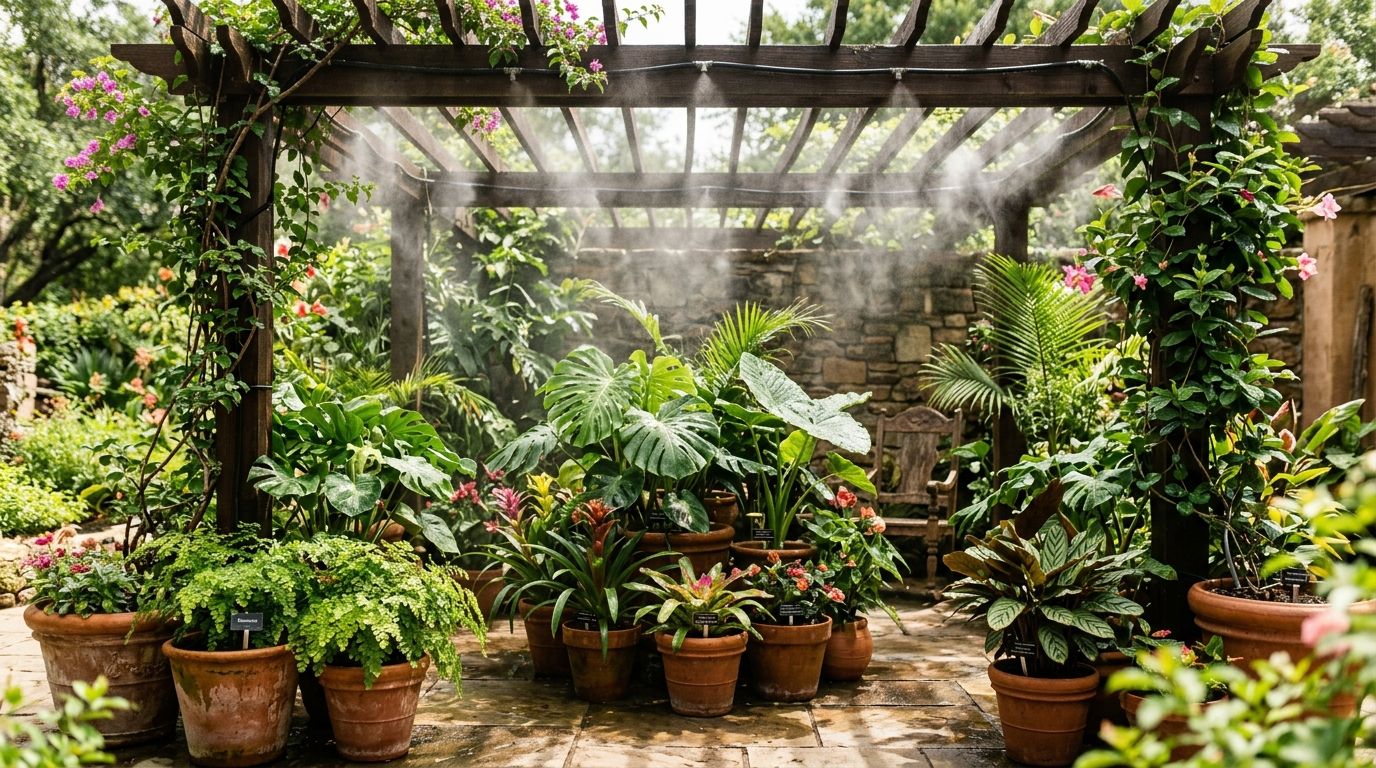
How High-Pressure Misting Modifies the Microclimate
Misting outdoor plants with a generic hand sprayer provides only a fleeting, negligible benefit; the large water droplets simply sit on the leaf surface and magnify the sun's rays, potentially causing localized burns. The regenerative, professional approach utilizes high-pressure misting systems (operating above 1,000 PSI) that force water through microscopic ceramic nozzles.
This technology creates a "flash evaporation" effect. The water droplets are so extraordinarily fine (under 10 microns) that they evaporate instantly upon contacting the hot patio air, long before they ever touch the plant's foliage. This rapid phase change from liquid to gas pulls massive amounts of latent heat out of the surrounding air.
A properly installed high-pressure misting system along the perimeter of a pergola can drop the ambient temperature of the patio microclimate by up to 25 degrees Fahrenheit, while simultaneously raising the relative humidity. By artificially lowering the Vapor Pressure Deficit (VPD) of the air surrounding the plants, you remove the environmental trigger that causes the stomata to close. The plants can continue to safely transpire, photosynthesize, and maintain their turgor pressure even during the peak heat of August.
Balancing Hydration and Fungal Pathogens
While modifying the microclimate via misting is a powerful tool against heat stress, it introduces a significant biological risk if mismanaged: fungal pathogens. Fungi, particularly powdery mildew and botrytis blight, require extended periods of leaf wetness to germinate their spores.
If your misting system operates at low pressure (creating large droplets that soak the leaves) or if you run the system too late in the evening, the foliage will remain wet as nighttime temperatures drop. This creates the perfect incubation chamber for disease, potentially destroying the very plants you were attempting to save.
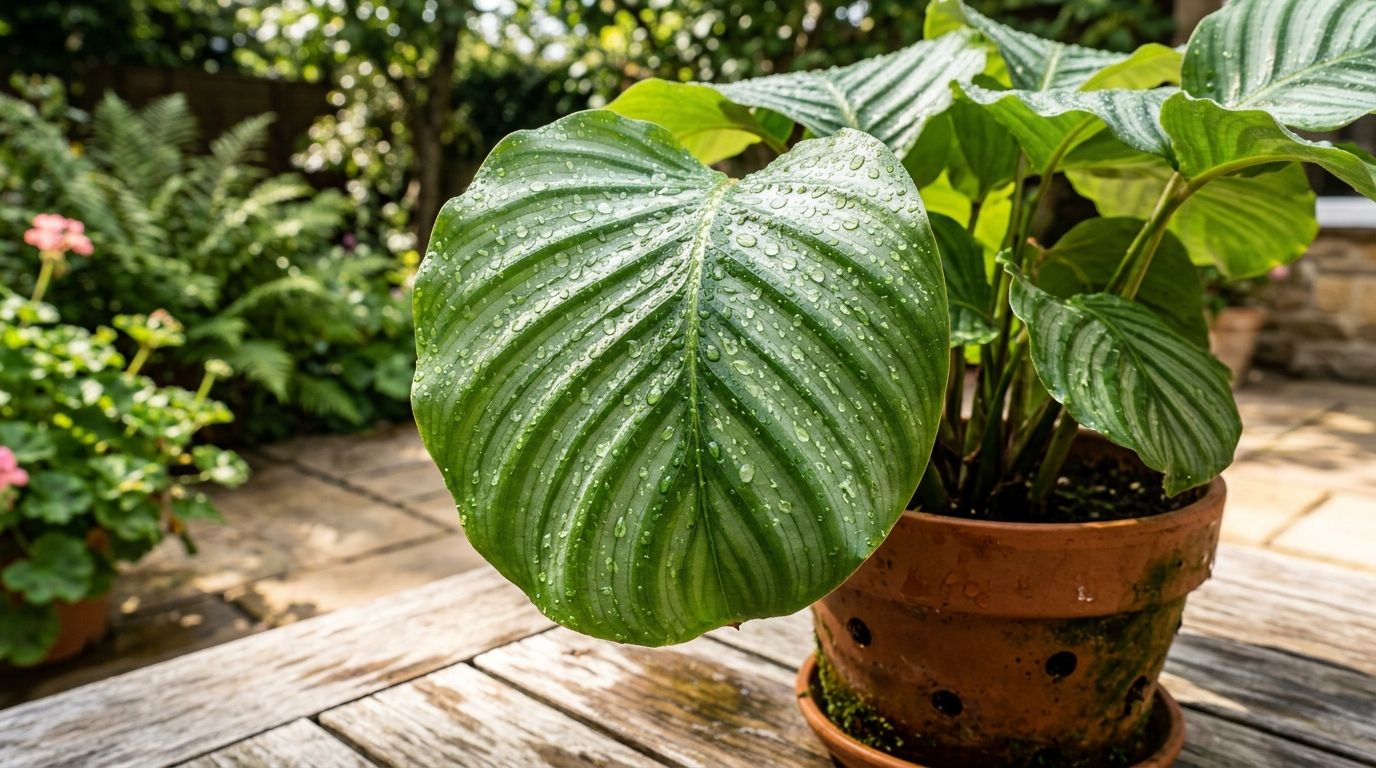
To execute this strategy successfully, you must adhere to strict operational parameters. Only run the misting system during the hottest, driest hours of the day (typically between 12:00 PM and 4:00 PM). Ensure your patio has adequate airflow to facilitate rapid evaporation. Most importantly, the system must be shut down entirely at least three hours before sunset. This guarantees that all residual moisture on the leaf surfaces has completely evaporated before nightfall, maintaining a hostile, dry environment for fungal spores while ensuring the plants survive the heat of the day.
Expert Insights & FAQs
Will misting my patio plants cause powdery mildew?
It can, if mismanaged. To prevent fungal pathogens, only run misting systems during the hottest, driest parts of the day and ensure the system is completely shut off at least three hours before sunset so the foliage dries entirely before nightfall.
Is a handheld spray bottle effective for cooling patio plants?
No. A handheld sprayer creates large water droplets that sit heavily on the leaves, which can magnify sunlight and cause foliar burns. Effective cooling requires a high-pressure system that creates microscopic droplets that flash-evaporate in the air.
Why do my potted plants wilt in the heat even when the soil is wet?
When the ambient air is extremely hot and dry, the plant may transpire water through its leaves faster than its confined root system can absorb it. In response, the plant closes its stomata to prevent dehydration, which causes it to wilt and halt photosynthesis.
Johnnie McCormick
Zone 7b/8a - North Central Alabama
Johnnie McCormick is a gardening hobbyist and the founder of My Garden Spot. Raised in north-central Alabama, his passion for gardening began in his youth. In 2008, he established a large market garden, teaching himself high-yield growing methods. In the years since, he has operated seasonal seedling sales for transplants, specializing in heirloom tomatoes, peppers, eggplants, decorative ground covers like Ajuga (Bugleweed), marigolds, nasturtiums, and fresh kitchen-window herb arrangements (basil, cilantro). Today, he gardens in the hills between Birmingham and Jasper, Alabama (Zone 7b/8a), sharing practical, community-focused gardening resources.
Verified Authoritative Citations & References
In alignment with our strict E-E-A-T research and verification guidelines, this guide cross-references data from the United States Department of Agriculture (USDA) and Cooperative Extension Service programs.
- Rutgers NJAES Cooperative Extension: Greenhouse energy conservation and climate management sheets. horteng.envsci.rutgers.edu
- Cornell Cooperative Extension: High-Yield Greenhouse management and passive climate control resources. cea.cals.cornell.edu
- Penn State Extension: High tunnel design, construction, and microclimate optimization. extension.psu.edu
- Iowa State University Extension: High tunnel production and ventilation guidelines. store.extension.iastate.edu


Please log in to view comments.