
Why Is My High Tunnel So Hot in June? (Arch vs Peaked Ventilation)
Welcome to June in the high tunnel, the exact moment of the growing season when a protective shelter transforms into a walk-in solar oven. In early April, stepping inside the plastic shelter feels like a blessing. Ambient outside temperatures might sit at 52°F, while inside your raised beds, tender tomato transplants bask in comfortable 74°F soil.
Two months later, that same structure becomes an intense agricultural challenge. You step inside to prune suckers at ten in the morning, and within thirty seconds, sweat stings your eyes, your glasses fog up, and the air feels thick and motionless. The thermometer hanging from your center purlin reads 108°F, and your prized indeterminate heirlooms are beginning to drop yellow blossom clusters onto the mulch.
Managing high tunnel temperatures in early summer is an exercise in applied thermodynamics and fluid dynamics. You have constructed a massive solar radiation trap. Unless you know how to move air, bleed off thermal load, and manage ambient humidity, your crops will enter survival mode. They will halt transpiration, abort fruit set, and burn through stored carbohydrates just trying to stay alive.
On our Alabama market farm, where June heat indices routinely push past 100°F, managing tunnel ventilation is the single biggest factor determining whether we harvest early summer tomatoes or watch our vines wither. You cannot treat a summer tunnel like a spring greenhouse. You have to adapt your architecture, balance pressure differentials, and manipulate passive airflow to keep your plants productive.
The Physics of Early Summer Overheating: Radiation and Thermal Mass
To fix heat buildup inside a high tunnel, you have to understand the electromagnetic physics driving the greenhouse effect. The sun does not heat the air inside your tunnel directly. The process is a two-stage energy conversion.
Shortwave Transmission vs. Longwave Trapping
Solar energy travels through Earth's atmosphere primarily as high-frequency, shortwave radiation (wavelengths between 0.3 and 3.0 micrometers). Standard greenhouse covering—whether single-layer 6-mil polyethylene film, double-layer inflated poly, or rigid polycarbonate sheets—is largely transparent to this shortwave spectrum. Approximately 85 to 90 percent of incoming solar energy passes straight through the plastic into your growing beds.
Once inside the structure, that shortwave radiation strikes dark garden soil, organic mulch, wooden purlins, and plant leaves. These surfaces absorb the shortwave radiation and warm up. As they heat, they re-radiate that energy back out into the tunnel atmosphere as low-frequency, longwave infrared radiation (wavelengths between 4.0 and 50 micrometers).
Polyethylene plastic is nearly opaque to longwave infrared radiation. The energy that entered as light cannot escape as heat through the plastic barrier. It bounces back down into the enclosed space, warming the air molecules trapped inside.
The Thermal Storage of Soil Mass
During March, April, and May, that heat retention helps warm cold ground. By June, however, the soil mass inside the tunnel has charged with thermal energy. Deep soil beds act like a radiant floor heating system.
Even when outside air temperatures cool down after sunset, the heated ground continues releasing longwave heat into the tunnel all night long. Without continuous night ventilation, your night temperatures inside the tunnel will remain 10 to 15 degrees higher than outside air, preventing plants from resting and metabolizing sugar efficiently.
Solar Angle and Photoperiod Expansion
June brings the summer solstice, meaning the sun reaches its highest celestial angle of the year and daylight hours stretch to their maximum. The angle of incidence on your roof plastic is near perpendicular at solar noon, minimizing reflection and maximizing energy transmission.
Your structure receives thirteen to fifteen hours of direct, intense solar radiation every day. If your passive ventilation system cannot exhaust heat faster than solar radiation enters, internal air temperatures will easily climb 25 to 35 degrees Fahrenheit above ambient outdoor conditions.
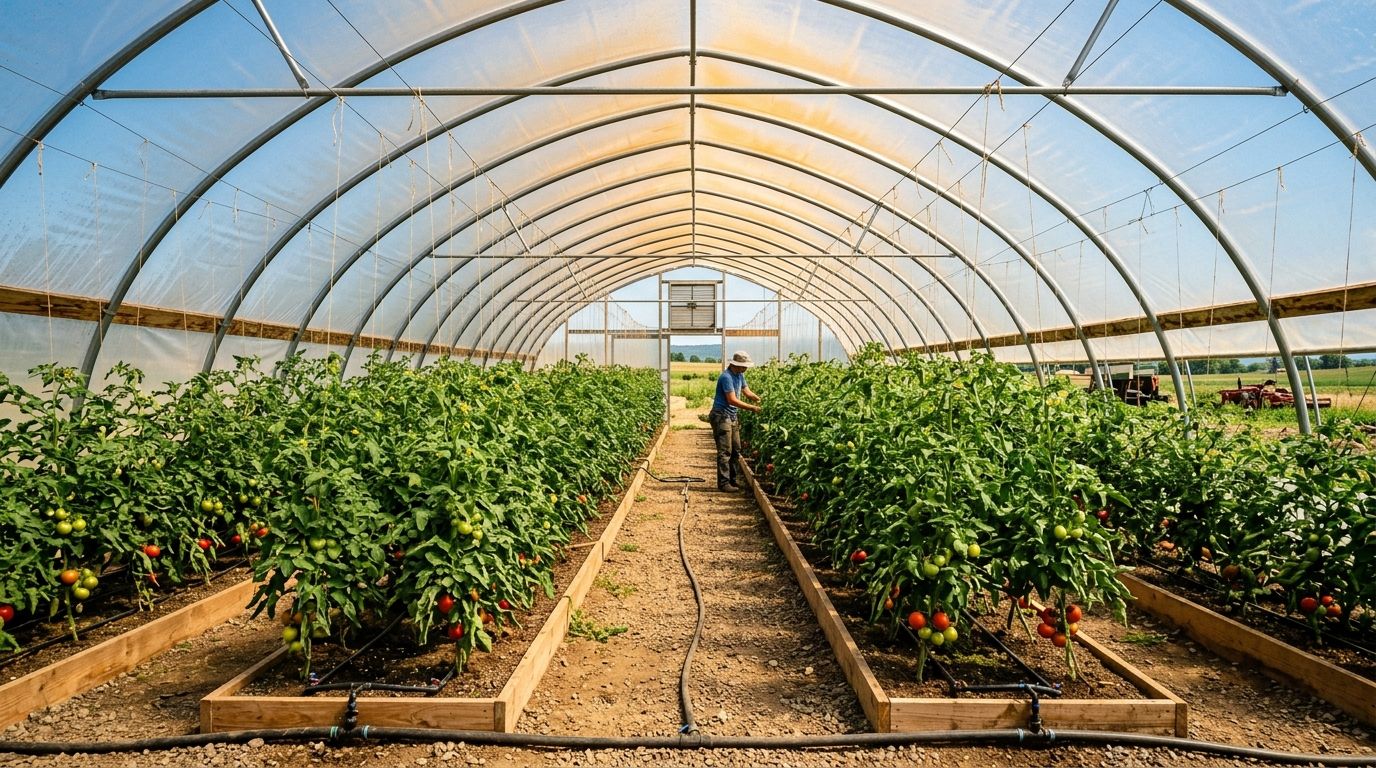
Arch vs. Peaked Roof Architecture: Aerodynamics and Buoyancy
High tunnel structures generally fall into two architectural categories: the rounded Quonset (Arch) and the Peaked design (Gable or Gothic Arch). The structural shape of your roof plays a massive role in how hot air moves inside the building.
The Quonset Arch: The Trapped Heat Bubble
The traditional Quonset high tunnel is formed by bending round galvanized steel pipes into a continuous half-circle arc. Growers favor the Quonset because it is economical, requires minimal hardware, and resists broadside wind gusts well.
From a thermodynamic ventilation perspective, however, the Quonset arch is fundamentally flawed in hot weather. Because the roof curve is uniform and gradual, the structure possesses no sharp apex or defined chimney point.
Hot air rises toward the top third of the hoop through natural thermal buoyancy. Once it reaches the curved ceiling, it has nowhere to go. It gathers in a massive, stagnant cushion of superheated air that sits trapped right above the crop canopy.
Because Quonsets rarely feature functional ridge vents, growers rely entirely on horizontal cross-ventilation from roll-up sidewalls. If the ambient wind drops to zero on a sweltering June afternoon, that trapped ceiling bubble remains stationary, radiating intense heat directly down onto the upper leaves of your crops.
The Peaked Roof: Gothic and Gable Chimney Dynamics
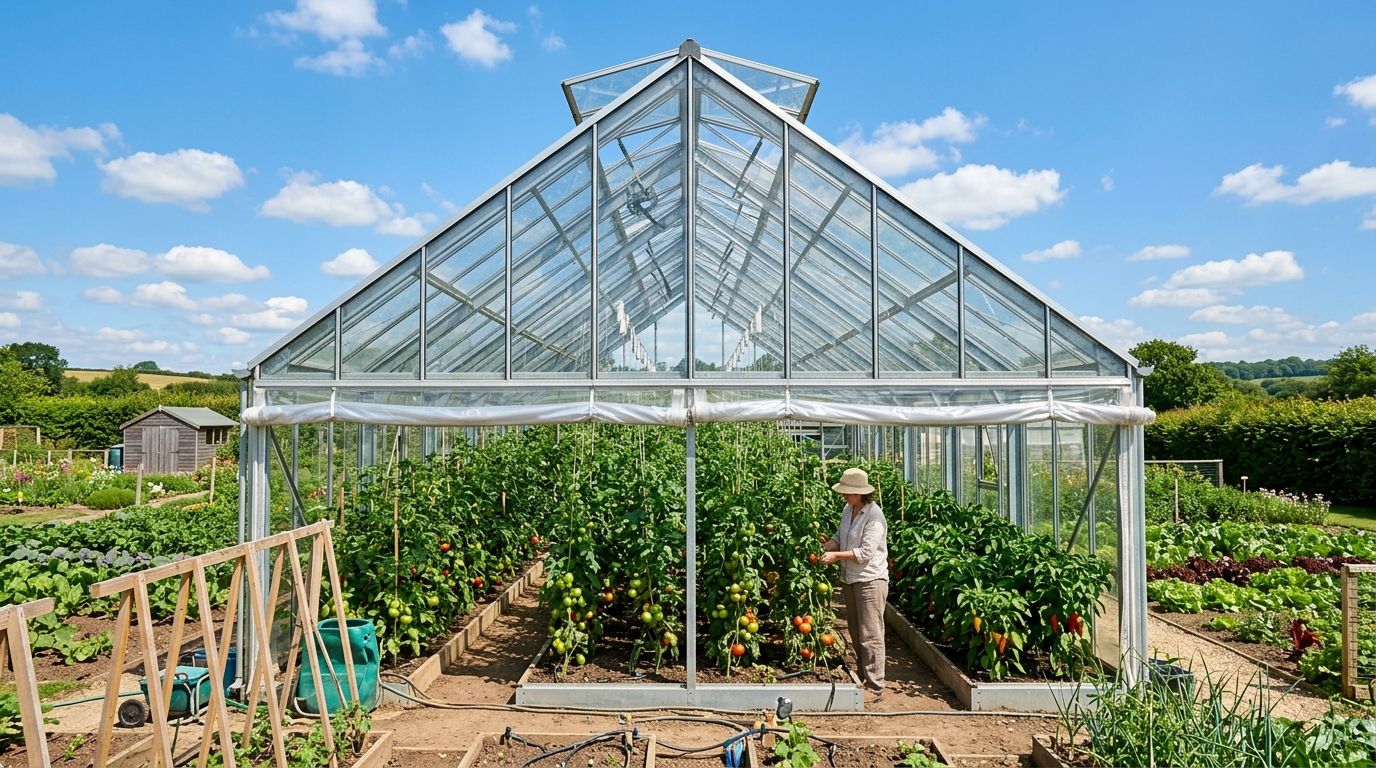
A peaked structure—such as a steep Gothic arch or a straight-walled Gable greenhouse—operates on an entirely different thermodynamic principle. The roof rafters meet at a sharp central peak.
Hot air is less dense than cool air. As air warms at crop level, it expands, becomes buoyant, and rises vertically. In a peaked structure, the angled rafters act like a funnel, guiding rising thermal currents directly toward the center ridge.
When that rising column of hot air reaches the peak, it encounters a ridge vent or gable louvers. The hot air exhausts outside, creating a mild negative pressure differential inside the building. That pressure drop naturally draws cooler outside air in through the lower sidewall vents.
This passive phenomenon is known as the Stack Effect (or thermal buoyancy ventilation). It functions independently of wind. Even on dead-calm days with zero ambient breeze, a tall, peaked high tunnel equipped with a ridge vent will generate its own continuous upward draft.
Comparative Ventilation Architecture Matrix
| Architectural Feature | Standard Quonset Arch | High Gothic Arch | Straight-Wall Gable Peak |
|---|---|---|---|
| Primary Airflow Engine | Horizontal cross-wind | Thermal buoyancy & cross-wind | Thermal buoyancy (Stack Effect) |
| Dead Air Stagnation | High (large bubble at apex) | Low (channeled to peak) | Very Low (straight chimney exit) |
| Ridge Vent Feasibility | Poor (awkward sealing on curve) | Good (continuous mechanical vent) | Excellent (standard rack & pinion) |
| Clearance Above Trellis | Restricted along sides | Generous central height | Maximum vertical buffer volume |
| Wind Deflection | Exceptional aerodynamic curve | Moderate deflection | Higher resistance on vertical walls |
| Initial Construction Cost | Lowest cost per square foot | Moderate cost | Higher cost (custom truss hardware) |
The Physics of Roof Pitch and Vertical Thermal Stratification
It is not merely the presence of a peak that dictates ventilation velocity; the actual mathematical pitch of your roof and the total height of the ridge are critical factors.
Height Differential and the Stack Effect Formula
The thermodynamic draft generated by the stack effect depends directly on the vertical distance between the air intake vents (the bottom of your roll-up sidewalls) and the exhaust vents (your roof peak). In fluid dynamics, this pressure difference is calculated as:
$$Delta P = ho_0 cdot g cdot h cdot rac{T_i - T_o}{T_i}$$
Where:
- $Delta P$ is the driving pressure differential
- $ ho_0$ is ambient air density
- $g$ is gravitational acceleration
- $h$ is the vertical height distance between intake and exhaust
- $T_i$ and $T_o$ are internal and outdoor absolute temperatures in Kelvin
Notice that the height $h$ directly multiplies the driving pressure. If your high tunnel has an 8-foot ridge height, your vertical buoyancy pressure is modest. If you construct a Gothic tunnel with a 14-foot or 16-foot ridge, you double the height differential $h$.
That taller column of air generates a much stronger thermal draft, pulling air through sidewall intakes with noticeable velocity even during stagnant summer heat waves.
Thermal Stratification and Crop Canopy Buffering
Air inside an enclosed greenhouse stratifies thermally. Hot air rises, while denser, cooler air settles near the ground. Temperature increases continuously as you move upward toward the roof poly.
On a hot summer afternoon:
- Soil level temperature might read 86°F.
- Five feet above the ground (mid-canopy for staked tomatoes) might measure 92°F.
- Ten feet above the ground might reach 104°F.
- Twelve to fourteen feet in the apex can easily exceed 125°F.
If your tunnel ceiling is low, that superheated 120°F layer sits right on top of your trellised vines, scorching apical buds, burning blossoms, and stopping vegetative growth. In a tall Gothic tunnel with steep rafters, that extreme heat sits safely suspended three to four feet above the trellis line, waiting to exit through the ridge vent without cooking your plants.
Passive Sidewall Roll-Ups: Sizing, Height, and Fluid Dynamics
While roof vents exhaust rising heat, sidewall roll-up curtains act as the intake lungs of your tunnel. Many commercial kits and DIY tunnels are built with inadequate sidewall venting.
The 20 to 30 Percent Ventilation Rule
Agronomic greenhouse engineering standards establish a clear baseline: the total combined open ventilation area must equal at least 20 percent of your structure's total ground floor footprint. In hot southern climates, expanding that vent ratio to 30 or 35 percent is essential for summer survival.
Let us run the real-world numbers on a standard 30x72-foot commercial high tunnel:
- Total footprint area: $30 imes 72 = 2,160 ext{ sq ft}$.
- Minimum 20% vent requirement: $2,160 imes 0.20 = 432 ext{ sq ft}$ of open vent area.
- Target 30% southern vent requirement: $2,160 imes 0.30 = 648 ext{ sq ft}$.
The Two-Foot Roll-Up Failure
Many budget high tunnel designs include roll-up curtains that only lift two feet off the baseboard. On a 72-foot tunnel with both sides rolled up two feet, your total vent area is:
$$(2 imes 72) + (2 imes 72) = 288 ext{ sq ft}$$
That provides barely 13 percent ventilation area—far below the minimum requirement.
To make matters worse, that lowest two feet of space is precisely where weed pressure, tall grass along the baseboard, raised bed edges, and dense perimeter crop foliage create friction and block incoming airflow. Real-world airflow through a two-foot roll-up drops to near zero during low-wind periods.
The Four-to-Five-Foot Standard
To ventilate effectively in June, sidewall curtains must roll up a minimum of four feet, and preferably five feet, above the ground:
- A four-foot roll-up on both 72-foot sides yields $576 ext{ sq ft}$ of intake area.
- A five-foot roll-up yields $720 ext{ sq ft}$ of intake area (over 33 percent of floor footprint).
Rolling up to four or five feet elevates the intake opening above outer weeds and lower tomato foliage. Incoming breezes sweep smoothly across the upper root zone and mid-canopy, picking up heat and moisture before rising toward the ridge exhaust.
Insect Netting Considerations
Many organic growers attach fine insect exclusion netting (such as 40-mesh or 50-mesh netting) over their roll-up sidewall openings to exclude hornworms, armyworms, and cucumber beetles.
While insect netting protects crops from pests, fine mesh creates substantial resistance to air movement. A 50-mesh thrips screen can reduce airflow volume through an opening by 35 to 50 percent.
If you install fine insect screens over your sidewalls, you must compensate by increasing your roll-up height or extending gable openings to maintain adequate air exchange rates.
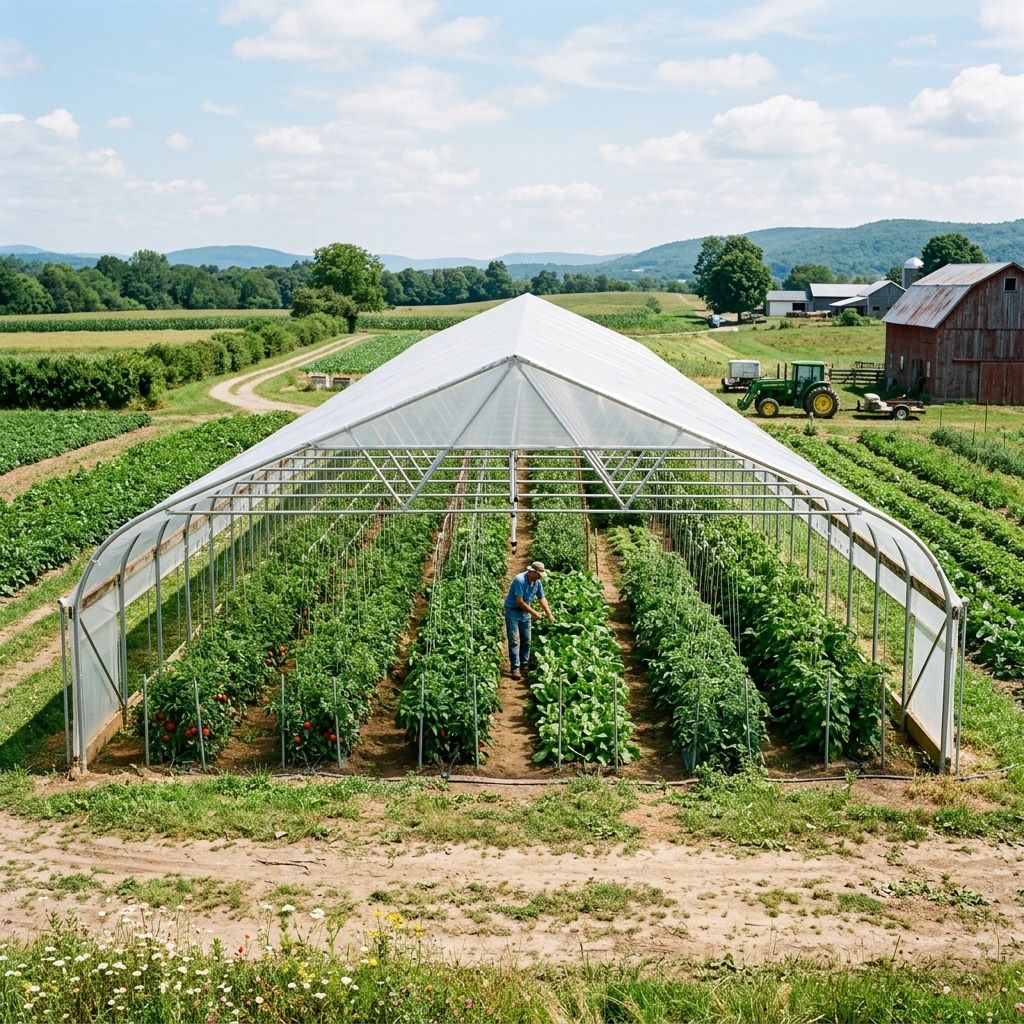
Ridge Vents and Gable Louvers: The Exhaust Engines
Relying on sidewalls alone only provides horizontal cross-ventilation. Cross-ventilation requires a steady outdoor breeze blowing perpendicular to your tunnel. If the wind blows parallel to your tunnel, or stops blowing entirely, cross-ventilation ceases.
To guarantee air movement on stagnant summer afternoons, you must have high-elevation exhaust points.
Continuous Mechanical Ridge Vents
A continuous ridge vent is a hinged opening running along the entire length of the roof peak. Controlled by a manual crank or an automated rack-and-pinion motor tied to a digital thermostat, the ridge vent opens outward to create an unobstructed chimney.
As buoyant hot air pours out the peak, ambient winds blowing across the roof create a localized low-pressure zone on the leeward side of the vent flap (the Bernoulli effect). This suction pulls hot air out of the tunnel at high velocity, dramatically outperforming sidewalls alone.
Research published by agricultural engineering teams demonstrates that a high tunnel combining four-foot roll-up sides with a continuous ridge vent can maintain internal temperatures within two to four degrees of ambient outdoor air without using an ounce of electrical power. For extensive engineering standards and airflow modeling, consult the Rutgers University EcoComplex high tunnel guides.
Gable-End Louvers and Drop-Down End Walls
If your existing Quonset tunnel cannot be retrofitted with a structural ridge vent, your next best passive exhaust option is opening your gable end walls at high elevation.
Many growers simply leave their end-wall personnel doors open. Opening ground-level doors creates a narrow air draft through the center aisle while leaving the back corners and upper canopy completely stagnant.
To exhaust heat effectively:
- Install large, triangular drop-down curtains or oversized aluminum louvers in the upper gable triangle above the doors.
- In hot weather, drop these upper gable curtains completely open.
- This creates a high-level exit path for rising heat trapped along the roofline, allowing incoming sidewall breezes to sweep warm air out both ends of the building.
Shade Cloth Engineering: Black Knitted vs. Aluminet
Even with four-foot roll-up sides and functional ridge vents, intense June sunlight can deliver more solar energy than passive air exchange can remove. When internal temperatures exceed 85°F, deploying exterior shade cloth becomes necessary.
How Shade Cloth Protects Plants
Photosynthesis does not increase indefinitely with more sunlight. Most fruiting vegetable crops reach their light saturation point at approximately 1,000 to 1,200 micromoles of photons per square meter per second ($mu ext{mol}/( ext{m}^2cdot ext{s})$) of Photosynthetically Active Radiation (PAR).
On a bright June day, direct sunlight often exceeds 2,000 $mu ext{mol}/( ext{m}^2cdot ext{s})$. That extra light cannot be processed by the plant. Instead, it gets absorbed as pure heat, elevating internal leaf temperatures and triggering photoinhibition.
Shade cloth cuts the incoming solar radiation load, keeping leaf temperatures below critical stress thresholds while transmitting plenty of light for continuous photosynthesis.
Black Knitted Polyethylene vs. Aluminet
The material composition of your shade cloth determines its cooling efficiency:
Traditional Black Knitted Shade Cloth
Black shade cloth works by absorbing sunlight. When sunlight hits black polyethylene threads, the fabric absorbs the energy and gets hot.
If black shade cloth rests directly against your greenhouse poly, it transfers that absorbed heat directly into the plastic skin via conduction, which then radiates heat into the tunnel interior.
To use black shade cloth effectively, you must suspend it on support pipes six to twelve inches above the greenhouse plastic. This air gap allows ambient breezes to carry away the absorbed heat before it warms the poly film.
Aluminized Shade Fabric (Aluminet)
Aluminet is manufactured from twisted strands of high-density polyethylene coated with micro-thin aluminum, creating a flexible, reflective screen.
- Reflective Rejection: Rather than absorbing solar radiation, Aluminet acts like thousands of tiny mirrors, reflecting shortwave and longwave infrared rays away from the structure before they ever enter the plastic.
- Light Diffusion: The remaining light passing through Aluminet is scattered at multiple angles. Diffused light penetrates deep into the lower leaf canopy rather than casting harsh shadows, improving overall canopy photosynthesis while dramatically reducing plant surface temperatures.
- Direct Application: Because Aluminet reflects heat instead of absorbing it, you can drape it directly over the exterior roof plastic without needing an elevated standoff frame.
Recommended Shading Percentages by Crop
| Crop Group | Recommended Shading | Light Transmittance | Agronomic Objective |
|---|---|---|---|
| Fruiting Solanaceous (Tomatoes, Peppers, Eggplants) | 30% to 40% | 60% to 70% | Preserves pollen viability, prevents blossom drop, high PAR |
| Cucurbits (Cucumbers, Summer Squash, Melons) | 30% | 70% | Prevents midday foliar wilting, supports heavy fruit swelling |
| Cool-Season Greens (Kale, Chard, Summer Lettuce) | 40% to 50% | 50% to 60% | Lowers soil temperature, delays bolting, prevents bitterness |
| Nursery Seedlings & Microgreens | 50% to 60% | 40% to 50% | Prevents seedling desiccation, maintains tender leaf texture |
Plant Physiology Under Thermal Stress: Blossom Drop and Transpiration
When high tunnel temperatures spike in June, heat does not simply make plants uncomfortable; it disrupts their cellular biochemistry.
The Mechanism of Blossom Drop
For market gardeners, the most frustrating symptom of early summer heat is blossom drop on tomatoes and peppers. A tomato vine can look lush, dark green, and vigorous, yet drop every newly opened yellow blossom onto the soil, producing zero fruit set.
Blossom drop occurs because of pollen sterilization under high temperatures:
- Tomato pollen is sensitive to thermal degradation. If ambient temperatures exceed 86°F (30°C) during the day, or remain above 75°F (24°C) at night, pollen grains inside the anther become misshapen and sterile.
- When bees or wind vibrate the flower, sterile pollen fails to germinate on the stigma, and fertilization cannot take place.
- The plant detects the unfertilized flower and forms an abscission layer of corky cells across the pedicel joint, dropping the dead flower within 48 to 72 hours.
- If a high tunnel sits at 98°F for ten consecutive days in June, you lose two full weeks of future fruit production.
Vapor Pressure Deficit (VPD) and Stomatal Closure
Vapor Pressure Deficit (VPD) measures the difference between the moisture pressure inside the saturated interior of a plant leaf and the moisture pressure of the surrounding air. VPD dictates how fast a plant transpires water.
In a poorly ventilated, hot high tunnel, ambient air becomes extremely hot. As air temperature rises, its capacity to hold water vapor expands exponentially. If humidity does not rise along with temperature, the VPD skyrockets into the danger zone (above 2.0 to 2.5 kPa).
When the VPD is too high, the air pulls moisture out of leaf tissue faster than root systems can absorb water from the soil. To prevent catastrophic cellular dehydration, the plant closes its microscopic leaf pores (stomata).
Once stomata close:
- Transpiration Halts: The plant loses its natural evaporative cooling system. Leaf surface temperatures can rapidly rise 10 to 15 degrees above ambient air, causing severe heat damage.
- Carbon Dioxide Starvation: The plant can no longer absorb atmospheric carbon dioxide ($CO_2$), shutting down photosynthesis completely.
- Nutrient Transport Stalls: Water movement through xylem tubes stops. Calcium—an immobile nutrient that travels exclusively through water transpiration streams—cannot reach rapidly expanding fruit cells, resulting in severe blossom-end rot on tomatoes and bell peppers.
Managing Evaporative Cooling and Soil Heat Buffers
When ambient outdoor temperatures exceed 95°F during midsummer heat waves, passive ventilation reaches its physical limit. Opening your vents completely will only equalize your indoor temperature with outdoor air. To cool a high tunnel below outdoor ambient levels, you must deploy evaporative cooling.
The Thermodynamics of Evaporation
Evaporative cooling relies on the latent heat of vaporization. When water transitions from a liquid to a vapor, it absorbs substantial heat energy from the surrounding atmosphere—approximately 2,260 kilojoules of energy for every liter of water evaporated.
This phase change extracts heat directly from the air, dropping ambient temperatures while raising relative humidity.
Wet Walls and Negative Pressure Fans
In commercial high tunnels, active evaporative cooling is implemented using an engineered cellulose pad (a wet wall) on one end and heavy-duty exhaust fans on the opposite gable end:
- Water trickles continuously down the corrugated cellulose pad.
- Exhaust fans pull hot, dry outdoor air through the saturated flutes of the wet wall.
- As water evaporates into the incoming air stream, air temperatures entering the tunnel drop by 10 to 20 degrees Fahrenheit.
- The cooled air sweeps across the crop canopy and exhausts out the far end.
Evaporative wet pads perform exceptionally well in arid and semi-arid climates (such as the American Southwest and Intermountain West) where ambient summer humidity is low. In high-humidity regions (like the Deep South), the cooling efficiency is more modest because humid air holds less capacity for additional water vapor.
Overhead Misting vs. High-Pressure Fogging
Some growers attempt evaporative cooling by running standard low-pressure overhead misting lines. In a vegetable tunnel, this is risky.
Low-pressure mist produces large water droplets that do not evaporate before landing on foliage. Saturated leaf surfaces combined with warm tunnel air create ideal breeding conditions for devastating fungal pathogens like Botrytis cinerea (gray mold), powdery mildew, and bacterial spot.
If you deploy evaporative water sprays over crops, you must use a commercial high-pressure fogging system operating at 800 to 1,000 PSI. High pressure atomizes water into microscopic droplets (under 20 microns) that flash-evaporate mid-air, cooling the atmosphere without wetting leaf surfaces.
Ground Cover and Soil Surface Management
The material covering your garden floor directly influences your internal thermal budget:
- Black Woven Landscape Fabric: While excellent for no-till weed suppression, black landscape fabric absorbs massive amounts of solar radiation and gets scorching hot (often exceeding 140°F on the surface). That absorbed heat radiates directly into the lower crop canopy.
- White Reflective Ground Covers: Switching to white woven ground fabric reflects incoming solar energy back out through the roof, keeping soil surfaces substantially cooler.
- Organic Straw Mulch: A thick, four-inch layer of clean wheat straw acts as an insulating blanket, preventing summer solar radiation from heating the soil mass below. To learn more about organic mulching options, review our deep dive into deep mulch gardening and soil buffering.
- Early Morning Drip Irrigation: Run drip irrigation lines before dawn. Saturating the root zone with cool groundwater cools the soil bed and ensures plants enter peak midday heat fully hydrated. Discover commercial drip layout techniques in our guide on drip irrigation setup for micro-farms.
Internal Circulation Fans: Mixing vs. Air Exchange
Many growers hang a pair of 12-inch or 16-inch oscillating fans from their greenhouse purlins and wonder why the structure remains scorching hot.
Why Circulation Fans Do Not Cool
Internal Horizontal Airflow (HAF) fans move air, but they do not exchange air.
Imagine sitting inside a parked car with closed windows on an August afternoon while running a battery-powered dashboard fan. The fan blows air across your skin, but the interior temperature remains 125°F.
HAF fans simply circulate the existing thermal mass in a loop. Unless paired with open sidewalls, ridge vents, or exhaust fans that bring in fresh air and push hot air out, circulation fans cannot lower the internal temperature of a high tunnel.
The Real Role of HAF Fans
While HAF fans do not exchange air, they serve vital agronomic functions when used correctly alongside active ventilation:
- Destratification: HAF fans break up the vertical heat strata, blending the cooler air sitting at the soil line with hot air accumulating under the roof.
- Boundary Layer Disruption: Every plant leaf is surrounded by a microscopic boundary layer of still, humid air. HAF fans maintain a gentle breeze (50 to 100 feet per minute) that strips away this boundary layer, encouraging healthy transpiration and gas exchange.
- Microclimate Prevention: In large tunnels with dense vining crops, pockets of dead, humid air form between rows, fostering fungal spores. Continuous circulation ensures uniform temperature and humidity from one end of the structure to the other.
Summer High Tunnel Maintenance Checklist
To keep your high tunnel productive and prevent crop loss as spring transitions into summer, follow this practical operational checklist:
1. Late Spring Transition (May)
- Clean and inspect sidewall roll-up gearboxes, handles, and guide pipes. Lubricate moving joints to ensure smooth operation.
- Clear weeds, tall grass, and debris along the outer perimeter baseboards to eliminate airflow obstructions.
- Inspect plastic film for tears or loose wiggle wire along the hip boards. Tighten plastic to ensure clean roll-up action.
- Install high-accuracy digital temperature and humidity sensors at mid-canopy level (not high on purlins) to monitor actual crop conditions.
2. Early Summer Shading and Venting (June)
- Deploy 30% to 40% Aluminet shade cloth over the exterior roof as soon as daytime internal temperatures consistently reach 85°F.
- Roll sidewalls up to a full four or five feet by 8:00 AM on sunny days. Do not wait until the tunnel is already 95°F to open vents.
- Open upper gable louvers and ridge vents completely to establish passive stack-effect drafts.
- Adjust drip irrigation timers to run in early morning hours, maintaining consistent soil moisture before peak heat.
- Prune indeterminate tomato vines to maintain open airflow pathways between rows.
3. Midsummer High-Heat Management (July & August)
- Monitor indeterminate crops daily for blossom drop or pollen abortion. If flower clusters fail to set fruit, increase shade cloth coverage or verify sidewall airflow.
- In dry climates, run evaporative wet pads or high-pressure foggers during peak afternoon heat hours (12:00 PM to 4:00 PM).
- Check plant foliage for heat-induced nutrient deficiencies, especially blossom-end rot caused by stalled calcium uptake.
- Scout for summer pest flare-ups. Hot, dry tunnel environments encourage rapid reproduction of spider mites and aphids. For natural predator protocols, consult our guide on organic aphid control and biological management.
Restoring Thermal Balance
A high tunnel is a tool for season extension, designed to capture solar heat when the outside world is cold. When early summer arrives, you must actively intervene to shed that thermal load.
By understanding the fluid dynamics of the stack effect, sizing your sidewall intakes properly, selecting peaked architectural profiles, and deploying reflective shade fabrics, you can control high tunnel heat. You transform a summer oven back into an efficient growing shelter, keeping your vines thriving and harvesting market-quality produce right through the heat of summer.
Expert Insights & FAQs
Why are my tomato blossoms falling off in June?
High temperatures above 85°F to 90°F cause tomato and pepper pollen to degrade and become sterile. When flowers fail to fertilize, the plant forms an abscission layer at the stem joint and drops the bloom to conserve water. Applying 30% to 40% shade cloth, maintaining continuous four-foot sidewall roll-ups, and watering early in the morning are essential to resume fruit set.
Is a gothic arch better than a standard quonset for heat management?
Yes. A gothic arch roof features a pronounced central peak that channels rising hot air upward toward the ridge line. In contrast, a rounded quonset arch creates a wide, stagnant heat bubble across the upper third of the structure that radiates thermal energy back down onto crops.
Can I retrofit a ridge vent onto an existing arch tunnel?
While structurally possible, retrofitting a continuous mechanical ridge vent onto a curved quonset frame requires custom brackets and cutting the main roof poly film, which risks leaks and wind damage. Most growers find it safer and more cost-effective to install large upper gable-end louvers, drop-down end curtains, or automated exhaust fans.
What percentage of shade cloth is best for summer tomatoes?
A 30% to 40% shade cloth provides the ideal balance for tomatoes and peppers. It filters out excess solar infrared radiation to lower leaf temperatures and preserve pollen viability, while transmitting 60% to 70% of Photosynthetically Active Radiation (PAR) needed for heavy photosynthesis.
How high should roll-up sides be on a high tunnel?
Roll-up sides must elevate at least four to five feet above the ground. Two-foot roll-ups are largely blocked by perimeter weeds, baseboards, and lower plant foliage, restricting real-world airflow. Four-foot curtains ensure incoming air sweeps smoothly across the crop canopy.
Will leaving the end doors open cool my high tunnel enough?
No. Leaving only ground-level end doors open creates a narrow tunnel of air movement through the center aisle, leaving the growing beds and upper ceiling zones stagnant. Effective cooling requires full-length four-foot sidewall roll-ups paired with high ridge or gable exhaust vents.
How does ground mulching inside a high tunnel impact summer temperature?
Ground mulching dramatically influences internal thermal mass. Black woven landscape fabric absorbs solar radiation and can reach surface temperatures over 140°F, radiating heat into the tunnel. Switching to white reflective fabric or a thick layer of clean organic straw insulates the soil and keeps root zones significantly cooler.
What is Vapor Pressure Deficit (VPD) and why does it matter in high tunnel ventilation?
Vapor Pressure Deficit (VPD) measures the difference between moisture pressure inside a leaf and the surrounding air. When a hot high tunnel lacks ventilation, the VPD spikes, pulling water out of leaves faster than roots can absorb it. Plants respond by closing their stomata, which stops transpiration, causes overheating, and leads to blossom-end rot.
Johnnie McCormick
Zone 7b/8a - North Central Alabama
Johnnie McCormick is a gardening hobbyist and the founder of My Garden Spot. Raised in north-central Alabama, his passion for gardening began in his youth. In 2008, he established a large market garden, teaching himself high-yield growing methods. In the years since, he has operated seasonal seedling sales for transplants, specializing in heirloom tomatoes, peppers, eggplants, decorative ground covers like Ajuga (Bugleweed), marigolds, nasturtiums, and fresh kitchen-window herb arrangements (basil, cilantro). Today, he gardens in the hills between Birmingham and Jasper, Alabama (Zone 7b/8a), sharing practical, community-focused gardening resources.
Verified Authoritative Citations & References
In alignment with our strict E-E-A-T research and verification guidelines, this guide cross-references data from the United States Department of Agriculture (USDA) and Cooperative Extension Service programs.
- Rutgers NJAES Cooperative Extension: Greenhouse energy conservation and climate management sheets. horteng.envsci.rutgers.edu
- Cornell Cooperative Extension: High-Yield Greenhouse management and passive climate control resources. cea.cals.cornell.edu
- Penn State Extension: High tunnel design, construction, and microclimate optimization. extension.psu.edu
- Iowa State University Extension: High tunnel production and ventilation guidelines. store.extension.iastate.edu


Please log in to view comments.