
Does Orienting a Greenhouse East-West Reduce Summer Heat?
Yes, orienting a greenhouse East-West really does reduce summer heat while maximizing winter solar gain, offering a clever thermodynamic hack for year-round climate control. By aligning the longest walls of your structure along an East-to-West axis, you fundamentally alter how solar radiation interacts with your glazing across different seasons. This layout exploits the changing angles of the sun, reflecting harsh, high-angle summer rays while welcoming low-angle winter light with open arms.
For many passionate growers, building a greenhouse is a dream that quickly turns into a humid, sweat-inducing nightmare when July rolls around. We tend to think of greenhouses as simple glass boxes designed to trap heat, but professional horticulturalists and agricultural architects view them as dynamic thermodynamic filters. If you do not plan your orientation carefully, you might accidentally build a high-tech solar oven that cooks your prized heirloom tomatoes before they even have a chance to ripen. Fortunately, by understanding the physics of solar angles, you can design a self-regulating structure that stays cooler in the summer and warmer in the winter. Before you dig your foundation or lay down your first ground anchor, using tools like the Garden Planning Tool can help you map out your site's microclimate and plan your seasonal crop rotations alongside your greenhouse layout.
How does greenhouse orientation affect solar radiation capture across different seasons?
To understand how greenhouse orientation affects solar radiation capture, we must first look at the sun's path as a seasonal vector. In the northern hemisphere, the sun rises in the southeast and sets in the southwest during the winter, tracking a very low path across the southern sky. In the summer, the sun rises in the northeast, climbs to a near-vertical zenith at solar noon, and sets in the northwest. This massive shift in solar altitude and azimuth means that the physical orientation of your greenhouse determines exactly how much solar energy, or insolation, penetrates your growing space.
When a greenhouse is oriented East-West (E-W), its long side walls face directly North and South. During the winter, the low-angle sun strikes the long southern wall at a nearly perpendicular angle. In the language of physics, the angle of incidence (the angle between the incoming light ray and a line perpendicular to the glass surface) is very small. A low angle of incidence means maximum light transmission and minimum reflection, allowing the greenhouse to capture precious warmth when ambient temperatures are freezing. This seasonal advantage is why E-W orientations are highly favored for cold-climate growing, acting similarly to how diy cold frames extend growing season budget setups work on a smaller, localized scale.
Conversely, during the summer, the sun climbs incredibly high in the sky. For an E-W greenhouse, this means the intense midday sun is positioned almost directly above the roof rather than shining through the side walls. Because the roof slope presents a highly oblique angle to this high-altitude sun, a significant portion of the solar radiation is reflected away rather than transmitted. Meanwhile, the short end walls (facing East and West) present minimal surface area to the intense, low-angle morning and afternoon sun, dramatically reducing the hours of direct, intense heat load.
| Season | East-West (E-W) Solar Gain | North-South (N-S) Solar Gain |
|---|---|---|
| Winter | Maximum: Low sun strikes the long south wall perpendicularly, maximizing light and heat capture. | Moderate: Low sun strikes the narrow south end wall; shadows from structural frames are long and stationary. |
| Summer | Minimized: High midday sun reflects off the roof; narrow east/west walls limit morning/evening solar gain. | Maximum: Long east and west walls capture intense morning and afternoon sun, leading to extreme heat spikes. |
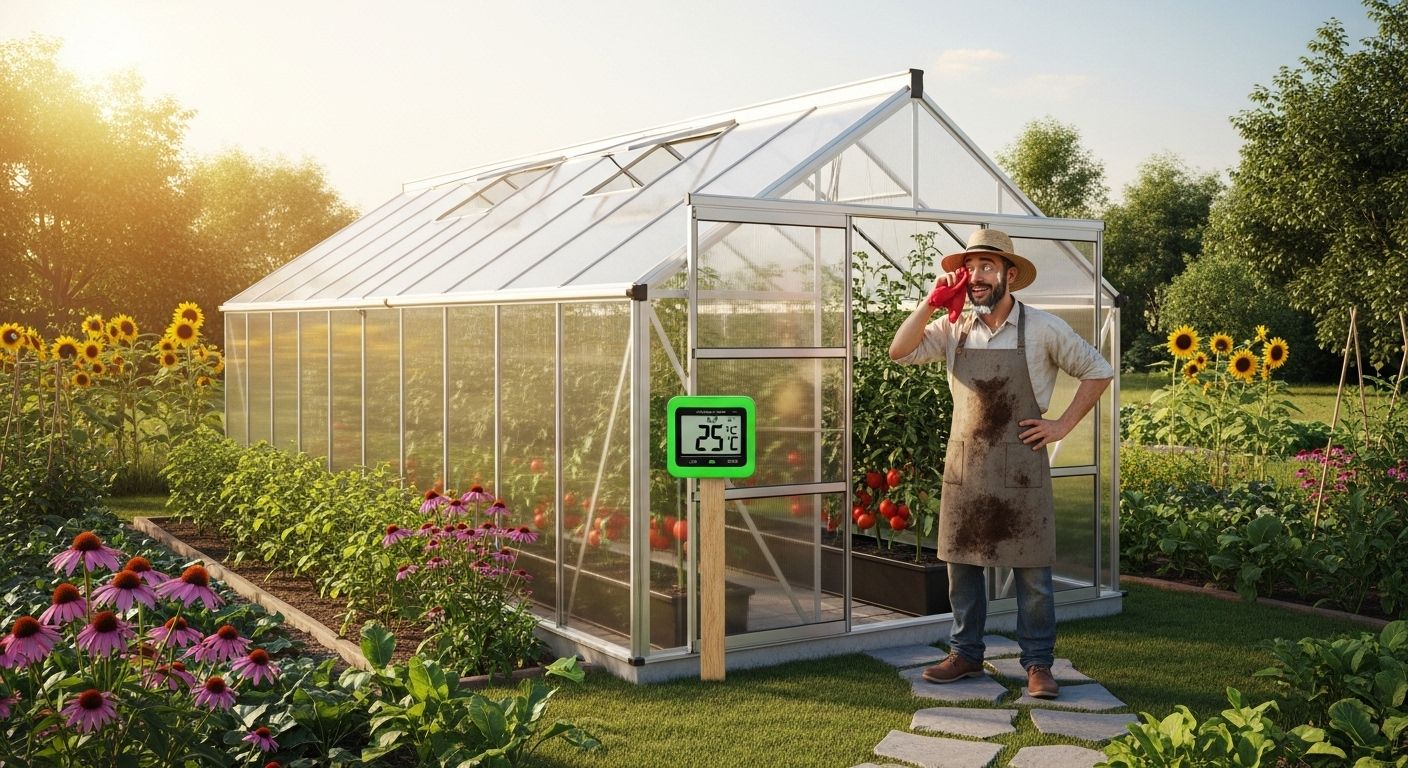
Why does an East-West greenhouse orientation collect less solar heat in the summer?
The secret to why an East-West greenhouse remains cooler in the summer lies in the mathematical relationship between the sun's altitude and the orientation of the glazing surfaces. During the summer solstice, the sun reaches its highest solar altitude angle of the year. In an E-W greenhouse, the long walls run parallel to the sun's daily path. This means that at solar noon, when solar radiation is at its peak intensity, the sun is shining directly down onto the roof rather than through the long vertical side walls.
Because the roof of a standard greenhouse is sloped (typically at an angle of 25 to 35 degrees), the high-altitude summer sun strikes this sloped glazing at an oblique angle. According to the laws of optical physics, when light strikes a transparent medium like glass or polycarbonate at a steep angle, the material ceases to act as a window and begins to act like a mirror. A massive portion of the incoming shortwave solar radiation is reflected back into the atmosphere. This prevents the radiation from entering the greenhouse, where it would otherwise strike internal surfaces (like soil, pots, and foliage), convert into longwave infrared radiation (heat), and become trapped by the greenhouse effect.
Furthermore, because the narrow end walls of an E-W greenhouse face East and West, they present a very small surface area to the low-angle morning and evening sun. In a North-South greenhouse, these low-angle rays hit the massive, long east and west walls head-on, heating the greenhouse up early in the morning and keeping it hot late into the evening. The E-W greenhouse avoids this double-whammy of morning and evening heating, resulting in a much shorter daily peak heating window and a significantly lower overall thermal load.
What is the physics of sun angle and roof reflection in greenhouse thermodynamics?
To truly appreciate the thermodynamic magic of greenhouse orientation, we have to dive into the math of optical reflection. The behavior of light passing through greenhouse glazing is governed by Snell's Law of refraction and Fresnel's equations. Fresnel's equations describe how light splits into reflected and transmitted components when it transitions between media with different refractive indices (such as air, which has a refractive index of approximately 1.0, and glass, which has a refractive index of approximately 1.5).
The reflection coefficient ($R$), which represents the fraction of incident light reflected from a surface, is highly sensitive to the angle of incidence ($\theta_i$). For unpolarized light, the average reflection from a single sheet of glass can be calculated using the simplified relationship:
$$R = \frac{1}{2} \cdot \left[ \left( \frac{\sin(\theta_i - \theta_t)}{\sin(\theta_i + \theta_t)} \right)^2 + \left( \frac{\tan(\theta_i - \theta_t)}{\tan(\theta_i + \theta_t)} \right)^2 \right]$$
Where the angle of refraction ($\theta_t$) is calculated via Snell's Law:
$$n_1 \sin(\theta_i) = n_2 \sin(\theta_t)$$
When the sun is directly overhead or perpendicular to the glass ($\theta_i = 0^\circ$), the reflection is minimal—only about 4% per surface, meaning roughly 92% of the light is transmitted through a standard double-pane window. However, as the angle of incidence ($\theta_i$) increases past 50 degrees, the reflection curve bends sharply upward. At an angle of incidence of 70 degrees, the reflection coefficient jumps to over 30%, and at 80 degrees, it skyrockets to over 60%.
In an East-West oriented greenhouse located at 40 degrees North latitude during the summer solstice, the solar noon altitude is approximately 73.5 degrees. If the greenhouse roof has a standard pitch of 30 degrees facing South, the normal vector of the roof points 30 degrees South of the zenith. The angle of incidence ($\theta_i$) of the midday sun on this south-facing roof slope is calculated as:
$$\theta_i = | 73.5^\circ - 30^\circ - 90^\circ | = 46.5^\circ$$
While 46.5 degrees still allows for decent transmission, the northern roof slope experiences an incredibly high angle of incidence, reflecting almost all direct sunlight. Meanwhile, in the winter, when the solar altitude drops to 26.5 degrees at the same latitude, the angle of incidence on the south-facing roof slope becomes:
$$\theta_i = | 26.5^\circ - 30^\circ - 90^\circ | = 93.5^\circ$$
This near-perpendicular alignment in winter allows almost 90% of the solar energy to penetrate the vertical south wall, warming the greenhouse. This seasonal shift in transmission directly reduces the summer heat load ($\Delta T$, or the temperature difference between the interior and exterior) by limiting the total heat input ($Q_{in}$) during the hottest months, making the E-W greenhouse a self-regulating thermal valve.
How does North-South orientation compare in terms of light uniformity and heat load?
While the East-West orientation is the undisputed champion of summer heat reduction and winter heat retention, the North-South (N-S) orientation has its own dedicated fan base—and for good reason. In a N-S greenhouse, the long side walls face East and West, while the narrow end walls face North and South. As the sun rises in the East and sets in the West, it tracks directly over the greenhouse, casting shadows from structural rafters, gutters, and purlins that move continuously across the floor from West to East.
This continuous movement of shadows is highly beneficial for crop growth because it maximizes the Light Uniformity Coefficient ($LUC$). The $LUC$ is a mathematical measure of how evenly light is distributed across a growing area, defined as:
$$LUC = 1 - \left( \frac{S_{dev}}{I_{mean}} \right)$$
Where $S_{dev}$ is the standard deviation of light intensity across the floor, and $I_{mean}$ is the mean light intensity. In a N-S greenhouse, because the shadows are always moving, no single plant is stuck in a permanent shadow for hours at a time. This prevents localized "cold spots" or light-deprived zones, ensuring that all plants receive an equal share of photosynthetically active radiation (PAR). This uniform light distribution is incredibly important for commercial growers who need their crops to mature at the exact same rate.
However, the massive drawback of the N-S orientation is its brutal summer heat load. Because the long east and west walls are exposed directly to the low-angle morning and evening sun, the greenhouse acts as a giant solar collector during the hottest parts of the summer day. The angle of incidence on these vertical walls is very small in the morning and afternoon, allowing maximum solar transmission. This causes the greenhouse to heat up incredibly early in the morning and remain hot long after the sun has begun to set, creating a massive thermal load that requires heavy mechanical ventilation, evaporative cooling pads, and extensive shading to manage.
What role does geographic latitude play in choosing the ideal greenhouse orientation?
When it comes to greenhouse design, there is no such thing as a one-size-fits-all solution. Your geographic latitude is the ultimate deciding factor in whether you should orient your greenhouse East-West or North-South. This is because latitude determines the maximum and minimum solar altitude angles throughout the year, which in turn dictates how much solar energy is available and how it strikes your structure. Particularly for growers situated above the 35th parallel, an East-West layout exploits the dramatic seasonal shifts in the sun's angle to passively control the interior climate.
If you live in a northern latitude—specifically above 40 degrees North (which includes the northern half of the United States, all of Canada, and most of Europe)—an East-West orientation is almost always the superior choice. At these high latitudes, winter days are short, the sun remains incredibly low on the horizon, and light is the primary limiting factor for plant growth. An E-W greenhouse captures up to 60% more solar radiation during the winter than a N-S greenhouse, keeping your plants growing and reducing your heating bills. The fact that it also reflects harsh summer light is a massive added bonus.
Conversely, if you live in a southern latitude—below 35 degrees North (such as the southern United States, Mexico, or North Africa)—the situation reverses. At these lower latitudes, winter light is rarely a limiting factor; the sun is relatively high in the sky even in December, and winter temperatures are mild. Instead, your primary challenge is managing the brutal, relentless summer heat. In these regions, a North-South orientation is often preferred. Because light is abundant year-round, growers prioritize the uniform light distribution of the N-S layout, relying on heavy shading, active ventilation, and evaporative cooling to handle the summer heat. To help plan your planting schedules based on your specific regional light levels and frost dates, be sure to consult our comprehensive Planting Calendar.
| Latitude Range | Recommended Orientation | Primary Thermodynamic Benefit | Main Challenge to Manage |
|---|---|---|---|
| Above 40° N/S | East-West (E-W) | Maximizes scarce winter solar gain; naturally reflects harsh summer midday sun. | Stationary structural shadows along the north wall during winter. |
| 35° to 40° N/S | E-W or N-S (Crop Dependent) | Balanced seasonal transition; customizable based on winter vs. summer production goals. | Requires careful coordination of shading and active ventilation. |
| Below 35° N/S | North-South (N-S) | Excellent year-round light uniformity; prevents localized burning of high-value crops. | High summer heat load requiring active cooling and heavy shading. |
How can you mitigate summer heat if your greenhouse is already oriented North-South?
If you just realized that your existing greenhouse is oriented North-South and you are currently using it as an accidental sauna, do not panic. You do not need to grab a bulldozer and start spinning your structure around. There are several highly effective, scientifically proven ways to mitigate summer heat in a N-S greenhouse, turning your solar sweatbox back into a thriving horticultural paradise.
The most effective weapon in your cooling arsenal is an external shade cloth. Many growers make the mistake of hanging shade cloths inside their greenhouses, but this is highly inefficient. Once solar radiation passes through the glazing, it is already inside the greenhouse envelope; even if it hits an internal shade cloth, a large portion of that energy converts into heat and remains trapped. By placing a 50% to 70% aluminized shade cloth (such as Aluminet) on the outside of the glazing, you intercept the solar radiation before it ever enters the structure, reflecting it back into the atmosphere and lowering internal temperatures by up to 10 to 15 degrees Fahrenheit.
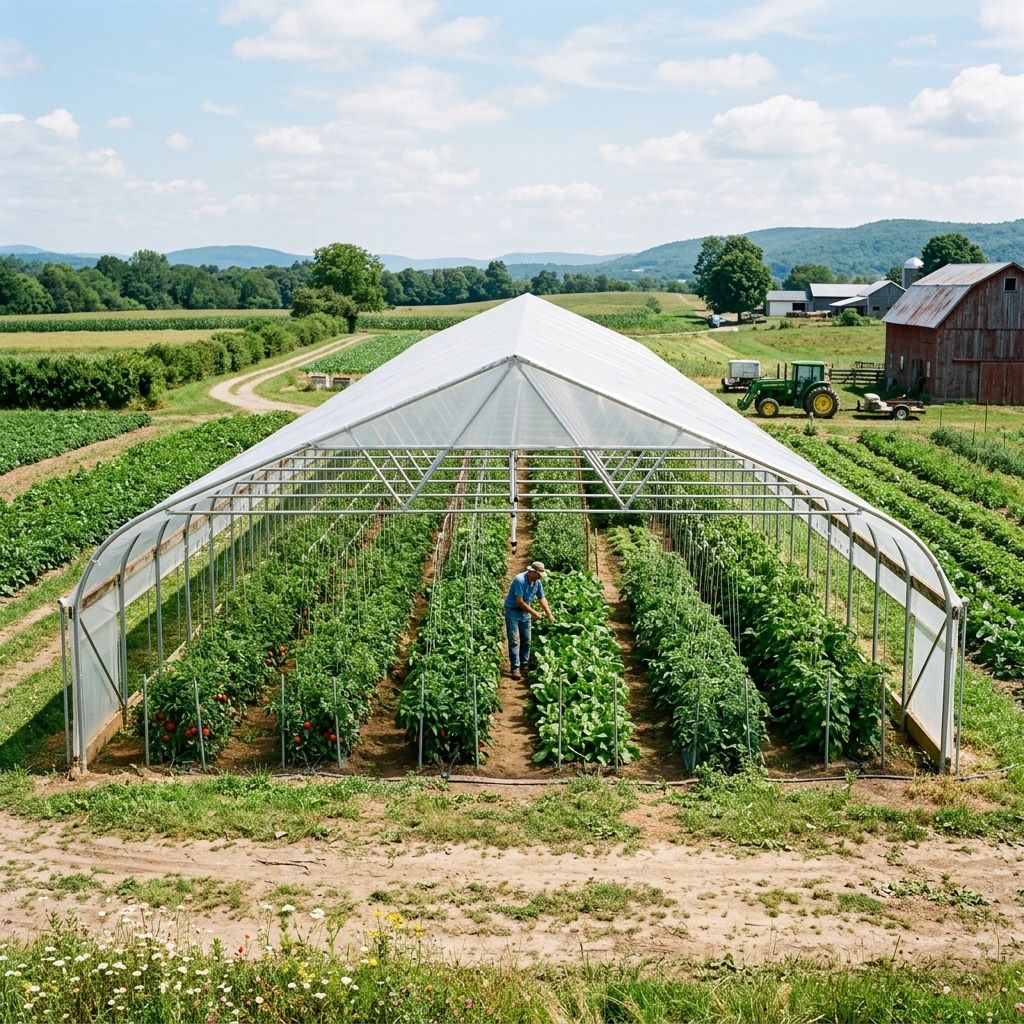
Another critical step is optimizing your passive and active ventilation. Warm air naturally rises due to buoyancy (the chimney effect). By pairing large, automated ridge vents with low sidewall intake vents, you can create a highly efficient natural draft. If you are looking to design or upgrade a high tunnel structure to maximize this natural cooling mechanism, our detailed guide on maximizing natural chimney effect ventilation in high tunnels offers deep architectural insights into optimizing airflow. Additionally, for active cooling, installing a wet pad and fan system (evaporative cooling) can drop temperatures significantly. Ensure your exhaust fans are sized to provide at least one full air change per minute (1 CFM per square foot of floor area at sea level, or up to 1.5 CFM in high-altitude, high-radiation zones) to keep air moving and prevent heat pockets from forming.
What is the relationship between orientation, thermal mass, and passive ventilation?
Greenhouse design is an exercise in systems engineering. Orientation does not work in a vacuum; it operates in a tight, thermodynamic partnership with your greenhouse's thermal mass and passive ventilation systems. When these three elements are properly aligned, they create a self-regulating thermal flywheel that smooths out extreme temperature swings between day and night.
Thermal mass refers to any material that has a high capacity to absorb, store, and later release heat energy. Water is one of the best and cheapest thermal mass materials available, possessing a high specific heat capacity of 4.184 Joules per gram per degree Celsius (J/g°C). In an East-West oriented greenhouse, the entire north wall is a permanent low-light zone because the sun is always in the southern sky. This makes the north wall the absolute perfect place to stack black-painted water barrels or construct a heavy masonry wall. In the winter, the low-angle southern sun shines directly onto this thermal mass all day, storing megajoules of heat. At night, as the air temperature drops, the thermal mass radiates this stored heat back into the greenhouse, preventing frost without consuming electricity.
In the summer, this system works in reverse. Because the high-altitude summer sun is blocked or reflected by the roof, the thermal mass on the north wall remains shaded and cool. During the heat of the day, this cool mass acts as a heat sink, absorbing excess sensible heat from the air and keeping the greenhouse cooler. This passive thermal regulation is incredibly elegant, operating on the exact same physical principles of energy conservation and microbial warmth found in advanced organic systems—such as those detailed in our guide on the science of composting carbon nitrogen balance, where thermal dynamics dictate biological success.
Passive ventilation also relies heavily on orientation. Airflow through a greenhouse is driven by two physical forces: thermal buoyancy (warm air rising) and wind pressure (wind blowing through side vents). If your local prevailing summer winds blow from the South, an East-West oriented greenhouse can utilize large, roll-up sidewall vents to capture this windward pressure, pushing cool air across the width of the greenhouse and exhausting warm air out the leeward side or through the roof. This cross-ventilation is incredibly efficient, requiring zero electrical power to maintain a comfortable growing environment.
How do you choose the ultimate orientation based on your specific crop priorities?
To choose the ultimate orientation for your greenhouse, you must look past the physics of solar angles and focus on the biological needs of your specific crops. Different plants have wildly different light and temperature requirements, and your orientation should reflect your primary agricultural goals. This is where your business plan or kitchen garden goals meet architectural reality.
If your primary goal is year-round production of high-light, fruiting crops—such as vining tomatoes, cucumbers, peppers, or strawberries—and you live in a mid-to-high latitude, an East-West orientation is almost always the best choice. These crops require a high Daily Light Integral (DLI) of 15 to 30 moles of light per square meter per day (mol/m²/day) to produce sweet, abundant fruit. An E-W greenhouse ensures you capture every single scrap of available winter light to keep these heavy feeders producing through the cold months. However, when growing tall, trellised crops in an E-W greenhouse, you must plant your rows running North-South within the greenhouse. If you plant your rows East-West, the southern-most row of tall plants will completely shade out the rows behind it, leaving your northern crops stunted and sad.
On the other hand, if your priority is spring and summer production of bedding plants, leafy greens, herbs, or microgreens, a North-South orientation is often superior. These crops do not require the intense, low-angle winter light that fruiting crops do. Instead, they thrive on the highly uniform, shadow-free light that a N-S greenhouse provides as the sun tracks from East to West. This uniform light prevents phototropic bending (where plants lean toward the light source) and ensures that your trays of lettuce or bedding flowers grow flat, even, and highly marketable. To help you map out your crop layouts and align them with your greenhouse's specific microclimate, be sure to use our interactive Garden Planning Tool to design the perfect growing footprint.
Ultimately, whether you choose East-West or North-South, understanding the thermodynamic physics of your greenhouse allows you to work with nature rather than fighting against it. By aligning your structure with the cosmic dance of the sun, you can create a highly efficient, self-regulating ecosystem that keeps your plants happy, your energy bills low, and your gardening thumbs green year-round.
Expert Insights & FAQs
How does greenhouse orientation affect solar radiation capture across different seasons?
Greenhouse orientation dictates the angle at which solar radiation strikes the glazing throughout the year. An East-West orientation maximizes winter light capture when the sun is low in the southern sky, while minimizing direct overhead solar penetration during the high-angle summer months, balancing seasonal thermal dynamics.
Why does an East-West greenhouse orientation collect less solar heat in the summer?
An East-West orientation collects less summer heat because the high-altitude summer sun strikes the long roof slope at a steep, oblique angle. This geometry increases solar reflection off the glazing, preventing excess infrared radiation from entering and trapping heat inside the structure during peak afternoon hours.
What is the physics of sun angle and roof reflection in greenhouse thermodynamics?
The physics relies on Fresnel's equations and Snell's Law, where the angle of incidence determines the ratio of reflected to transmitted light. High incident angles in summer cause the glazing to act like a mirror, reflecting away thermal energy, whereas low winter angles allow deep transmission.
How does North-South orientation compare in terms of light uniformity and heat load?
A North-South greenhouse orientation provides superior light uniformity throughout the day as the sun tracks from east to west, casting moving shadows. However, this constant exposure results in a much higher summer heat load, requiring aggressive mechanical cooling to prevent heat stress.
What role does geographic latitude play in choosing the ideal greenhouse orientation?
Geographic latitude is the primary decider: above 40°N/S latitude, an East-West orientation is highly recommended to capture scarce winter light. Closer to the equator (below 35°N/S), a North-South orientation is preferred, as year-round light is abundant and uniform crop exposure takes precedence over winter heat retention.
How can you mitigate summer heat if your greenhouse is already oriented North-South?
If your greenhouse is locked into a North-South orientation, you can mitigate summer heat using external shade cloths (50-70% block), high-efficiency evaporative cooling pads, automated ridge vents, and applying liquid greenhouse shading compounds to reflect infrared light before it penetrates the glazing.
What is the relationship between orientation, thermal mass, and passive ventilation?
Greenhouse orientation works synergistically with thermal mass and passive ventilation. An East-West layout allows low winter sun to strike heavy thermal masses (like water barrels) on the north wall, storing heat, while facilitating cross-ventilation from prevailing summer winds that typically blow along north-south or east-west corridors.
How do you choose the ultimate orientation based on your specific crop priorities?
Choose your orientation by aligning crop light requirements with seasonal production goals. For year-round fruiting crops (tomatoes, cucumbers) in northern climates, an East-West orientation is superior for winter light. For spring and summer bedding plants or leafy greens, a North-South orientation provides the uniform, shadow-free light they require.
Johnnie McCormick
Zone 7b/8a - North Central Alabama
Johnnie McCormick is a gardening hobbyist and the founder of My Garden Spot. Raised in north-central Alabama, his passion for gardening began in his youth. In 2008, he established a large market garden, teaching himself high-yield growing methods. In the years since, he has operated seasonal seedling sales for transplants, specializing in heirloom tomatoes, peppers, eggplants, decorative ground covers like Ajuga (Bugleweed), marigolds, nasturtiums, and fresh kitchen-window herb arrangements (basil, cilantro). Today, he gardens in the hills between Birmingham and Jasper, Alabama (Zone 7b/8a), sharing practical, community-focused gardening resources.
Verified Authoritative Citations & References
In alignment with our strict E-E-A-T research and verification guidelines, this guide cross-references data from the United States Department of Agriculture (USDA) and Cooperative Extension Service programs.
- Rutgers NJAES Cooperative Extension: Greenhouse energy conservation and climate management sheets. horteng.envsci.rutgers.edu
- Cornell Cooperative Extension: High-Yield Greenhouse management and passive climate control resources. cea.cals.cornell.edu
- Penn State Extension: High tunnel design, construction, and microclimate optimization. extension.psu.edu
- Iowa State University Extension: High tunnel production and ventilation guidelines. store.extension.iastate.edu


Please log in to view comments.