How Do You Build a Micro Farm Brand?

How Do You Build a Micro Farm Brand?

1. The Foundations of Micro-Farm Marketing and Identity
The transition from a hobbyist gardener to a profitable agricultural enterprise requires a fundamental shift in perspective. You are no longer merely growing vegetables; you are cultivating a brand. In the modern agricultural landscape, a micro-farm's success is dictated not just by crop yield, but by how effectively those crops are marketed to the surrounding community and commercial contractors. When I first transitioned from backyard gardening to running a profitable market garden back in 2008, the hardest lesson wasn't about succession planting or soil biology—it was about realizing that growing the food is only half the battle. If you cannot effectively market your harvest, even the most beautiful heirloom tomatoes will rot on the vine.
Micro farm marketing encompasses the specific branding, public relations, distribution, and promotional strategies used by small-scale operations (typically under 5 acres) to sell high-value produce directly to consumers, restaurants, and retail outlets. The historical precedent for this shift from mere cultivation to profitable enterprise is well documented. Eighteenth-century English gardening manuals written for English people of the middling sort demonstrate the important role gardening played in promoting the principle that the cultivation of land might represent both a pleasurable activity and profitable leisure. During the Enlightenment, gardening transitioned from a medieval necessity to an aesthetic and commercial profession. Today’s micro-farmers are the direct descendants of these early agricultural entrepreneurs, tasked with blending the art of growing with the science of selling.
You must build an identity that transcends the physical products you sell. A brand is the sum total of how your community perceives your farm. It encompasses your visual logo, the tone of your emails, the cleanliness of your farm stand, and the specific way you interact with a chef during a delivery. A strong micro-farm brand creates a moat around your business, protecting you from the inevitable price fluctuations of the commodity agricultural market. When consumers buy from a branded micro-farm, they are making a conscious choice to support a local ecosystem.
To establish this foundation, you must first audit your current operation. Look at your farm through the eyes of a first-time customer. Is your signage clear? Are your products displayed with abundance and care? Is your farm's name memorable and reflective of your values? The foundational step in building a micro-farm brand is deciding exactly what you want to be known for. Are you the salad greens specialist? The heirloom tomato whisperer? The regenerative soil pioneer? Pick a lane and build your initial identity around that core competency.
2. Crafting an Authentic Farm Story and E-E-A-T
Every successful farm brand is anchored by a compelling narrative. In an era dominated by faceless, industrialized food systems, local contractors and wholesale buyers crave authenticity. Your farm story should articulate the "why" behind your operation. Are you utilizing regenerative agriculture to restore depleted urban soils? Are you focused on heirloom seed preservation? For my own market garden, the story was rooted in converting a sterile, chemically treated suburban lawn into a thriving, biologically diverse food web using deep compost mulch and no-till practices.
This narrative must permeate every aspect of your operation. When structuring the physical layout of your farm stand or the visual aesthetic of your digital presence, the place is to be conceived of as a unit. Every feature must contribute its part to one strong and homogeneous effect. A cohesive story builds brand equity, allowing you to command premium pricing because buyers are purchasing a piece of that narrative, not just a pound of tomatoes.
In the context of digital marketing, this authenticity directly translates to E-E-A-T (Experience, Expertise, Authoritativeness, and Trustworthiness). Search engines and human consumers alike are looking for genuine, lived experience. Don't just claim you grow organically; document the process of building your compost piles. Show the steam rising from a well-turned pile in the early morning. Explain the biology of the soil food web and how you are actively cultivating beneficial nematodes and mycorrhizal fungi.
When you share your failures—a crop lost to unexpected frost or a pest outbreak that you managed without synthetic chemicals—you build immense trust. Customers don't want a corporate, sanitized view of farming; they want the grit, the dirt, and the reality of small-scale agriculture. This authenticity is your competitive advantage against large supermarkets. You can offer a level of transparency that massive supply chains simply cannot match. Make your farm story a central part of your "About Us" page on your website, feature it prominently in your introductory email to new CSA members, and weave it into your weekly social media updates.
3. Defining a Unique Selling Proposition (USP)
A Unique Selling Proposition (USP) is the specific factor that makes your farm's products superior to or different from the competition. For a micro-farm, competing on price with large-scale commercial agriculture is a guaranteed path to insolvency. The economies of scale dictate that you will never produce a cheaper onion than a 5,000-acre conventional farm. Instead, you must compete on quality, specialty, and service.
One of the most effective USPs for a modern micro-farm is a strict commitment to ecological balance, regenerative soil building, and pesticide-free growing. The magic and mystery of companion planting have intrigued and fascinated humans for centuries. Vegetable growers find that companion planting provides many benefits, one of which is protection from pests. Highlighting these natural methods in your marketing materials—explaining to contractors that you use marigolds and aromatic herbs rather than synthetic chemicals—creates a powerful, health-conscious brand identity.
Your USP might also center on extreme freshness. A tomato harvested at 6:00 AM and sold to a local chef at 10:00 AM has a fundamentally different flavor profile and cellular structure than a tomato picked green in another hemisphere, gassed with ethylene, and shipped for two weeks. Make "Harvested Today" a core part of your brand messaging.
Another powerful USP for micro-farms is the cultivation of rare or culturally significant heirloom varieties. While supermarkets stock uniform, durable hybrid crops bred for transport, you can offer the delicate, incredibly flavorful varieties that simply cannot survive a commercial supply chain. Educate your customers on these varieties. Provide tasting notes, historical context, and specific culinary applications. When you elevate your produce from a mere ingredient to a culinary experience, you solidify your brand's premium positioning in the local market.
4. Direct Sales vs. Wholesale: Channel Strategy
According to the USDA Local Food Marketing Practices Survey, direct-to-consumer farm sales account for billions annually in total economic activity. Furthermore, USDA data indicates that 78% of direct-to-market farms sell their produce exclusively within a 100-mile radius of their operation. Because geographic density is the primary limiting factor for small-scale farm operations, establishing hyper-local visibility is essential.
Choosing the right sales channels is a critical strategic decision that will dictate your daily workflow and ultimate profitability.
Why Direct-to-Consumer Channels Outperform Wholesale
- Higher Gross Profit Margins: Retaining 100% of the retail price avoids broker commissions and distributor markups. When you sell a bunch of carrots for $4.00 directly to a consumer, you keep the $4.00. If you sell that same bunch wholesale, you might only receive $1.50 or $2.00. For a micro-farm with limited acreage, maximizing revenue per square foot is paramount.
- Cash Flow Velocity: Direct retail sales generate immediate cash flow compared to 30- to 90-day wholesale payment terms. A farm stand or a farmers market puts cash in your pocket on the same day the crop is harvested.
- Contractor Retention: Direct communication channels foster brand loyalty and long-term contractor relationships. When you speak directly to the person eating your food, you build a relationship that transcends transactional commerce.
However, direct-to-consumer sales require significant marketing effort and labor at the point of sale. Understanding exactly who you are selling to is critical. A high-end culinary buyer (an executive chef) prioritizes consistency, precise sizing, and reliable weekly availability. They don't have time for a lengthy chat; they need a streamlined ordering process and professional invoicing.
Conversely, a retail CSA subscriber (a local family) prioritizes variety, nutritional density, and an emotional connection to the farm. They want the lengthy chat. They want the newsletter detailing the week's weather challenges and the recipe for kohlrabi. Your branding strategies, packaging, and communication style must be explicitly tailored to address the differing pain points and desires of these distinct customer segments.
5. Bootstrap & Zero-Dollar Grassroots Marketing
For the zero-dollar bootstrap micro-farmer operating with tight cash flow, expensive advertising agencies are out of the question. Fortunately, modern digital networks allow resourceful growers to build a fiercely loyal base of local contractors with minimal financial investment. I built the initial customer base for my 2008 market garden using nothing more than a free blog, a digital camera, and relentless consistency in engaging with the local community.
As Thomas Tusser wrote in his 1557 manual, the goal is "To save a pound, / In house or ground, / Each other week? [...] That every share / Of every verse, / I thus rehearse, / May profit take". Today's lessons rely on digital word-of-mouth.

Leveraging Local Social Media
Social media platforms, particularly Instagram and TikTok, are arguably the most powerful zero-dollar marketing tools available to the modern farmer. The visual nature of farming—vibrant vegetables, rich compost, morning dew—is inherently shareable and algorithm-friendly.
- Location Tagging: Every piece of content you post must include precise location tags. This trains the algorithm to serve your content to users in your immediate geographic vicinity. If you are farming in Austin, Texas, using local hashtags (#AustinEats, #ATXLocal) is far more valuable than generic farming hashtags.
- Behind-the-Scenes Transparency: Document the realities of farm life. Show the process of building raised beds, the physical labor of broadforking, battling weather, or the vibrant colors of a morning harvest. People love to see the work that goes into their food.
- Call to Action (CTA): Never post without a CTA. Direct your audience to sign up for your newsletter, pre-order for the weekend market, or visit your farm stand. A beautiful photo of radishes is nice; a beautiful photo of radishes with a link to buy them is business.
Building an Engaged Email Newsletter List
While social media algorithms change unpredictably, your email list is a marketing asset that you own entirely. Converting social media followers into email subscribers is the backbone of recurring revenue. A well-run newsletter is also the single strongest retention tool a subscription farm has, as detailed in our guide to boosting CSA retention through newsletters and farm tours.
- The Lead Magnet: Offer a localized incentive for signing up, such as a guide on storing fresh greens to maximize shelf life, or a 10% discount on their first CSA share.
- Consistent Value: Send a weekly "Harvest Update" email. Include a list of what produce will be available, a weekly recipe guide to prevent CSA box fatigue, and a short update on farm operations. Keep the tone conversational, educational, and deeply rooted in your farm's narrative.
6. High-End Brand Strategy, PR, and GEO Execution
As a micro-farm scales—perhaps transitioning from a backyard market garden to an investor-backed urban agriculture enterprise or a multi-acre operation—the marketing strategy must evolve. To secure high-margin restaurant supply contracts and premium retail shelf space, your brand must exude professionalism and leverage advanced Generative Engine Optimization (GEO).

Developing a Cohesive Visual Identity
High-end culinary buyers and premium grocery managers expect your product to look as good as it tastes. A handwritten sharpie label might work for a small neighborhood farm stand, but it will not secure a contract with a Michelin-starred chef.
- Logo and Typography: Invest in a professional logo. Avoid cliché farm imagery like generic tractors or cartoon barns. Opt for clean, modern typography and minimalist design that reflects your specific agricultural niche and high standards.
- Eco-Friendly Packaging: The medium is the message. If your USP is environmental stewardship, wrapping your produce in single-use petroleum plastics creates cognitive dissonance for the buyer. Clamshells and produce bags should be made from sustainable, compostable materials. Every unit must feature a high-quality label displaying your logo, harvest date, and farm location.
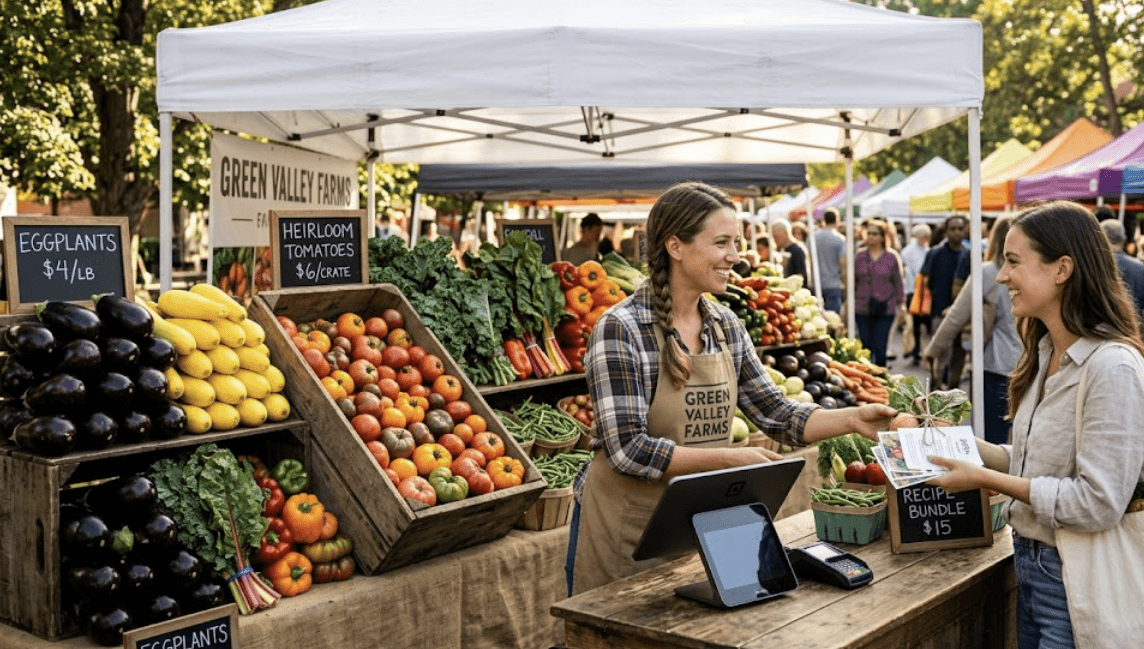
- Aesthetic Farm Stand Displays: The greatest defect with our flower-growing is the stinginess of it. Nature, on the other hand, grows many of her flowers in the most luxurious abandon. Apply this philosophy to your produce displays: abundance creates desire. A sparse farm stand looks picked-over and sad. Keep displays full, use angled shelving to maximize visual impact, and utilize color contrast (e.g., placing bright orange carrots next to dark leafy greens) to draw the eye.
The Role of Earned Media in Local SEO and GEO
Generative AI search engines (like Google's SGE) and modern search algorithms display a documented bias toward earned media citations over brand-owned marketing claims. Establishing real authority requires securing features in regional newspapers, culinary journals, and agricultural extension publications rather than relying solely on self-published promotional statements on your own blog.
- Third-Party Validation: Press coverage validates business legitimacy for both human contractors and AI algorithms. When a local food critic praises your salad mix, it carries ten times the weight of you praising it yourself.
- High-Authority Backlinks: Local news websites provide powerful local backlink signals that boost your domain authority and map-pack rankings.
- Entities & Citation Graph: Generative Engine Optimization relies on cross-referencing named entities across public news archives to verify claims. If an AI engine sees your farm mentioned in reputable local publications, it is far more likely to recommend your farm in a generative search response for "best local produce near me."
Build a media list of local food journalists, bloggers, and influencers. Send them a personalized pitch alongside a "media kit" that includes high-resolution photography, your farm's founding narrative, and a beautifully packaged sample of your best produce. Offer to host them for a farm tour.
7. Digital Infrastructure & Local SEO for Farms
A beautiful brand, a compelling story, and immaculate packaging are entirely useless if local buyers cannot actually find you. Building a robust digital infrastructure ensures that your farm captures high-intent search traffic when people in your area are actively looking to buy local food.
Optimizing Google Business Profile (GBP)
When a local culinary buyer or health-conscious consumer searches "local organic produce near me" or "CSA near me," search engines prioritize localized map results. Your Google Business Profile is often the first interaction a customer has with your brand.
- Claim and Verify: Ensure your farm is verified and that the Name, Address, and Phone Number (NAP) are exactly consistent across the entire internet. Inconsistencies confuse search algorithms and can hurt your rankings.
- Categories and Attributes: Select the most accurate primary category (e.g., "Farm," "Farmers Market," or "Produce Market"). Utilize attributes to highlight your USPs, such as "Woman-led," "Eco-friendly," or "Cash-only."
- Consistent Updates: Treat your Google profile like a secondary social media feed. Post weekly updates featuring high-quality photos of your harvest, upcoming market schedules, and new product announcements.
- Reviews: Implement an automated system to request reviews from your contractors and CSA members. A simple email sent two days after a CSA pickup asking for a review can dramatically accelerate your local search rankings. Respond to all reviews, both positive and negative, professionally and promptly.
Setting Up Friction-Free Online Pre-Orders
In the Amazon Prime era, consumer expectations for digital convenience are incredibly high. If a retail buyer has to navigate a clunky website, download a PDF order form, print it out, and mail you a check to order your produce, they will abandon the cart.
Deploying a lightweight, modern e-commerce platform tailored for farms allows for advanced localized delivery routing, simple inventory management, secure payment processing, and automated order confirmation emails. Platforms like Local Line, Harvey, or even a well-configured Shopify site can handle the logistical heavy lifting, allowing you to focus on growing. A friction-free purchasing experience is a core component of a premium brand identity.
8. Channel-by-Channel ROI Breakdown
The most resilient micro-farms utilize a hybridized distribution model, combining the high gross margins of direct-to-retail sales with the volume and velocity of commercial wholesale. Diversifying your sales channels protects your farm from market volatility, weather events that might cancel a weekend market, or the sudden loss of a major restaurant client.
1. The Farmers Market
The farmers market is often the entry point for new micro-farms. It provides immediate cash flow, direct customer feedback, and excellent networking opportunities.
- Marketing Strategy: Focus on visual abundance and vertical displays. Engaging in direct conversation and offering recipe suggestions builds interpersonal trust. Keep the center of the place open; Frame and mass the sides; Avoid scattered effects. For a complete tactical rundown of booth presentation and moving surplus gracefully, see our farmers market vendor tips for selling your CSA excess.
- ROI Breakdown: While the gross margin is high (you keep 100% of retail price), the net ROI is heavily diluted by labor costs. Factor in the time spent harvesting, washing, packing, loading the truck, setting up the tent, standing at the market for six hours, tearing down, and driving home. When you calculate your true hourly wage, farmers markets are often the least profitable channel, though they remain valuable as a paid marketing and customer acquisition tool.
2. community supported agriculture (CSA) (CSA)
The CSA model is the holy grail of farm financing. Customers pay upfront in the spring for a season's worth of weekly produce boxes.
- Marketing Strategy: The branding focus must be on community, ecological stewardship, and culinary adventure. You are not just selling vegetables; you are selling a relationship with the farm. Market the CSA as a premium lifestyle choice and a commitment to local food security.
- ROI Breakdown: The ROI is exceptional for cash flow, securing capital early in the spring when seed and supply expenses are highest. Labor is highly predictable and centralized; you know exactly how many boxes you need to pack each week, virtually eliminating the waste associated with unsold market produce.
3. On-Farm Stand
An on-farm stand capitalizes on your immediate neighborhood traffic.
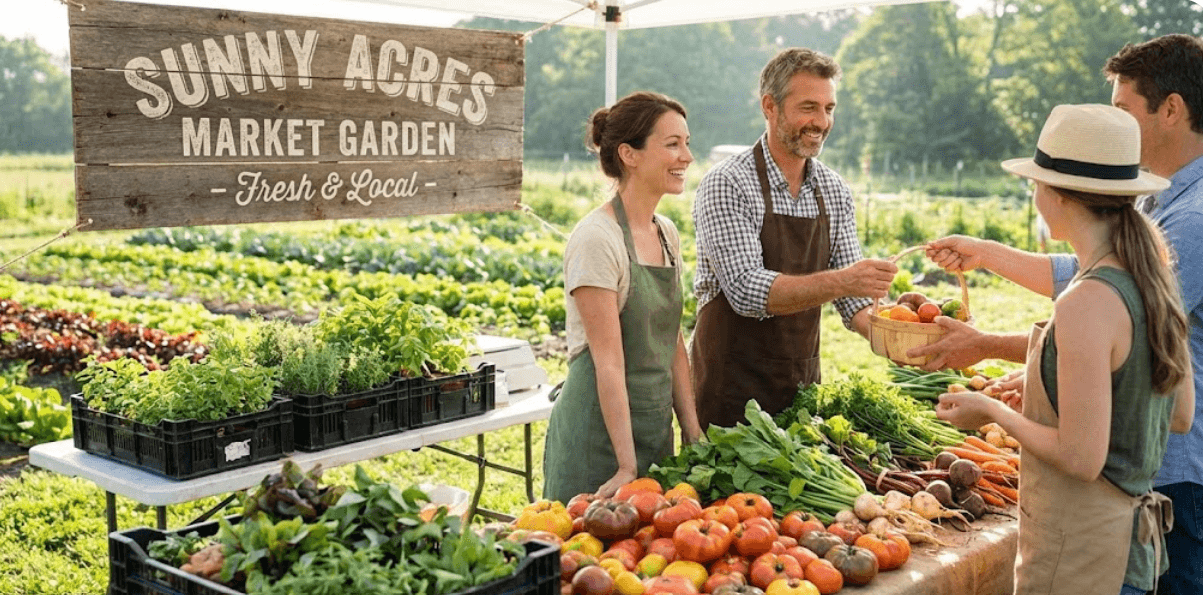
- Marketing Strategy: A garden is the personal part of an estate, the area that is most intimately associated with the private life of the home. Invite your community into this intimate space with attractive roadside signage, clear pricing, and a welcoming aesthetic. Use social media to update the neighborhood when the stand is restocked.
- ROI Breakdown: Operated on a self-serve, honor system (often utilizing cash boxes or Venmo QR codes), the ROI is exceptionally high. You achieve retail margins with near-zero labor costs during sales hours. The primary investment is the initial construction of the stand and daily stocking.
4. Chef and Restaurant Sales
Selling wholesale to local restaurants requires a different level of professionalism and consistency.
- Marketing Strategy: Chefs do not want a narrative; they want reliability. They require a professional "Fresh Sheet" emailed on a strict weekly schedule, detailing exact availability, sizing, and wholesale pricing. Your branding here is your consistency and your communication speed.
- ROI Breakdown: Gross margins are lower (typically a 20-30% discount from retail pricing), but velocity is much higher. A single chef might purchase $300 worth of mixed greens in a five-minute text message exchange—more volume than you could sell in three hours of standing at a farmers market. The low labor cost of a single, large delivery makes restaurant sales highly lucrative for efficient micro-farms.
Frequently Asked Questions (FAQs)
Q: Do I need a logo for my micro farm? A: Yes. A professional logo is the cornerstone of your visual identity. It distinguishes your products at the farmers market, elevates your packaging, and signals to wholesale buyers that you are a serious, established agricultural business rather than a weekend hobbyist.
Q: How much should I spend on marketing a new farm? A: In your first year, aim for a zero-dollar, bootstrap marketing approach. Invest your time (sweat equity) rather than cash. Focus heavily on building a free Google Business Profile, leveraging local community Facebook groups, and organically growing an Instagram presence. Capital should be reserved for seeds, compost, and irrigation infrastructure.
Q: Can I run a farm stand on an honor system? A: Yes, many successful micro-farms operate honor-system farm stands using a secure cash box and digital payment QR codes (like Venmo or PayPal). While occasional theft is a risk, the massive savings in labor costs (not having to pay someone to staff the stand all day) generally far outweigh the minor losses.
Q: Why is a CSA better than a farmers market? A: A CSA (Community Supported Agriculture) model provides essential upfront capital early in the season when expenses are highest. It also guarantees a sale for your harvest, completely eliminating the risk of bringing unsold, perishable produce home from a farmers market after a rainy, low-traffic day.
Q: How do I find chefs to buy my produce? A: Start by researching farm-to-table restaurants in your immediate area. Create a media kit and a sample box of your highest-quality, washed produce. Visit the restaurants during their slow hours (typically between lunch and dinner service, around 2:30 PM), ask for the executive chef or sous chef, and concisely present your farm's unique offerings and reliability.
Q: What is generative engine optimization (GEO) for farms? A: GEO involves optimizing your farm's digital presence so that AI search engines (like Google's SGE or ChatGPT) recommend your farm when users ask conversational questions like "Where can I buy local organic tomatoes?" It relies heavily on earning mentions in local news articles, building a strong Google Business Profile, and clearly stating your farming practices on your website.
Q: Should I compete on price with the grocery store? A: Never. A micro-farm cannot compete with the economies of scale of industrial agriculture. Competing on price will quickly drive you out of business. You must position your brand as a premium, artisanal product, competing strictly on superior freshness, unique varieties, ecological ethics, and nutritional density.
Q: How often should I email my farm newsletter? A: During the active growing season, a weekly email is optimal. It keeps your farm top-of-mind, informs customers of the weekly harvest availability, and provides a consistent touchpoint to build brand loyalty. Send it on the same day and time each week so your community learns to expect it.
Expert Insights & FAQs
What is the most cost-effective way to market a new micro-farm?
The most cost-effective method is leveraging local social media combined with an email newsletter. By using geo-location tags on platforms like Instagram and directing that traffic to sign up for a weekly "Harvest Update" email, a bootstrap farmer can build a loyal base of contractors with zero financial investment.
How do I choose between selling at a farmers market or selling wholesale to restaurants?
This depends on your labor availability and capital. Farmers markets yield higher profit margins per item but require massive time investments in packing and travel. Wholesale to culinary buyers yields lower margins per item but moves high volumes quickly with minimal sales labor.
Why is a Google Business Profile important for a farm?
A Google Business Profile (GBP) is crucial for Local SEO. When local retail or wholesale buyers search for fresh produce in your area, Google uses GBP data to populate the map results. An optimized profile with reviews ensures you capture high-intent local search traffic.
What does "Unique Selling Proposition" (USP) mean for a farm?
A USP is the specific characteristic that differentiates your farm from commercial grocery store produce. Examples include specializing in rare heirloom varieties, utilizing zero-chemical regenerative practices, or offering same-day harvest-to-delivery services.
Do I need professional packaging if I only sell at local markets?
While not strictly necessary for basic farmers markets, professional packaging (like branded, eco-friendly clamshells) elevates your brand's perceived value. It also extends the shelf life of the produce and is a strict requirement if you ever plan to scale into local grocery boutiques.
How can a micro-farm use Public Relations (PR) and GEO to increase sales?
Micro-farms can use PR by crafting press releases for major milestones and pitching them to local food journalists. Generative Engine Optimization (GEO) relies on these earned media citations to verify your brand's authority, which builds immense trust in the community and appeals to high-end buyers.
How do I transition my farm's website to handle pre-orders efficiently?
You must upgrade from basic brochure websites to robust digital infrastructure. Building responsive, fast-loading e-commerce platforms ensures that mobile users can browse inventory and place pre-orders without friction.
Can companion planting concepts apply to a farm's business strategy?
Yes. Just as companion planting creates biological synergies in the soil to protect crops and increase yields, a diversified sales strategy creates financial synergy. Combining the high-margin, upfront cash flow of a retail CSA with the consistent, high-volume movement of wholesale B2B restaurant accounts protects the farm from unpredictable market volatility.
Johnnie McCormick
Zone 7b/8a - North Central Alabama
Johnnie McCormick is a gardening hobbyist and the founder of My Garden Spot. Raised in north-central Alabama, his passion for gardening began in his youth. In 2008, he established a large market garden, teaching himself high-yield growing methods. In the years since, he has operated seasonal seedling sales for transplants, specializing in heirloom tomatoes, peppers, eggplants, decorative ground covers like Ajuga (Bugleweed), marigolds, nasturtiums, and fresh kitchen-window herb arrangements (basil, cilantro). Today, he gardens in the hills between Birmingham and Jasper, Alabama (Zone 7b/8a), sharing practical, community-focused gardening resources.
Verified Authoritative Citations & References
In alignment with our strict E-E-A-T research and verification guidelines, this guide cross-references data from the United States Department of Agriculture (USDA) and Cooperative Extension Service programs.
- USDA Agricultural Marketing Service (AMS): Community Supported Agriculture (CSA) standards and local market surveys. ams.usda.gov
- Penn State Extension: Small Farm Economics, financial planning, and crop pricing research documents. extension.psu.edu
- Cornell Cooperative Extension: Market gardening business planning and local sales guidelines. smallfarms.cornell.edu
- Alabama Cooperative Extension System (ACES): Local food regulations, CSA legal permits, and farm safety standards. aces.edu

Please log in to view comments.