The Economics of the Market-Style CSA vs. Pre-Packed Subscription Boxes

How Do the Economics of a Market-Style CSA Compare to Pre-Packed Subscription Boxes?
1. Introduction: The Evolution of the Community Supported Agriculture Share
When Community Supported Agriculture arrived in North America during the mid-1980s, its operational structure was intentionally straightforward. Modeled after European biodynamic farms and Japanese Teikei partnerships, the agreement centered on mutual commitment: the farmer cultivated the land, packed a standardized allotment of whatever crops were ready for harvest, and the member traveled out to the farm to collect their weekly share. If that week's box contained three pounds of turnips and two heads of bitter chicory that the customer had never cooked, that was simply the price of participating in a regional food system.
                           THE DIVERGING CSA PATHWAYS
TRADITIONAL PRE-PACKED MODEL                       MARKET-STYLE FREE-CHOICE MODEL
[Farm Field Harvest]                              [Farm Field Harvest]
       |                                                 |
[Wash-and-Pack Assembly Line]                     [Bulk Wash & Display Setup]
(15-20 mins labor per box)                        (5-8 mins labor per visitor)
       |                                                 |
[Expensive Wax Box / Plastic Tote]                [Customer Brings Own Reusable Bag]
       |                                                 |
[Centralized Drop Site / Home Route]              [On-Farm / Market Table Pickup]
* Standardized logistics                          * Zero packaging expense
* Lower retention (Box Fatigue)                   * High retention (>80% renewal)
As direct-to-consumer farming has matured and commercial market gardens have become more sophisticated, customer expectations have shifted. Today's consumers demand the ecological ethics and soil health of local regenerative agriculture, but they also expect the flexibility and personal agency offered by modern grocery stores.
To meet these demands while staying profitable, commercial market gardeners face an operational fork in the road: should they operate a Market-Style (Free-Choice) CSA or a Pre-Packed Subscription Box? This decision dictates the farm's labor allocation, packaging expenses, delivery logistics, customer retention rate, and ultimate net profit margins.
2. The Pre-Packed Subscription Model: Industrial Efficiency vs. Pack Shed Bottlenecks
The Pre-Packed CSA represents the standard approach of the modern local food movement. In this setup, the grower evaluates field maturity, harvests crops in bulk, packs identical boxes on an assembly line in the wash-and-pack shed, and transports those finished containers to centralized pickup points or directly to residential doorsteps.
                         PRE-PACKED COST BREAKDOWN PER SHARE
Labor: Pack Shed Assembly ($4.50 - $6.00)  |  Box Packaging ($2.50 - $4.00)  |  Field Harvest ($6.00)
------------------------------------------------------------------------------------------------------
Total Non-Production Overhead per Box: $7.00 - $10.00
In a 20-week season, non-field labor and packaging consume $140 to $200 per member before driving.
The Economic Advantages of Pre-Packing
- Centralized Distribution Scalability: Because every box carries identical weight and dimensions, transport logistics are simple. A single delivery van can pack one hundred uniform boxes, navigate to a Corporate CSA Partnership drop site, unload the entire route in fifteen minutes, and return to the farm.
- Absolute Field Inventory Control: The farmer dictates the harvest schedule based on crop performance. If a sudden heat wave causes two beds of butterhead lettuce to mature four days early, the crew harvests every head and places two into every share. The crop sells completely without lingering on display tables.
- Spatial and Regulatory Efficiency: Pre-packing requires no retail storefront, customer parking lot, or public bathroom facilities. The farm operates purely as a closed production facility. This layout is ideal for urban micro-farms or suburban properties operating under strict residential zoning laws that forbid commercial retail traffic.

The Hidden Labor and Packaging Expenses
The financial strain of the Pre-Packed model concentrates inside the packing shed.
- The Assembly Line Burden: Assembling one hundred identical boxes requires an organized packing line, multiple crew members, and quality control checks. Packing a standard share—including unfolding boxes, lining containers, weighing portions, packing delicate items on top, closing lids, and stacking pallets—consumes between 15 and 20 minutes of labor per box. At twenty dollars per hour for experienced farm labor, packing labor costs four to six dollars per box before the vehicle leaves the farm.
- The "Kohlrabi Factor" and Customer Churn: When members receive vegetables they do not know how to prepare, uneaten produce rots in crisper drawers. That food waste creates customer guilt and dissatisfaction, leading to annual member turnover rates between 45% and 55%. To retain members, farms must spend substantial time writing recipe guides, producing instructional videos, and buying social media ads to recruit new subscribers every winter.
3. The Market-Style (Free-Choice) Model: Customer Agency and Labor Inversion
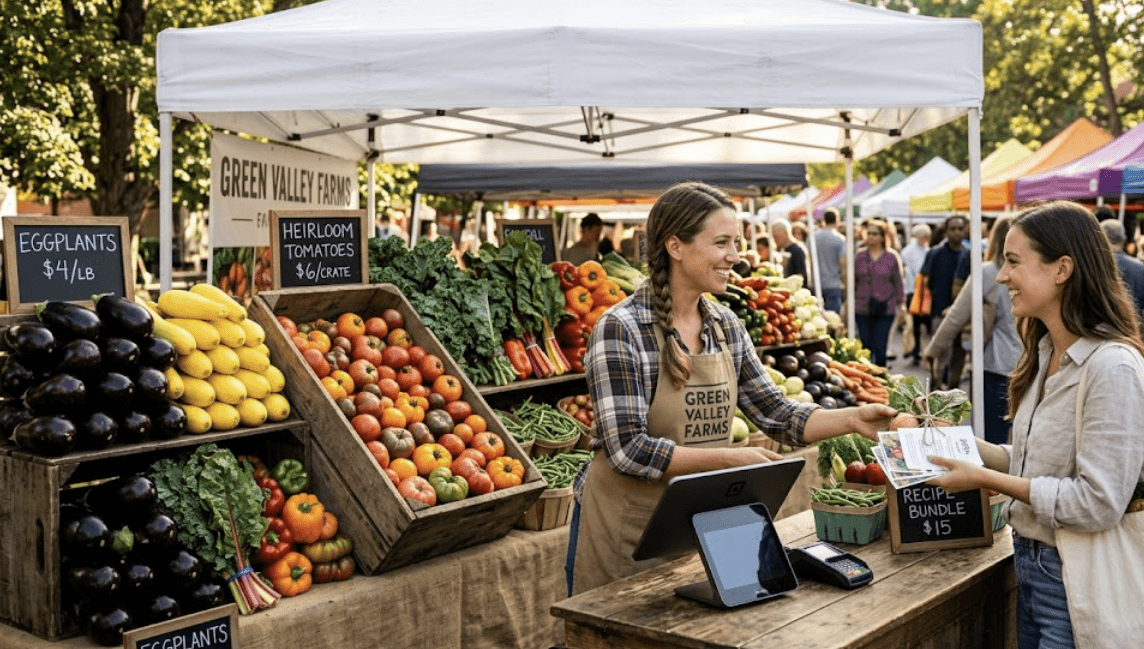
The Market-Style CSA reverses the operational workflow. Instead of packing boxes behind closed doors, the farm sets up bulk display bins at a designated location—such as an on-farm barn, an open-air pavilion, or a community market table. Members arrive during a scheduled distribution window and select their own produce using a point allowance, a credit balance, or a category checklist (such as "Choose 2 root crops, 2 salad greens, and 3 culinary herbs").
                      MARKET-STYLE LABOR & COST ADVANTAGES
Field Harvest ---> Bulk Wash / Dunk Tank ---> Set Bulk Bins on Table ---> Member Packs Bag
Labor saved: 60% to 75% reduction in packing shed time.
Packaging cost: $0.00 (Customer brings reusable canvas tote).
Annual Member Retention: 78% to 85% renewal rate.
The Economic Benefits of Free-Choice Distribution
- Substantial Labor Reduction: The labor savings in post-harvest handling are significant. The farm crew washes carrots, radishes, and beets in bulk dunk tanks, drains them in harvest lugs, and moves those lugs directly onto display tables. The customer handles the time-consuming work of portioning, inspecting, and packing their produce into their own bag. Staff time drops from 15 to 20 minutes per box down to 5 to 8 minutes of customer service and table restocking per member.
- Superior Annual Retention Rates: Member satisfaction increases when customers control their selections. If a household dislikes beets, they leave the beets and select extra carrots or summer squash. Because members only take produce they plan to cook, household food waste drops to zero. That personal control increases perceived value, pushing renewal rates between 78% and 85% year after year.
- On-Farm Retail Cross-Selling: When subscribers visit your farm each week, they become an active retail audience. You can stock nearby shelves with high-margin items like local raw honey, sourdough loaves, pasture-raised eggs, or specialty heirloom bean seeds. These impulse add-on sales capture extra income each week.

Infrastructure Demands and Leftover Management
- Physical Facility Requirements: Hosting free-choice pickups requires space for parking, clear driveways, commercial general liability insurance, and compliance with local municipal zoning for agricultural retail. If your farm sits far down a rutted gravel road thirty miles outside the city, getting customers to visit weekly is difficult.
- Inventory Leveling and Arrival Waves: If the first thirty members take all the early cherry tomatoes or sweet corn, members arriving during the final hour see picked-over tables. Growers must set clear limits on high-demand crops (such as "One pint cherry tomatoes per share") and restock tables gradually throughout the pickup window.
- Managing Leftover Display Produce: Unlike pre-packed shares that clear the shed completely, market-style displays must remain abundant and full throughout the distribution window. That requires harvesting surplus produce, which leaves unsold inventory when the pickup closes.
4. Packaging Economics: Waxed Cardboard vs. Reusable Bags
When farmers calculate CSA enterprise budgets, packaging costs are frequently underestimated. Depending on the model you operate, packaging can represent either an ongoing expense or a clean budget line of zero dollars.
+---------------------------+---------------------------------+---------------------------------+
| Packaging Parameter       | Pre-Packed Box Operations       | Market-Style Free-Choice Setup  |
+---------------------------+---------------------------------+---------------------------------+
| Container Type            | Waxed 1 1/9 bushel box          | Customer-supplied canvas tote   |
| Per-Unit Packaging Cost   | $2.50 - $4.00 per box           | $0.00                           |
| Annual Container Loss     | 25% - 35% attrition/damage      | None (Customer responsibility)  |
| Plastic Liners / Bags     | $0.35 - $0.65 per share         | $0.00                           |
| Season Total (100 Shares) | $2,500 - $3,500 per year        | $0.00                           |
| Cleaning & Sanitizing     | High labor if using totes       | Zero farm sanitation labor      |
+---------------------------+---------------------------------+---------------------------------+
The Cost of Waxed Produce Boxes
If you run a pre-packed delivery route, you must pack vegetables in containers that are stackable, moisture-resistant, and visually appealing.
- Waxed Cardboard Boxes: Standard 1 1/9 bushel waxed cardboard produce boxes cost between $2.50 and $4.00 per unit when purchased in bulk. A 100-member farm running a 20-week season goes through 2,000 box uses. Even with a strict box-return policy, boxes get wet, tear, or vanish in customer garages. With typical box attrition running around 30%, replacing damaged boxes costs between $1,500 and $2,400 each season.
- Plastic Liners and Clamshells: In a packed box, tender greens and ripe tomatoes need plastic bags or ventilated clamshells to avoid being crushed by heavy root vegetables. These plastic packaging components add thirty to sixty cents per box, creating an additional $600 to $1,200 annual expense while generating single-use plastic waste that frustrates eco-conscious members.
The Zero-Packaging Free-Choice Advantage
A market-style pickup removes the packaging budget entirely.
- Bring Your Own Bag (BYOB): Members bring their own canvas bags, market baskets, or coolers to the pickup table. The farm provides bulk display bins; the customer supplies the transport vessel.
- Eliminating Single-Use Plastics: In a free-choice display, customers place heavy squash and roots at the bottom of their bags and nestle delicate greens and herbs gently on top. This customer-controlled packing allows growers to eliminate plastic clamshells and bags, advertising their farm as a plastic-free operation.
5. Accounting and Pricing Architectures: Point Systems vs. Cash Balances
Operating a Market-Style CSA requires updating your pricing and accounting approach. In a pre-packed system, calculating pricing is basic math: divide seasonal operational expenses by total members to determine share cost. In a free-choice system, you must assign explicit values to every item on the table.
                           ACCOUNTING MODEL COMPARISON
THE POINT SYSTEM (Gamified Value)             THE DECLINING CASH BALANCE
* Member prepays $600 for 600 points          * Member prepays $600 account credit
* Cherry tomatoes = 5 pts | Kale = 3 pts      * Cherry tomatoes = $5.00 | Kale = $3.00
* Obscures retail supermarket comparisons     * Directly compared to grocery prices
* Easy to adjust points during crop gluts     * Transparent, easy accounting balance
The Point System (Gamified Allotment)
Under a point system, a member prepays six hundred dollars in winter and receives an account loaded with six hundred points. At the pickup table, a pint of cherry tomatoes costs 5 points, a bunch of kale costs 3 points, and a bag of potatoes costs 4 points.
- The Psychological Advantage: Points obscure direct cash comparisons with grocery stores. Members focus on their total allotment rather than evaluating whether three dollars for kale matches retail supermarket pricing.
- Managing Scarcity and Gluts: Points allow growers to adjust values based on field supply without friction. If an early cucumber beetle outbreak reduces harvests, you can raise cucumbers to 6 points. When zucchini floods the beds in July, you can drop zucchini to 1 point to encourage members to clear the tables.
The Declining Cash Balance (Farm Debit Account)
In a cash balance setup, a member prepays six hundred dollars and receives an account credited with six hundred dollars. Vegetables carry standard retail market prices ($5.00 for tomatoes, $3.00 for kale), with purchases deducted from their balance at checkout.
- The Advantage: This structure is simple for consumers to understand. Members take whatever volume they need each week, whether they need twenty dollars of salad greens for a light week or eighty dollars of pickling cucumbers for home canning.
- The Risk: Transparent dollar pricing invites members to compare prices against local supermarkets, occasionally creating friction if field-grown organic items cost more than industrial produce. For guidance on setting prices that reflect production costs, review our guide on Pricing Your CSA Shares for Profitability.
6. The Hybrid Model: Software-Driven Customized Subscription Boxes
Over the past five years, specialized agricultural software platforms (like Local Line, GrownBy, and Farmigo) have created a third pathway: the customized pre-packed subscription box.
                            THE HYBRID COMPROMISE
            [Customer Logs into Software Portal (Monday Night)]
            * Swaps Turnips for Heirloom Tomatoes
            * Adds $12 Honey & $8 Farm Eggs
                                   |
            [Software Generates Individual Packing Manifests]
                                   |
            [Packing Shed Crew Packs Custom Unique Boxes]
            * Higher labor per box than identical pre-pack
            * Retains central drop convenience & home delivery
            * Churn drops from 50% to under 25%
The Operational Balance of Customization
- Customer Satisfaction with Delivery Convenience: The hybrid model provides the convenience of a delivered box alongside the personal choice of a farm stand. Customers adjust their selections online, and the farm crew packs their personalized order into a labeled box.
- The Software Expense: Using custom box software typically involves paying a monthly platform fee or a transaction percentage (often 3% to 7% of gross sales).
- Packing Line Complications: Customization slows down the packing shed. Instead of packing one hundred identical shares in rapid succession, workers must read individual labels for every box, check custom swap requests, and double-check add-on items. Packing labor increases to 18 to 25 minutes per box.
For small farms managing fewer than thirty shares, custom packing adds significant administrative overhead. For mid-scale commercial growers managing 150 to 300 members, the software fees and extra packing time are balanced by higher retention rates and additional revenue from add-on sales. To evaluate specific platforms, explore our review of the 5 Best CSA Management Software Platforms.
7. Logistics of Centralized Corporate Drop-Offs
While free-choice farmstand distribution provides clear labor and packaging advantages, it cannot serve one of the most profitable direct sales channels: corporate workplace deliveries.
                           THE CORPORATE WORKPLACE MODEL
           [Single Delivery Van] ---> [Corporate Office Park / Hospital]
                                                 |
                                     [Unload 60 Uniform Boxes]
                                                 |
                                     [Completed in 15 Minutes]
                                                 |
                                     [$2,100 Gross Revenue]
Efficient Business-to-Business Sales
Reaching individual consumers across a city requires marketing campaigns, farmers market attendance, and steady outreach. Corporate wellness partnerships allow a farm to enroll forty to eighty members through a single business agreement.
- Corporate Wellness Benefits: Employers often subsidize vegetable shares as an employee wellness perk, covering a percentage of subscription fees. The human resources department handles internal promotions and registration.
- Why Pre-Packing Is Non-Negotiable: Corporate partners will not permit farmers to display loose produce bins on folding tables in a corporate lobby. Deliveries must arrive as clean, uniform, labeled boxes that employees can grab and set in their cars at the end of the day.
- The Strategic Fit: If your business plan targets workplace delivery routes, mastering efficient pre-packed assembly workflows is essential. For detailed guidance on structuring workplace partnerships, consult our guide on Corporate CSA Partnerships.
8. Managing Farmstand Leftovers and Post-Harvest Shrinkage
A frequent concern regarding the Market-Style CSA is post-harvest shrinkage—the unsold produce remaining in display lugs after the pickup window closes.
                     MONETIZING MARKET-STYLE LEFTOVERS
                        [Unsold Pickup Inventory]
                                   |
       +---------------------------+---------------------------+
       |                                                       |
[Commercial Kitchen Processing]    [Next-Day Chef Wholesale]   [Subsidized Solidarity Box]
Roast into pasta sauce, salsa,     Text availability list to   Deliver to food pantries or
or freeze for soup stocks.         local farm-to-table chefs.  sliding-scale members.
The Reality of Pre-Packed Waste
Growers who run pre-packed models sometimes claim their operation has zero waste because they only harvest what goes into boxes. In practice, that waste is simply hidden in the field. To ensure one hundred premium heads of lettuce for one hundred boxes, a grower must harvest 120 heads to account for slug damage, tip burn, or undersized heads. The extra heads stay behind or go into the compost pile.
Turning Leftovers into Revenue
In a market-style setup, display bins must remain full throughout the pickup window, which naturally produces leftovers. Rather than absorbing a loss, farms can channel extra produce into secondary outlets:
- Value-Added Kitchen Processing: If you maintain a certified commercial kitchen, extra tomatoes, garlic, and peppers can be roasted and processed into salsa, marinara sauce, or pickled vegetables.
- Next-Day Chef Wholesale Deliveries: Surplus greens and root crops can be assembled onto an availability list and texted to local culinary accounts for Wednesday morning delivery.
- Community Food Access Programs: Leftover produce can supply free or subsidized shares through Sliding-Scale Payment Models, supporting local food pantries and community access.
9. Comprehensive Model Comparison Matrix
This comparison matrix summarizes the operational parameters of both distribution models to help you select the right system for your farm.
+-----------------------------+-------------------------------+-------------------------------+
| Operational Dimension       | Pre-Packed Subscription Model | Market-Style Free-Choice Model|
+-----------------------------+-------------------------------+-------------------------------+
| Packing Labor Overhead      | High (15 - 20 mins/share)     | Low (5 - 8 mins/visitor)      |
| Packaging Expense           | $2.50 - $4.00 per share/week  | $0.00 (Customer BYOB)         |
| Average Annual Member Churn | High (45% - 55% turnover)     | Low (15% - 22% turnover)      |
| On-Farm Customer Traffic    | None required (Closed farm)   | High (Requires parking & road)|
| Municipal Zoning Constraint | Low (Standard agricultural)   | Moderate to High (Retail)     |
| Corporate Delivery Fit      | Excellent (Standard drop-off) | Incompatible                  |
| Add-On Retail Impulse Sales | Limited to online storefront  | High (Direct farmstand sales) |
| Post-Distribution Shrink    | Low (Waste occurs in field)   | Moderate (Requires secondary) |
| Software Expense            | Low to Moderate ($50 - $150)  | Variable (POS fees or SaaS)   |
| Customer Community Building | Low to Moderate (Remote)      | High (Weekly face-to-face)    |
+-----------------------------+-------------------------------+-------------------------------+
For additional enterprise budgeting data, crop yield schedules, and direct-marketing publications, explore the resources available through the University of Kentucky Center for Crop Diversification.
Expert Insights & FAQs
What are the core economic differences between market-style CSAs and traditional pre-packed subscription boxes?
Market-style CSAs shift the labor of selecting and portioning produce to the customer, significantly reducing paid farm hours spent on wash-and-pack assembly lines. Pre-packed subscription boxes provide standardized convenience for off-farm deliveries but require substantial labor for packing and recurring expenses for containers. The main economic difference comes down to the balance between centralized delivery logistics and on-farm customer service.
How do packaging costs and packaging labor overhead affect the net margins of pre-packed subscription boxes?
Packaging costs for pre-packed boxes include waxed cardboard containers, plastic bin liners, and produce labels, which erode net margins by 5% to 10% each season. Box assembly labor adds four to six dollars of expense per box, consuming crew hours that could otherwise support field cultivation, weed control, or irrigation management.
Why do market-style customizable CSAs achieve significantly higher annual member retention rates?
Market-style CSAs achieve higher retention by giving members agency over what they take home. When customers select their own vegetables, household food waste drops and perceived value rises. That control prevents the vegetable fatigue common in rigid pre-packed setups, driving renewal rates above 80%.
How does product shrinkage and farmstand leftover waste compare between the two CSA subscription models?
Product shrinkage in pre-packed operations is often hidden in the field, as growers must over-harvest to ensure enough uniform first-grade produce for every box. Market-style setups require harvesting extra produce to keep display bins full, which creates leftover inventory at closing. However, farms can channel those leftovers into value-added canning, restaurant wholesale accounts, or community donation programs.
What is the detailed operating labor breakdown (hours/box) for packing versus supervising a free-choice market CSA?
Packing a standardized box takes 15 to 20 minutes of labor per share, covering box construction, sorting, portioning, and pallet staging. A market-style setup requires 5 to 8 minutes of staff time per member visit for greeting customers, restocking bulk bins, and managing checkout, reducing post-harvest handling labor by more than half.
How do you price market-style shares to ensure financial viability and fair farm compensation?
Pricing market-style shares works best using a prepaid credit or point system where members pay an upfront fee for a seasonal allotment. Setting point values based on retail market rates guarantees early operating capital for the farm while providing customers flexibility. Establishing clear member policies on vacation rollovers ensures fair compensation.
What specific software tools and point-of-sale systems optimize customizable farm share transactions?
Customizable shares run smoothly on dedicated agricultural software like Local Line, GrownBy, or Farmigo, paired with mobile point-of-sale hardware like Square or Stripe terminal readers. These tools track customer balances, manage member accounts, and record inventory adjustments, reducing bookkeeping errors during busy pickup windows.
How does the physical setup of a market-style pick-up site build higher social capital and customer loyalty?
Market-style distribution points build social capital by turning routine pickups into weekly community gatherings. Direct conversations between the grower and customer build trust, share seasonal recipes, and highlight the labor required to produce organic food. That personal relationship creates customer loyalty that insulates the farm from member turnover.
Johnnie McCormick
Zone 7b/8a - North Central Alabama
Johnnie McCormick is a gardening hobbyist and the founder of My Garden Spot. Raised in north-central Alabama, his passion for gardening began in his youth. In 2008, he established a large market garden, teaching himself high-yield growing methods. In the years since, he has operated seasonal seedling sales for transplants, specializing in heirloom tomatoes, peppers, eggplants, decorative ground covers like Ajuga (Bugleweed), marigolds, nasturtiums, and fresh kitchen-window herb arrangements (basil, cilantro). Today, he gardens in the hills between Birmingham and Jasper, Alabama (Zone 7b/8a), sharing practical, community-focused gardening resources.
Verified Authoritative Citations & References
In alignment with our strict E-E-A-T research and verification guidelines, this guide cross-references data from the United States Department of Agriculture (USDA) and Cooperative Extension Service programs.
- USDA Agricultural Marketing Service (AMS): Community Supported Agriculture (CSA) standards and local market surveys. ams.usda.gov
- Penn State Extension: Small Farm Economics, financial planning, and crop pricing research documents. extension.psu.edu
- Cornell Cooperative Extension: Market gardening business planning and local sales guidelines. smallfarms.cornell.edu
- Alabama Cooperative Extension System (ACES): Local food regulations, CSA legal permits, and farm safety standards. aces.edu

Please log in to view comments.